

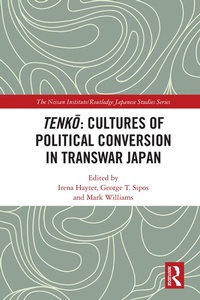
Tenko: Cultures of Political Conversion in Transwar Japan
1st Edition
Published on 17. June 2021
290 pages
978-1-000-39730-7 (ISBN)
Description

This book approaches the concept of tenko (political conversion) as a response to the global crisis of interwar modernity, as opposed to a distinctly Japanese experience in postwar debates.
Tenko connotes the expressions of ideological conversion performed by members of the Japanese Communist Party, starting in 1933, whereby they renounced Marxism and expressed support for Japan's imperial expansion on the continent. Although tenko has a significant presence in Japan's postwar intellectual and literary histories, this contributed volume is one of the first in Englishm language scholarship to approach the phenomenon. International perspectives from both established and early career scholars show tenko as inseparable from the global politics of empire, deeply marked by an age of mechanical reproduction, mediatization and the manipulation of language. Chapters draw on a wide range of interdisciplinary methodologies, from political theory and intellectual history to literary studies. In this way, tenko is explored through new conceptual and analytical frameworks, including questions of gender and the role of affect in politics, implications that render the phenomenon distinctly relevant to the contemporary moment.
Tenko: Cultures of Political Conversion in Transwar Japan will prove a valuable resource to students and scholars of Japanese and East Asian history, literature and politics.
Tenko connotes the expressions of ideological conversion performed by members of the Japanese Communist Party, starting in 1933, whereby they renounced Marxism and expressed support for Japan's imperial expansion on the continent. Although tenko has a significant presence in Japan's postwar intellectual and literary histories, this contributed volume is one of the first in Englishm language scholarship to approach the phenomenon. International perspectives from both established and early career scholars show tenko as inseparable from the global politics of empire, deeply marked by an age of mechanical reproduction, mediatization and the manipulation of language. Chapters draw on a wide range of interdisciplinary methodologies, from political theory and intellectual history to literary studies. In this way, tenko is explored through new conceptual and analytical frameworks, including questions of gender and the role of affect in politics, implications that render the phenomenon distinctly relevant to the contemporary moment.
Tenko: Cultures of Political Conversion in Transwar Japan will prove a valuable resource to students and scholars of Japanese and East Asian history, literature and politics.
Reviews / Votes
"This is a welcome addition to scholarship on midcentury Japan. It brings a stellar group of historians and literary scholars together around an ambitious scholarly vision. The editors argue that the study of tenko?-a juridical process of political conversion in the 1930s-offers a blueprint for interdisciplinary and comparative research into local expressions of the politics of affect, framed with reference to a theoretically nuanced concept of a global yet uneven capitalist modernity." - Adam Bronson, Durham UniversityMore details
Series
Edition
1. Auflage
Language
English
Place of publication
London
United Kingdom
Publishing group
Taylor & Francis Ltd
Target group
College/higher education
Product notice
Reflowable
Illustrations
1 Tables, black and white; 4 Line drawings, black and white; 8 Halftones, black and white; 12 Illustrations, black and white
ISBN-13
978-1-000-39730-7 (9781000397307)
Copyright in bibliographic data and cover images is held by Nielsen Book Services Limited or by the publishers or by their respective licensors: all rights reserved.
Schweitzer Classification
Other editions
Additional editions
Irena Hayter | George T. Sipos | Mark Williams
Tenko: Cultures of Political Conversion in Transwar Japan
Cultures of Political Conversion in Transwar Japan
Book
06/2021
1st Edition
Routledge
€206.70
Shipment within 15-20 days
Irena Hayter | George T. Sipos | Mark Williams
Tenko: Cultures of Political Conversion in Transwar Japan
Cultures of Political Conversion in Transwar Japan
Book
06/2021
1st Edition
Routledge
€60.60
Shipment within 15-20 days
Persons
Irena Hayter is Associate Professor of Japanese Studies at the University of Leeds. Her research brings together domains normally kept apart: literature, visual studies, consumer culture. The overarching concern is with the perceptual changes of the interwar years in Japan and their urban and technological contexts. Articles in positions: asia critique, Japanese Language and Literature and Japan Forum, amongst others, have explored the effects of these changes not only on cultural practices, but also on the politico-ideological domain. Her current monograph project is a media-historical investigation of urban spectacle, technologies of image commodification and literary modernism in interwar Japan.
George T. Sipos is Associate Professor at the West University of Timisoara, in Romania, where he teaches Japanese literature, language and culture. His research focuses on modern and contemporary Japanese society and literature from a transcultural perspective, in particular on comparative perspectives on Japan's modernity, modern nation state, activism, and resistance against state oppression. His recent publications include 'Journeys of Political Self-Discovery: The Writings of Miyamoto Yuriko and Panait Istrati from late 1920s Soviet Russia' (Human and Social Studies, 2018), and book chapters on the works of Mishima Yukio (in Mishima Monogatari: Un samurai delle arti, 2020), Kawabata Yasunari and Akutagawa Ryunosuke (in? Critical Insights: Modern Japanese Literature, 2017). He is currently preparing his first single authored book on Japan's tenko? and tenko ?literature, due to be published in 2021 by Routledge.
Mark Williams is Vice President for International Academic Exchange at International Christian University in Tokyo, Japan. Until 2017, he was Professor of Japanese Studies at the University of Leeds, UK. He received his PhD in Japanese Literature from the University of California, Berkeley. He has published widely in both English and Japanese - on themes such as Christianity and Japan, the literature of Endo Shusaku and literary representations of the Asia Pacific War.
George T. Sipos is Associate Professor at the West University of Timisoara, in Romania, where he teaches Japanese literature, language and culture. His research focuses on modern and contemporary Japanese society and literature from a transcultural perspective, in particular on comparative perspectives on Japan's modernity, modern nation state, activism, and resistance against state oppression. His recent publications include 'Journeys of Political Self-Discovery: The Writings of Miyamoto Yuriko and Panait Istrati from late 1920s Soviet Russia' (Human and Social Studies, 2018), and book chapters on the works of Mishima Yukio (in Mishima Monogatari: Un samurai delle arti, 2020), Kawabata Yasunari and Akutagawa Ryunosuke (in? Critical Insights: Modern Japanese Literature, 2017). He is currently preparing his first single authored book on Japan's tenko? and tenko ?literature, due to be published in 2021 by Routledge.
Mark Williams is Vice President for International Academic Exchange at International Christian University in Tokyo, Japan. Until 2017, he was Professor of Japanese Studies at the University of Leeds, UK. He received his PhD in Japanese Literature from the University of California, Berkeley. He has published widely in both English and Japanese - on themes such as Christianity and Japan, the literature of Endo Shusaku and literary representations of the Asia Pacific War.
Content
Part 1: Conceptual Excursions 1. 'Ideological Conversion as Historical Catachresis: Coming to Terms with tenko' 2. 'The Historical Origins of tenko as an Intellectual and Social Issue: Marxism - Thought Control - Media' 3. 'Tenko in Korea: Revealing the Critical Threshold of Colonial Empire' 4. 'Takeuchi Yoshimi and the Problem of tenko' Part 2: Literary Possibilities 5. 'Literature and Affect: Proletarian Literature as Discovery' 6. 'Common Tropes and Themes in Japan's tenko Literature' 7. "Doublethink" in Seisan bungaku Theory' 8. "Truth": The tenko of Nakano Shigeharu and Hayashi Fusao' 9. 'The Disjointed Narratives and Fractured Subjects of Takami Jun' 10. 'Crossing the Void: Shimaki Kensaku's Search for Meaning in "Leprosy" and "Blindness" 11. 'The Tenko of Anarchist Poets: Agrarian and Cinematic Latencies' 12. 'A Proletarian Writer in the Showcase Window: The Shifting Representation of "the Masses" in Sata Ineko's Kurenai' 13. 'Mythic Reality, Battlefield Survival and Psycho-social Conversion in Yoshida Mitsuru's The End of Battleship Yamato'
