

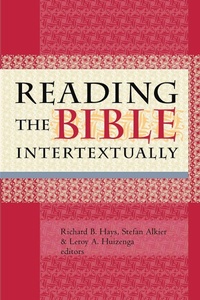
Reading the Bible Intertextually
Description

Reading the Bible Intertextually explores the revisionary hermeneutical practices of the writers of the four gospels. Each of the contributors examines the distinctive ways that the canonical evangelists put a particular "spin" on the story of Jesus through rereading the Old Testament in different ways. In addition, the evangelists' different ways of reading Israel's Scripture are correlated with different visions for the embodied life of the community of Jesus' followers. This is an exciting new reading of the gospels, bringing interdisciplinary and intertextual readings to the texts, articulated by some of the most brilliant New Testament scholars of our time.
More details
Other editions
Additional editions
Persons
Content
Foreword to the German Edition
Stefan Alkier and Richard B. Hays
Foreword to the English Edition
Richard B. Hays
Intertextual Interpretation of Biblical Texts
The Bible in Dialogue and the Problem of Hardening in Mark 4: Intertextuality within the Framework of a Categorical Semiotics of Biblical Texts, Stefan Alkier
Intertextuality and Historical Approaches to the Use of Scripture in the New Testament, Steve Moyise
How Does God Act? Intertextual Readings of 1 Corinthians 10, Michael Schneider
Allegorical Reading and Intertextuality: Narrative Abbreviations of the Adam Story in Paul (Rom 1:18-28), Eckart Reinmuth
The Matthean Jesus and the Isaac of the Early Jewish Encyclopedia, Leroy Andrew Huizenga
Paul as User, Interpreter and Reader of the Book of Isaiah, Florian Wilk
The Liberation of Israel in Luke-Acts: Intertextual Narration as Countercultural Practice, Richard B. Hays
Psalm 113 and the Song of Hannah (1 Sam 2:1-10): A Paradigm for Intertextual Reading?, Marianne Grohmann
Intertextual Interpretation Outside the Boundaries of the Canon
Canon as Intertext: Restraint or Liberation?, George Aichele
Christian Apocalypses and their Mimetic Potential in Pagan Education: A Contribution concerning Lucian's True History, Peter von Möllendorf
Nonnus and his Tradition, Tomas A. Schmitz
Literary Reading(s) of the Bible: Aspects of a Semiotic Conception of Intertextuality and Intertextual Analysis of Texts, Magdolna Orosz
Reading the Bible in the Context of "Thick Description": Reflections of a Practical Theologian on a Phenomenological Concept of Contextuality, Hans-Günter Heimbrock
Semiotics, Intertextuality and New Testament Studies
New Testament Studies on the basis of Categorical Semiotics: A Conception, Stefan Alkier
[Indices]
