

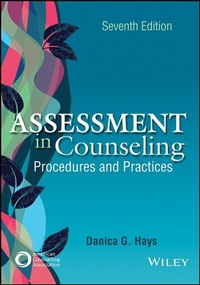
Assessment in Counseling
Description

This best-selling text explains the basic principles of psychological assessment and measurement and guides students and practitioners in the appropriate selection, interpretation, and communication of test results. Danica Hays introduces more than 150 assessment instruments used to evaluate mental health, intelligence, career development, wellness, personality, and interpersonal relationships. This latest edition covers new or expanded content on assessment use in schools, colleges/universities, and telehealth platforms; interprofessional collaboration to support assessment practices and procedures; qualitative assessment approaches and how they can be infused throughout counseling and assessment; cultural and social justice considerations and practices; and crisis and trauma assessment.
Numerous in-text features facilitate teaching and learning, including chapter pretests, trainee-centered reflective and field activities, practitioner perspectives, tip sheets on major concepts and practices, sample assessment items and tools, and case examples. A supplemental Instructor's Guide is available by request that consists of a test bank, PowerPoint slides, and a sample syllabus.
READ MORE:
*Requests for digital versions from ACA can be found on www.wiley.com.
*To purchase print copies, please visit the ACA website here
*Reproduction requests for material from books published by ACA should be directed to publications@counseling.org
More details
Person
Content
- Cover
- Title Page
- Copyright Page
- Dedication Page
- Table of Contents
- Preface
- Council for Accreditation of Counseling and Related Educational Programs 2024 Standards and Corresponding Chapters
- Acknowledgments
- About the Author
- Section I Foundations of Assessment in Counseling
- Chapter 1 Use of Assessment in Counseling
- Introduction to Assessment
- Key Assessment Terms
- Purpose of Assessment in Counseling
- History of Assessment
- Key Questions for Selecting Assessments
- Assessment Usage in Counseling Settings
- Chapter Summary
- Review Questions
- Resources for Further Learning
- Chapter 2 The Assessment Process
- Assessment Methods
- Types of Assessments
- An Overview of the Assessment Process
- Monitoring Client Progress and Evaluating Counseling Outcomes
- Chapter Summary
- Review Questions
- Resources for Further Learning
- Chapter 3 Ethical, Legal, and Professional Considerations in Assessment
- Core Values for Effective Assessment
- Standards and Guidelines for Evaluating Assessments and Usage
- Key Ethical and Legal Considerations in Assessment
- Key Professional Issues in Assessment
- Chapter Summary
- Review Questions
- Resources for Further Learning
- Chapter 4 Multicultural and Social Justuce Considerations in Assessment
- Multicultural and Social Justice Counseling Competency and Assessment
- Fairness and Cultural Bias in Assessment
- Cultural Factors in Assessment
- Multicultural and Social Justice Assessment
- Culture-Fair Tests
- Dynamic Assessment
- Chapter Summary
- Review Questions
- Resources for Further Learning
- Section II Key Measurement, Statistical, and Qualitative Concepts
- Chapter 5 Understanding and Transforming Raw Scores
- Scales of Measurement
- Raw Scores
- Measures of Central Tendency
- Measures of Variability
- Characteristics of Data Distributions
- Norms and Ranks
- Standard Scores
- Chapter Summary
- Review Questions
- Resources for Further Learning
- Chapter 6 Measurement and Qualitative Assessment Concepts
- The Correlation Coefficient
- Reliability
- Validity
- Trustworthiness
- Assessment Development
- Chapter Summary
- Review Questions
- Resources for Further Learning
- Section III Initial Psychological Assessment
- Chapter 7 Initial Assessment in Counseling
- Crisis and Trauma Counseling
- Intake Interview
- Mental Status Examination
- Quantitative Screening Inventories
- Qualitative Tools for Initial Assessment
- Suicide Risk Assessment
- Trauma Assessment
- The Mental Health Ecosystem
- Chapter Summary
- Review Questions
- Resources for Further Learning
- Chapter 8 Mental Health and Addictions Assessment
- Diagnostic and Statistical Manual of Mental Disorders
- Mental Health Disorders and Assessment
- Assessment of Depression
- Assessment of Bipolar Disorders
- Assessment of Anxiety and Fear
- Assessment of Posttraumatic Stress Disorder
- Assessment of Anger
- Assessment of Self-Injury
- Assessment of Eating Disorders
- Assessment of Attention-Deficit/Hyperactivity Disorder
- Assessment of Addictions
- Chapter Summary
- Review Questions
- Resources for Further Learning
- Section IV Types of Assessment
- Chapter 9 Assessment of Intelligence
- Introduction to Intelligence
- Theories of Intelligence
- Individual Intelligence Assessments
- Group Intelligence Assessments
- Intelligence Assessment and Special Education
- Chapter Summary
- Review Questions
- Resources for Further Learning
- Chapter 10 Assessment of Aptitude and Achievement
- Introduction to Aptitude and Achievement Assessment
- Aptitude Assessments for Higher Education
- Graduate and Professional School Admissions Tests
- Academic Achievement Tests
- High-Stakes Testing
- Study Habits Inventories
- Chapter Summary
- Review Questions
- Resources for Further Learning
- Chapter 11 Assessment of Career Development and Wellness
- Introduction to Career Assessment
- Career Assessment Across the Life Span
- Qualitative Career Assessment
- Quantitative Career Assessment Programs
- Wellness Assessment
- Chapter Summary
- Review Questions
- Resources for Further Learning
- Chapter 12 Career Assessment Tools
- Career Readiness Assessments
- Interest Assessments
- Values Assessments
- Chapter Summary
- Review Questions
- Resources for Further Learning
- Chapter 13 Assessment of Personality
- Introduction to Personality Assessment
- Structured Personality Assessments
- Unstructured Personality Assessments
- Chapter Summary
- Review Questions
- Resources for Further Learning
- Chapter 14 Assessment of Interpersonal Relationships
- Interpersonal Relationship Assessment
- Genograms
- Network Mapping Techniques
- Assessment of Couples and Families
- Assessment of Intimate Partner Violence
- Assessment of Child Abuse
- Assessment of Elder Abuse
- Additional Interpersonal Assessment Inventories
- Community Asset Mapping
- Chapter Summary
- Review Questions
- Resources for Further Learning
- Section V The Assessment Report and Future Trends
- Chapter 15 Communication of Assessment Findings
- Introduction to Communicating Assessment Findings
- The Assessment Interpretation Interview
- The Case Conference
- The Assessment Report
- Chapter Summary
- Review Questions
- Resources for Further Learning
- Chapter 16 Future Trends in Counseling Assessment
- The Assessment Process: Looking Back to Look Ahead
- Changing Client Demographics and Assessment Practice
- Globalization and Problematizing Counseling and Assessment
- Greater Attention to Client, Counselor, and Community Wellness
- Technological Advances
- Increased Sophistication of Assessment Practice
- The Continuation and Adaptability of Educational Accountability
- Assessment and Managed Care
- Building Assessment Systems
- Building Partnerships With Health Professions
- Assessment as Relevant and Actionable
- The Next Frontier in Assessment Research and Training
- Chapter Summary
- Review Questions
- Resources for Further Learning
- Appendix A Statistical Formulas
- Appendix B Sample Assessment Report
- Appendix C Test Your Knowledge Answer Key
- References
- Subject Index
- Name Index
- Technical Support
- EULA
