

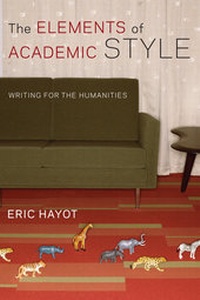
The Elements of Academic Style
Writing for the Humanities
1st Edition
Published on 26. August 2014
256 pages
978-0-231-53741-4 (ISBN)
Description

Eric Hayot teaches graduate students and faculty in literary and cultural studies how to think and write like a professional scholar. From granular concerns, such as sentence structure and grammar, to big-picture issues, such as adhering to genre patterns for successful research and publishing and developing productive and rewarding writing habits, Hayot helps ambitious students, newly minted Ph.D.'s, and established professors shape their work and develop their voices.
Hayot does more than explain the techniques of academic writing. He aims to adjust the writer's perspective, encouraging scholars to think of themselves as makers and doers of important work. Scholarly writing can be frustrating and exhausting, yet also satisfying and crucial, and Hayot weaves these experiences, including his own trials and tribulations, into an ethos for scholars to draw on as they write. Combining psychological support with practical suggestions for composing introductions and conclusions, developing a schedule for writing, using notes and citations, and structuring paragraphs and essays, this guide to the elements of academic style does its part to rejuvenate scholarship and writing in the humanities.
Hayot does more than explain the techniques of academic writing. He aims to adjust the writer's perspective, encouraging scholars to think of themselves as makers and doers of important work. Scholarly writing can be frustrating and exhausting, yet also satisfying and crucial, and Hayot weaves these experiences, including his own trials and tribulations, into an ethos for scholars to draw on as they write. Combining psychological support with practical suggestions for composing introductions and conclusions, developing a schedule for writing, using notes and citations, and structuring paragraphs and essays, this guide to the elements of academic style does its part to rejuvenate scholarship and writing in the humanities.
All prices
More details
Other editions
Additional editions
Book
08/2014
Columbia University Press
€76.88
Article not available at the moment
Book
08/2014
Columbia University Press
€24.80
Shipment within 10-20 days
Person
Eric Hayot is professor of comparative literature and Asian studies at the Pennsylvania State University. He is the author of On Literary Worlds, The Hypothetical Mandarin: Sympathy, Modernity, and Chinese Pain (co-recipient of the 2010 Modernist Studies Association Book Prize), and Chinese Dreams: Pound, Brecht, Tel quel. He has worked for the Columbus Dispatch and the Associated Press. More recently, his writing has appeared in the Los Angeles Review of Books and Public Books. He also is a cofounder of the blog Printculture.
Content
1. Why Read This Book?
Part I. Writing as Practice
2. Unlearning What You (Probably) Know
3. Eight Strategies for Getting Writing Done
4. Institutional Contexts
5. Dissertations and Books
6. A Materialist Theory of Writing
7. How Do Readers Work?
Part II. Strategy
8. The Uneven U
9. Structure and Subordination
10. Structural Rhythm
11. Introductions
12. Don't Say It All Early
13. Paragraphing
14. Three Types of Transitions
15. Showing Your Iceberg
16. Metalanguage
17. Ending Well
18. Titles and Subtitles
Part III. Tactics
19. Citational Practice
20. Conference Talks
21. Examples
22. Figural Language
23. Footnotes and Endnotes
24. Jargon
25. Parentheticals
26. Pronouns
27. Repetition
28. Rhetorical Questions and Clauses
29. Sentence Rhythm
30. Ventilation
31. Weight
Part IV. Becoming
32. Work as Process
33. Becoming a Writer
34. From the Workshop to the World (as Workshop [as World])
35. Acknowledgments
Appendix: A Writer's Workbook
Works Cited
Bibliography
Part I. Writing as Practice
2. Unlearning What You (Probably) Know
3. Eight Strategies for Getting Writing Done
4. Institutional Contexts
5. Dissertations and Books
6. A Materialist Theory of Writing
7. How Do Readers Work?
Part II. Strategy
8. The Uneven U
9. Structure and Subordination
10. Structural Rhythm
11. Introductions
12. Don't Say It All Early
13. Paragraphing
14. Three Types of Transitions
15. Showing Your Iceberg
16. Metalanguage
17. Ending Well
18. Titles and Subtitles
Part III. Tactics
19. Citational Practice
20. Conference Talks
21. Examples
22. Figural Language
23. Footnotes and Endnotes
24. Jargon
25. Parentheticals
26. Pronouns
27. Repetition
28. Rhetorical Questions and Clauses
29. Sentence Rhythm
30. Ventilation
31. Weight
Part IV. Becoming
32. Work as Process
33. Becoming a Writer
34. From the Workshop to the World (as Workshop [as World])
35. Acknowledgments
Appendix: A Writer's Workbook
Works Cited
Bibliography
Read an excerpt from The Elements of Academic Style:
