

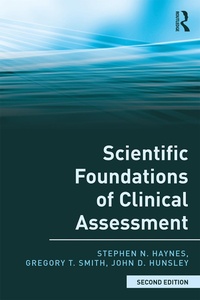
Scientific Foundations of Clinical Assessment
2nd Edition
Published on 8. November 2018
326 pages
978-1-351-21054-6 (ISBN)
Description

Scientific Foundations of Clinical Assessment is a user-friendly overview of the most important principles and concepts of clinical assessment. It provides readers with a science-based framework for interpreting assessment research and making good assessment decisions, such as selecting the best instruments and measures and interpreting the obtained assessment data. Written in a direct and highly readable fashion, with plenty of clinical examples that illustrate the relevance of psychometric principles and assessment research, this text is one every professional and graduate student needs to read. The second edition is expanded and fully updated, and includes additional coverage of the principles and methods of developing new assessment instruments.
Reviews / Votes
"Measurement is arguably the most foundational task in a science-and one of the most complex. These complexities are too often ignored in clinical science and practice and as a result misinformation is created and promulgated. This well written, comprehensive, and practical book is an important corrective. The authors are leading scholars in behavioral assessment and psychometrics and write in a clear and integrative manner that provides readers with thorough understanding of the complexities of measurement in clinical psychology."William O'Donohue, Ph.D., Professor, University of Nevada, Reno
"Scientific Foundations of Clinical Assessment is a tour-de-force! For many years no credible graduate program in clinical psychology would fail to include Wiggin's seminal text, Personality and Prediction, in their clinical assessment course. The same should now be said with respect to this text by Stephen Haynes, Greg Smith, and John Hunsley. Clinical assessment is a very difficult enterprise, riddled with confusing and complex psychometric and statistical principles. This text by Haynes and colleagues is wonderfully rich and comprehensive, yet presented in a very user-friendly manner that the average clinician and student can readily follow and fully appreciate"
Thomas A. Widiger, Department of Psychology, University of Kentucky, Editor: Annual Review of Clinical Psychology and Personality Disorders: Theory, Research, and Treatment
More details
Series
Edition
2nd edition
Language
English
Place of publication
London
United Kingdom
Publishing group
Taylor & Francis Ltd
Target group
College/higher education
Product notice
Reflowable
Illustrations
12 Tables, black and white; 6 Line drawings, black and white; 6 Illustrations, black and white
File size
2,60 MB
ISBN-13
978-1-351-21054-6 (9781351210546)
Copyright in bibliographic data and cover images is held by Nielsen Book Services Limited or by the publishers or by their respective licensors: all rights reserved.
Schweitzer Classification
Other editions
Additional editions
Stephen N. Haynes | Gregory T. Smith | John D. Hunsley
Scientific Foundations of Clinical Assessment
Book
12/2018
2nd Edition
Routledge
€69.90
Shipment within 15-20 days
Stephen N. Haynes | Gregory T. Smith | John D. Hunsley
Scientific Foundations of Clinical Assessment
Book
11/2018
2nd Edition
Routledge
€196.10
Shipment within 15-20 days
Persons
Stephen N Haynes is an Emeritus Professor of Psychology at the University of Hawai'i at Manoa in Clinical Psychology. Dr. Haynes was previously the Director of Clinical Psychology and Department Chair in psychology. He was editor of the APA journal Psychological Assessment, has served on 14 editorial boards, and has published 8 books and 130 articles and chapters on clinical assessment and psychopathology.
Gregory T Smith is a Professor of Psychology and University Research Professor at the University of Kentucky. He has published over 200 research articles and book chapters, the majority of which focus on clinical psychological assessment. He served for 12 years as the director of the doctoral program in clinical psychology at the University of Kentucky and is now Chair of the Psychology Department there.
John Hunsley is a Professor of Psychology and Director of the Clinical Psychology Program in the School of Psychology at the University of Ottawa. He published over 130 articles, chapters, and books related to assessment, evidence-based practice, and professional issues in psychology.
Gregory T Smith is a Professor of Psychology and University Research Professor at the University of Kentucky. He has published over 200 research articles and book chapters, the majority of which focus on clinical psychological assessment. He served for 12 years as the director of the doctoral program in clinical psychology at the University of Kentucky and is now Chair of the Psychology Department there.
John Hunsley is a Professor of Psychology and Director of the Clinical Psychology Program in the School of Psychology at the University of Ottawa. He published over 130 articles, chapters, and books related to assessment, evidence-based practice, and professional issues in psychology.
Content
Preface
Chapter 1: Introduction to the Scientific Foundations of Clinical Assessment
Chapter 2: Reliability of Clinical Assessment Measures
Chapter 3: Validity of Clinical Assessment Measures
Chapter 4: Applying Psychometric Evidence to Clinical Judgments
Chapter 5: How to Evaluate Commonly Used Statistical Methods and Outcomes In Clinical Assessment Research
Chapter 6: The Contributions of Factor Analysis to Clinical Assessment
Chapter 7: The Utility of Science-Based Clinical Assessment
Chapter 8: The Conditional and Dynamic Nature of Psychometric Evidence
Chapter 9: Using Data from Multiple Sources in Clinical Assessment
Appendix: The Importance of Content Validity in the Development of Clinical Assessment Instruments
Glossary of Terms and Concepts in the Scientific Foundations of Clinical Assessment
References
Author Index
Subject Index
Chapter 1: Introduction to the Scientific Foundations of Clinical Assessment
Chapter 2: Reliability of Clinical Assessment Measures
Chapter 3: Validity of Clinical Assessment Measures
Chapter 4: Applying Psychometric Evidence to Clinical Judgments
Chapter 5: How to Evaluate Commonly Used Statistical Methods and Outcomes In Clinical Assessment Research
Chapter 6: The Contributions of Factor Analysis to Clinical Assessment
Chapter 7: The Utility of Science-Based Clinical Assessment
Chapter 8: The Conditional and Dynamic Nature of Psychometric Evidence
Chapter 9: Using Data from Multiple Sources in Clinical Assessment
Appendix: The Importance of Content Validity in the Development of Clinical Assessment Instruments
Glossary of Terms and Concepts in the Scientific Foundations of Clinical Assessment
References
Author Index
Subject Index
