

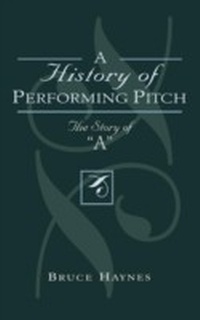
A History of Performing Pitch
The Story of 'A'
1st Edition
Published on 6. November 2002
632 pages
978-1-4616-6415-4 (ISBN)
Description

This is the first complete survey of the historical pitch standards used by musicians during the last four centuries. Written from a practical perspective and addressed to performers it is the first book to attach frequency values to pitch names and describe where, when, and why various historical pitch levels were used. It surveys a period from the 16th century to the present and focuses on Italy, France, Germany, the northern and southern Netherlands, and the Habsburg Lands, following the developments in the design and function of instruments and how they influenced and were influenced by pitch changes.
The History of Performing Pitch explores the relationships between pitches like Chorton, Cammerton, and Consort-Pitch and what pitch frequencies they represented at various times and places. It also examines what effect pitch differences had on musical notation and choice of key, and discusses practical considerations musicians would have had to make when transposing, especially with regards to the range of singers' voices.
What distinguishes this book from previous pitch studies is that it has been written since the rise of the early music revival within the context of the growing understanding of how "early" instruments work. This development has provided a new source of empirical information not previously available, which allows this book to base its conclusions on a much larger and more relevant sample than has ever been possible before. It refers to the original pitches of some 1,382 historical instruments, including cornetts, Renaissance flutes, traversos, recorders, clarinets, organs, pitchpipes, and automatic instruments from all over Europe and compares this information with music and written texts. While this study avoids categorical answers where historical information is not yet sufficient to justify them, it locates a number of historical pitch levels, discovers several that were previously unnoticed, and disproves several common myths about pitch.
The History of Performing Pitch explores the relationships between pitches like Chorton, Cammerton, and Consort-Pitch and what pitch frequencies they represented at various times and places. It also examines what effect pitch differences had on musical notation and choice of key, and discusses practical considerations musicians would have had to make when transposing, especially with regards to the range of singers' voices.
What distinguishes this book from previous pitch studies is that it has been written since the rise of the early music revival within the context of the growing understanding of how "early" instruments work. This development has provided a new source of empirical information not previously available, which allows this book to base its conclusions on a much larger and more relevant sample than has ever been possible before. It refers to the original pitches of some 1,382 historical instruments, including cornetts, Renaissance flutes, traversos, recorders, clarinets, organs, pitchpipes, and automatic instruments from all over Europe and compares this information with music and written texts. While this study avoids categorical answers where historical information is not yet sufficient to justify them, it locates a number of historical pitch levels, discovers several that were previously unnoticed, and disproves several common myths about pitch.
More details
Edition
1. Auflage
Language
English
Place of publication
New York
United States
ISBN-13
978-1-4616-6415-4 (9781461664154)
Copyright in bibliographic data and cover images is held by Nielsen Book Services Limited or by the publishers or by their respective licensors: all rights reserved.
Schweitzer Classification
Other editions
Additional editions
Book
11/2002
Scarecrow Press
€171.50
Shipment within 10-20 days
Person
Bruce Haynes was a part-time teacher at the University of Montreal. He published nearly 50 articles, a bibliography of oboe repertoire, and The Eloquent Oboe (2001).
Content
Chapter 1 List of Illustrations
Chapter 2 List of Graphs
Chapter 3 Preface
Chapter 4 Acknowledgements
Chapter 5 Mechanics
Chapter 6 Introduction
Chapter 7 Notes
Chapter 8 1 The Evidence
Chapter 9 Notes
Chapter 10 2 Pitch before the Instrument Revolution of ca. 1670
Chapter 11 Notes
Chapter 12 3 The Instrument Revolution and Pitch Fragmentation 1670-1700
Chapter 13 Notes
Chapter 14 4 The General Adoption of A-1, 1700-1730
Chapter 15 Notes
Chapter 16 5 Germany, 1700-1730: Cammerton, Chorton, Cornet-Ton
Chapter 17 Notes
Chapter 18 6 Sebastian Bach and Pitch
Chapter 19 Notes
Chapter 20 7 1730-1770: A "Diversity of Pitches"
Chapter 21 Notes
Chapter 22 8 Classical Pitches, 1770-1800
Chapter 23 Notes
Chapter 24 9 Early Romantic Pitches, 1800-1830
Chapter 25 Notes
Chapter 26 10 Pitch Standards, 1830-2001
Chapter 27 Notes
Chapter 28 Graphs
Chapter 29 Appendixes
Chapter 30 Citations in Original Languages
Chapter 31 Bibliography
Chapter 32 Index
Chapter 33 About the Author
Chapter 2 List of Graphs
Chapter 3 Preface
Chapter 4 Acknowledgements
Chapter 5 Mechanics
Chapter 6 Introduction
Chapter 7 Notes
Chapter 8 1 The Evidence
Chapter 9 Notes
Chapter 10 2 Pitch before the Instrument Revolution of ca. 1670
Chapter 11 Notes
Chapter 12 3 The Instrument Revolution and Pitch Fragmentation 1670-1700
Chapter 13 Notes
Chapter 14 4 The General Adoption of A-1, 1700-1730
Chapter 15 Notes
Chapter 16 5 Germany, 1700-1730: Cammerton, Chorton, Cornet-Ton
Chapter 17 Notes
Chapter 18 6 Sebastian Bach and Pitch
Chapter 19 Notes
Chapter 20 7 1730-1770: A "Diversity of Pitches"
Chapter 21 Notes
Chapter 22 8 Classical Pitches, 1770-1800
Chapter 23 Notes
Chapter 24 9 Early Romantic Pitches, 1800-1830
Chapter 25 Notes
Chapter 26 10 Pitch Standards, 1830-2001
Chapter 27 Notes
Chapter 28 Graphs
Chapter 29 Appendixes
Chapter 30 Citations in Original Languages
Chapter 31 Bibliography
Chapter 32 Index
Chapter 33 About the Author
