

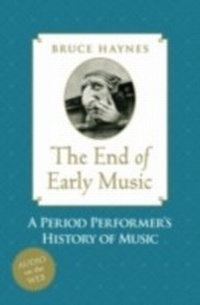
The End of Early Music
A Period Performer's History of Music for the Twenty-First Century
1st Edition
Published on 20. July 2007
305 pages
978-0-19-804094-1 (ISBN)
Description

Part history, part explanation of early music, this book also plays devil's advocate, criticizing current practices and urging experimentation. Haynes, a veteran of the movement, describes a vision of the future that involves improvisation, rhetorical expression, and composition.
More details
Other editions
Additional editions
Bruce Haynes
The End of Early Music
A Period Performer's History of Music for the Twenty-First Century
Book
08/2007
Oxford University Press Inc
€94.70
Shipment within 15-20 days
Person
Recently retired as a performer, Bruce Haynes worked for many years in Holland. He introduced the hautboy into the Dutch music curriculum, teaching at the Royal Conservatory. Currently, he is Associate Professor in the Faculty of Music at the University of Montreal. He has published widely on the history of the oboe and performing pitch standards.
Content
- Intro
- Contents
- List of Recorded Excerpts
- Introduction
- Literacy
- The Romantic Revolution
- Canonism and Classicism
- Progress or Adaptation
- Serendipity
- Musical Rhetoric
- Authenticity as a Statement of Intent
- "Scare-Quotes" for Authenticity
- The End of Early Music
- Musicking
- Terminology and Concepts
- PART I: Performing Styles
- Chapter 1. When You Say Something Differently, You Say Something Different
- "Style Is That Which Becomes Unstylish"
- Innovation
- Eating the Cookbook
- Chronocentrism: "Music as Tradition"
- The Rise of Pluralism: Matching Style to Period
- Chapter 2. Mind the Gap Current Styles
- Three Abstractions: Romantic, Modern, and Period Styles
- Romantic Style: An Absolute
- Recordings That Document the Heart of Romantic Practice
- Prophets of the Revolution: Dolmetsch and Landowska
- The Authenticity Revolution of the 1960s
- The Advent of Period Instruments and "Low Pitch": "Strange and Irregular Colors"
- Chain Reaction
- Guru Style: Rhetoric without the Name
- Chapter 3. Mainstream Style "Chops, but No Soul"
- Modernism and Modern Style
- The Performance Practices of Romantic Style and Modern Style Compared
- Vibrato, the MSG of Music
- Children of Modernism
- Period Style Compared to Modern Style
- Click-Track Baroque
- Strait Style and Modernism
- Strike Up the Bland: Strait Style Described
- PART II: How Romantic Are We?
- Chapter 4. Classical Music's Coarse Caress
- The Musical Canon
- Charles Burney and the Beginnings of Musical History
- Why Did the Romantics Call Music "Classical"?
- What Conservatories Conserve
- Absolute Music (the Autonomy Principle)
- Pachelbel's Canon Becomes Canon
- Originality and the Cult of Genius
- Attribution and Designer Labels
- Repeatability and Ritualized Performance
- Chapter 5. The Transparent Performer
- Composer-Intention ("Fidelity to the Composer")
- What Is a Piece of Music?
- Werktreue (Work-Fidelity): The Musical Analogue of Religious Fundamentalism
- The Urtext Imperative and Text Fetishism
- Untouchability
- The "Transparent" Performer and "Perfect Compliance"
- The Romantic Invention of the Interpretive Conductor
- The Maestro-Rehearsal
- Chapter 6. Changing Meanings, Permanent Symbols
- Changing Meanings, Permanent Symbols
- Descriptive and Prescriptive Notation
- The Incomplete Musical Score
- Written Music's Oral Element
- Writing Only the Essential in Rhetorical Music
- Implicit Notation
- Strait Style and the Neutral "Run-Through"
- Style versus Interpretation
- "Saying Bach, Meaning Telemann": Composer-Intention before the Romantic Period
- PART III: Anachronism and Authenticity
- Chapter 7. Original Ears
- Vintage Compared with Style
- Seconda Pratica
- Past Examples of Authenticity Movements
- The Difference between an Art Fake and a Period Concert
- How Historical Musicology and HIP Differ
- Romantic and Baroque Audiences Compared
- Period Musicians in Victorian Outfits
- Chapter 8. Ways of Copying the Past
- Emulation and Replication: Two Renaissance Approaches to Imitation
- The Emulation Principle
- The Replication Principle
- Imitation in the Canonic System
- Style-Copying and Work-Copying
- "Talking to Ghosts" and Work-Copying
- The Kon-Tiki Observation
- "What Really Happened" in History
- Beyond History: The Shelf Life of Historical Evidence
- What's Wrong with Anachronisms
- Chapter 9. The Medium Is the Message Period Instruments
- The Instrument Trade-off
- The Influence of Instruments on Performing Style
- The Violins of Autumn
- Period Instruments: Hardware and Software
- Measuring the Makers
- "Faults" in an Original
- The Lefébure: More Than a Style-Copy
- A Plea for More "Correctly Attributed Fakes"
- "Don't Fix It if It Ain't Broke"
- PART IV: What Makes Baroque Music "Baroque"?
- Chapter 10. Baroque Expression and Romantic Expression Compared
- Rhetoric: Beyond Communication
- Once More, with Feeling: The Affections
- Persuasion: Winning Over the Listeners
- Declamation / Expression / Vortrag
- Commitment: The Baroque Performer "Himself in Flames"
- Romantic Expression: The "Autobiography in Notes"
- Rhetoric Abandoned by the Romantics: An Art "Broken to Service"
- Rhetoric Overwhelmed by Beauty (= Æsthetics)
- Chapter 11. The Rainbow and the Kaleidoscope Romantic Phrasing Compared with Baroque
- Figures and Gestures
- Examples of Melodic Figures
- Gestures as the Antiphrase
- Orders or Levels of Meaning: Gesture and Phrase
- Inflection (Individual Note-Shaping)
- PART V: The End of "Early" Music
- Chapter 12. Passive and Active Musicking Stop Staring and Grow Your Own
- The Cover Band Mentality
- Playing in the Wind
- Gracing: The Border between Composing and Performing
- Improvisation: The Domain of the Performer
- Style-Copying in Composing
- Roll over Beethoven
- Thoughts on the Genius Barrier
- Two Examples of Present-Day Period Composing
- Designer Labels
- Our Own Music
- Chapter 13. Perpetual Revolution
- "The Musick of Fools and Madd Men": Limits to What Taste Will Accept
- The Illusion of an Unbroken Performing Style from Mozart's Time to Ours
- Beethoven Lite and Manifest Destiny
- "Perpetual Revolution" and Changing Taste
- HIP Is Anti-Classical
- Default Style
- Historians of Necessity
- Trying to See over the Horizon of Time
- The Pursuit of Authenticity
- Notes
- Bibliographic Abbreviations
- Bibliography
- Index
- A
- B
- C
- D
- E
- F
- G
- H
- I
- J
- K
- L
- M
- N
- O
- P
- Q
- R
- S
- T
- U
- V
- W
