

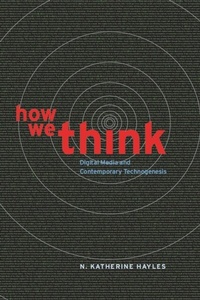
How We Think
Description

"How do we think?" N. Katherine Hayles poses this question at the beginning of this bracing exploration of the idea that we think through, with, and alongside media. As the age of print passes and new technologies appear every day, this proposition has become far more complicated, particularly for the traditionally print-based disciplines in the humanities and qualitative social sciences. With a rift growing between digital scholarship and its print-based counterpart, Hayles argues for contemporary technogenesis-the belief that humans and technics are coevolving-and advocates for what she calls comparative media studies, a new approach to locating digital work within print traditions and vice versa.
Hayles examines the evolution of the field from the traditional humanities and how the digital humanities are changing academic scholarship, research, teaching, and publication. She goes on to depict the neurological consequences of working in digital media, where skimming and scanning, or "hyper reading," and analysis through machine algorithms are forms of reading as valid as close reading once was. Hayles contends that we must recognize all three types of reading and understand the limitations and possibilities of each. In addition to illustrating what a comparative media perspective entails, Hayles explores the technogenesis spiral in its full complexity. She considers the effects of early databases such as telegraph code books and confronts our changing perceptions of time and space in the digital age, illustrating this through three innovative digital productions-Steve Tomasula's electronic novel, TOC; Steven Hall's The Raw Shark Texts; and Mark Z. Danielewski's Only Revolutions. Deepening our understanding of the extraordinary transformative powers digital technologies have placed in the hands of humanists, How We Think presents a cogent rationale for tackling the challenges facing the humanities today.All prices
More details
Other editions
Additional editions
Person
N. Katherine Hayles is professor of literature at Duke University. Her books include How We Became Posthuman: Virtual Bodies in Cybernetics, Literature, and Informatics and Writing Machines.
Content
- Intro
- Contents
- List of Figures
- Acknowledgments
- 1. How We Think: Digital Media and Contemporary Technogenesis
- First Interlude: Practices and Processes in Digital Media
- 2. The Digital Humanities: Engaging the Issues
- 3. How We Read: Close, Hyper, Machine
- Second Interlude: The Complexities of Contemporary Technogenesis
- 4. Tech-TOC: Complex Temporalities and Contemporary Technogenesis
- 5. Technogenesis in Action: Telegraph Code Books and the Place of the Human
- Third Interlude: Narrative and Database: Digital Media as Forms
- 6. Narrative and Database: Spatial History and the Limits of Symbiosis
- 7. Transcendent Data and Transmedia Narrative: Steven Hall's The Raw Shark Texts
- 8. Mapping Time, Charting Data: The Spatial Aesthetic of Mark Z. Danielewski's Only Revolutions
- Notes
- Works Cited
- Index

