

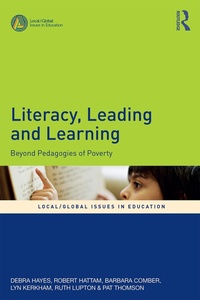
Literacy, Leading and Learning
Beyond Pedagogies of Poverty
Published on 14. July 2017
228 pages
978-1-351-71807-3 (ISBN)
Description

How might educational leaders and teachers improve literacy achievement in schools serving communities experiencing high levels of poverty? This question is the focus of this book. Drawing on long-term case studies of four primary schools located in these communities, this book describes the difference between what is commonly practiced and those practices that have a greater chance of supporting young people's literacy learning.
In this multi-layered analysis of the effects of policy on practice, the authors: discuss global concerns with literacy policy and testing in view of the growing gaps between rich and poor; examine the effects of the intensification of inequality and entrenched poverty, and the implications for schools; illustrate how deficit discourses pertaining to communities living in poverty are contested in schools; and describe the complexities of sustaining pedagogical and curriculum change to address the problem of unequal educational outcomes in literacy.
This book grapples with some of the most debated questions regarding educational disadvantage, school change, leadership and literacy pedagogy that face educational researchers, policy-makers and practitioners internationally. As well as providing a critique of the risks of current policy rationales, it conveys some hopeful accounts of practice that provide leads for further development.
In this multi-layered analysis of the effects of policy on practice, the authors: discuss global concerns with literacy policy and testing in view of the growing gaps between rich and poor; examine the effects of the intensification of inequality and entrenched poverty, and the implications for schools; illustrate how deficit discourses pertaining to communities living in poverty are contested in schools; and describe the complexities of sustaining pedagogical and curriculum change to address the problem of unequal educational outcomes in literacy.
This book grapples with some of the most debated questions regarding educational disadvantage, school change, leadership and literacy pedagogy that face educational researchers, policy-makers and practitioners internationally. As well as providing a critique of the risks of current policy rationales, it conveys some hopeful accounts of practice that provide leads for further development.
More details
Series
Language
English
Place of publication
London
United Kingdom
Publishing group
Taylor & Francis Ltd
Target group
College/higher education
Professional and scholarly
Illustrations
6 s/w Abbildungen, 10 s/w Tabellen, 6 s/w Photographien bzw. Rasterbilder
10 Tables, black and white; 6 Halftones, black and white; 6 Illustrations, black and white
File size
2,82 MB
ISBN-13
978-1-351-71807-3 (9781351718073)
Copyright in bibliographic data and cover images is held by Nielsen Book Services Limited or by the publishers or by their respective licensors: all rights reserved.
Schweitzer Classification
Other editions
Additional editions
Debra Hayes | Robert Hattam | Barbara Comber
Literacy, Leading and Learning
Beyond Pedagogies of Poverty
Book
06/2017
1st Edition
Routledge
€60.20
Shipment within 10-20 days
Debra Hayes | Robert Hattam | Barbara Comber
Literacy, Leading and Learning
Beyond Pedagogies of Poverty
Book
06/2017
1st Edition
Routledge
€215.41
Shipment within 10-20 days
Persons
Debra Hayes is an Associate Professor in the Faculty of Education and Social Work, as the University of Sydney. She is a co-author of Teachers and Schooling Making a Difference: Productive Pedagogies, Assessment & Performance (Allen & Unwin, 2006), and Leading Learning: Making Hope Practical in Schools (Open University Press, 2003). She is a former secondary school science teacher.
Robert Hattam is an Associate Professor in the School of Education at the University of South Australia. He has been involved in book projects with others that include: Schooling for a Fair Go, Teachers' Work in a Globalising Economy, Dropping Out, Drifting Off, Being Excluded: Becoming Somebody Without School, Connecting Lives and Learning, and Pedagogies for Reconciliation.
Barbara Comber is a Research Professor in the School of Education at the University of South Australia. Her research interests include teachers' work, critical literacy and social justice. She has conducted longitudinal ethnographic case studies and collaborative action research with teachers working in high poverty and culturally diverse communities. Her research examines the kinds of teaching that make a difference to young people's literacy learning trajectories and what gets in the way. She recently published Literacy, place and pedagogies of possibility (Comber, 2016).
Lyn Kerkham is a research associate and teacher in the School of Education, University of South Australia. Recent publications include 'Literacy, sustainability and landscapes for learning' in Nichols, S & Snowdon, C (Eds) (2016) Languages and Literacies as Mobile and Placed Resources and a co-authored chapter, 'Literacy leadership and accountability practices: holding onto ethics in ways that count' in Lingard,B., Thomson, G. & Sellar, S. (2016) National Testing in Schools: An Australian assessment. She is a former primary school teacher.
Ruth Lupton is a Professor of Education at the Manchester Institute of Education, University of Manchester, England. She was formerly Deputy Director at the Centre for Analysis of Social Exclusion at the London School of Economics. She is the author of Poverty Street: The Dynamics of Neighbourhood Decline and Renewal, and numerous papers on the subject of school context and its effect on school practice.
Pat Thomson is a former school principal in disadvantaged schools in South Australia. Now in England at the University of Nottingham, her research focuses on arts, creativity and school and community change, and academic writing and doctoral education. Her most recent books are Educational leadership and Pierre Bourdieu (Routledge November 2016), Place based methods for researching schools, with Christine Hall (Bloomsbury, November 2016) and Detox your writing: Strategies for doctoral researchers with Barbara Kamler (Routledge, 2016). She blogs at patthomson.net.
Robert Hattam is an Associate Professor in the School of Education at the University of South Australia. He has been involved in book projects with others that include: Schooling for a Fair Go, Teachers' Work in a Globalising Economy, Dropping Out, Drifting Off, Being Excluded: Becoming Somebody Without School, Connecting Lives and Learning, and Pedagogies for Reconciliation.
Barbara Comber is a Research Professor in the School of Education at the University of South Australia. Her research interests include teachers' work, critical literacy and social justice. She has conducted longitudinal ethnographic case studies and collaborative action research with teachers working in high poverty and culturally diverse communities. Her research examines the kinds of teaching that make a difference to young people's literacy learning trajectories and what gets in the way. She recently published Literacy, place and pedagogies of possibility (Comber, 2016).
Lyn Kerkham is a research associate and teacher in the School of Education, University of South Australia. Recent publications include 'Literacy, sustainability and landscapes for learning' in Nichols, S & Snowdon, C (Eds) (2016) Languages and Literacies as Mobile and Placed Resources and a co-authored chapter, 'Literacy leadership and accountability practices: holding onto ethics in ways that count' in Lingard,B., Thomson, G. & Sellar, S. (2016) National Testing in Schools: An Australian assessment. She is a former primary school teacher.
Ruth Lupton is a Professor of Education at the Manchester Institute of Education, University of Manchester, England. She was formerly Deputy Director at the Centre for Analysis of Social Exclusion at the London School of Economics. She is the author of Poverty Street: The Dynamics of Neighbourhood Decline and Renewal, and numerous papers on the subject of school context and its effect on school practice.
Pat Thomson is a former school principal in disadvantaged schools in South Australia. Now in England at the University of Nottingham, her research focuses on arts, creativity and school and community change, and academic writing and doctoral education. Her most recent books are Educational leadership and Pierre Bourdieu (Routledge November 2016), Place based methods for researching schools, with Christine Hall (Bloomsbury, November 2016) and Detox your writing: Strategies for doctoral researchers with Barbara Kamler (Routledge, 2016). She blogs at patthomson.net.
Content
Lists of figures, maps, tables or cases
Series Editor Introduction
Acknowledgements
List of abbreviations
About the Authors
Introduction
Chapter 1. Poverty Now
Chapter 2. Studying Schools
Chapter 3. Educational Leadership Practices: Making and Remaking the School
Chapter 4. Uncommon Pedagogies
Chapter 5. Common Pedagogies: Missed Opportunities and Unmet Hopes
Chapter 6. Supporting Children's Literacy Learning at School and Home: Analysing the Effects of Discourse
Chapter 7. 'We Can Make a Difference': Educational Leadership Practices for Literacy Learning
Appendix A
Series Editor Introduction
Acknowledgements
List of abbreviations
About the Authors
Introduction
Chapter 1. Poverty Now
Chapter 2. Studying Schools
Chapter 3. Educational Leadership Practices: Making and Remaking the School
Chapter 4. Uncommon Pedagogies
Chapter 5. Common Pedagogies: Missed Opportunities and Unmet Hopes
Chapter 6. Supporting Children's Literacy Learning at School and Home: Analysing the Effects of Discourse
Chapter 7. 'We Can Make a Difference': Educational Leadership Practices for Literacy Learning
Appendix A
