

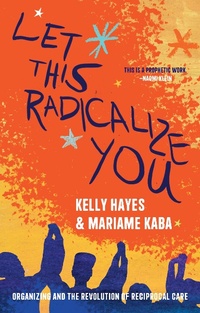
Let This Radicalize You
Description

What fuels and sustains activism and organizing when it feels like our worlds are collapsing? Let This Radicalize You is a practical and imaginative resource for activists and organizers building power in an era of destabilization and catastrophe.
Longtime organizers and movement educators Mariame Kaba and Kelly Hayes examine some of the political lessons of the COVID-19 pandemic, including the convergence of mass protest and mass formations of mutual aid, and consider what this confluence of power can teach us about a future that will require mass acts of care, rescue and defense, in the face of both state violence and environmental disaster.
The book is an assemblage of co-authored reflections, interviews and questions that are intended to aid and empower activists and organizers as they attempt to map their own journeys through the work of justice-making. It includes insights from a spectrum of experienced organizers, including Sharon Lungo, Carlos Saavedra, Ejeris Dixon, Barbara Ransby, and Ruth Wilson Gilmore about some of the difficult and joyous lessons they have learned in their work.
More details
Persons
Mariame Kaba is an organizer, educator, librarian, and prison industrial complex (PIC) abolitionist who is active in movements for racial, gender, and transformative justice. Kaba is the founder and director of Project NIA, a grassroots abolitionist organization with a vision to end youth incarceration. Mariame co-leads the initiative Interrupting Criminalization, a project she co-founded with Andrea Ritchie in 2018.
Kaba is the author of the New York Times Bestseller We Do This Til We Free Us: Abolitionist Organizing and Transforming Justice (Haymarket Press 2021), Missing Daddy (Haymarket 2019), Fumbling Towards Repair: A Workbook for Community Accountability Faciltators with Shira Hassan (Project NIA, 2019), See You Soon (Haymarket, March 2022) and No More Police: A Case for Abolition with Andrea Ritchie (The New Press, Aug 2022).
Kelly Hayes is a Menominee author, organizer, movement educator, and photographer. She is also the host of Truthout's podcast Movement Memos. Hayes is a cofounder of the Lifted Voices collective and the Chicago Light Brigade. Her written work is featured in numerous publications and multiple anthologies, including Who Do You Serve, Who Do You Protect? Police Violence and Resistance in the United States (Haymarket Books, 2016), Education in Movement Spaces: Standing Rock to Chicago Freedom Square (Routledge, 2020), and The Solidarity Struggle: How People of Color Succeed and Fail at Showing Up for Each Other in the Fight for Freedom (BGD Press, 2016). Hayes also coauthored an essay with Mariame Kaba in Kaba's book We Do This 'Til We Free Us: Abolitionist Organizing and Transforming Justice (Haymarket Books, 2021). Hayes's movement photography is featured in the Freedom and Resistance exhibit of the DuSable Museum of African American History.
Content
Chapter 2: Refusing to Abandon
Chapter 3: Care Is Fundamental
Chapter 4: Think Like a Geographer
Chapter 5: Rejecting Cynicism and Building Broader Movements
Chapter 6: "Violence" in Social Movements
Chapter 7: Don't Pedestal Organizers
Chapter 8: Hope and Grief Can Coexist
Chapter 9: Organizing Isn't Matchmaking
Chapter 10: Avoiding Burnout and Going the DistanceConclusion: Relationships, Reciprocity, and Struggle by Kelly HayesConclusion: Beyond Doom, toward Collective Action by Mariame KabaAfterword: Movements Make Life by Harsha Walia
