

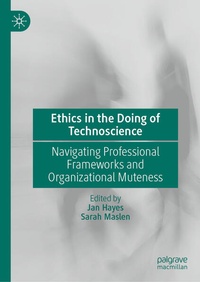
Ethics in the Doing of Technoscience
Description

This book takes us beneath the banality of business as usual where technoscientific professionals routinely make judgments that impact the lives of others. Be it the safety of engineered systems, the speed and accuracy of medical diagnoses, or the wellbeing of animals subject to genetic modification, mindful, ethical choices contribute to the society we want to live in.
In these decision making moments, professionals working in laboratories, clinics, offices and data centers weigh what constitutes ethical action in the face of ambiguity and uncertainty. This navigation is highly social and messy. The impact may be distant in time and geography and, as our cases show, professionals don't always get it right. Making ethical choices in a given context is not readily codified, which is a critical observation in the context of escalating trends to automate decision making.
We show how engineers, doctors, nurses, synthetic biologists, and other technoscientific professionals work through conflicting values, complex social organization, and societal expectations, grasping always for a hold on the potentially big consequences of everyday decisions.
Reviews / Votes
"From Titan's deep-sea implosion to the overuse of diamorphine in an elderly care unit, Hayes and Maslen's edited collection dissects compelling stories of failure and wrongdoing. With the appeal of a true crime podcast, the authors take us close to the action, revealing the messy reality of ethical decision making in technoscientific settings." (Rebecca Olson, Professor of Sociology, University of Queensland)
"Starting from real situations in very diverse domains and environments, this book unveils the complexity of professional ethics: its social nature, its variability across contexts, its contestation. In an original move, the authors get beyond ethical principles and the organisational scale of analysis to examine ethics in the making from the perspective of professionals on the ground. This is a rare and welcome contribution." (Corinne Bieder, Scientific Director, Foncsi (Foundation for an Industrial Safety Culture)
More details
Other editions
Additional editions
Persons
Jan Hayes is a sociologist with 35 years' experience in safety and risk management. Her research interests are all connected to organizational accident prevention and include professional ethics, expertise, decision making and use of standards.
Sarah Maslen is a sociologist working on expert decision making in critical contexts, with a particular focus on the cultivation of embodied and other tacit forms of knowledge. She is the author of Learning to Hear: The Auditory Bases of Excellence in Practicing Medicine, Climbing Mountains, Making Music, and Communicating in Morse Code (Columbia University Press).
Content
Chapter 1. Introducing professional ethics in practice ( Jan Hayes and Sa-rah Maslen ).- Chapter 2. "Keep as 'VERY CONFIDENTIAL!!!!'": How the behavior of technical professionals contributed to the Grenfell Tower disaster ( Jan Hayes, Orana Sandri and Sarah Maslen ).- Chapter 3. The in-visible influence of expert consultants in engineering risk-based decision making ( Jan Hayes ).- Chapter 4. Industrial development, invisible haz-ards, and bringing to light their entanglements: Lessons for ethics from the 2014 Kaohsiung propene explosions in Taiwan ( Bono Po-Jen Shih, Wen-Ling Hong and Jr-Ping Wang ).- Chapter 5. Technology and micros-copy in biomedical education: navigating the ethical landscape ( R. Claire Aland, Rebecca Lush and Nicole Shepherd ).- Chapter 6. The limits of eth-ical engineering actions: the Titan case ( Jan Hayes, Rune Storesund and Sarah Maslen ).- Chapter 7. What does it take to "settle" a scandal? The ethics of hearing and acting on safety concerns (Dawn Goodwin and Daniel Taylor).- Chapter 8. Divergent attitudes towards ethics and collec-tive responsibility in Canadian engineering discourse ( Kari Zacharias and Robyn Mae Paul ).- Chapter 9. Industry and geopolitical tensions: Ethical dilemmas when safety meets security ( Sissel Haugdal Jore, Ole Andreas Hegland Engen, Susanne Therese Hanse and Øyvind Midttun ).- Chapter 10. Ethical licensing in practice: the case of CRISPR gene editing technol-ogy ( Alison McLennan and Sarah Maslen ).- Chapter 11. The price of safe-ty: The ethics of occupational risk monetization in Brazil ( Carolina Bonemer Cury and Caio Caesar Dib ).- Chapter 12. AI as an epistemic technology: Navigating ethics in practice in cases of distributed decision making ( Sarah Maslen and Jan Hayes ).
