

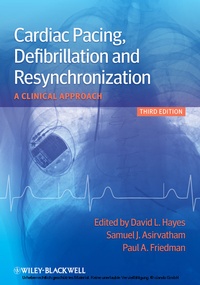
Cardiac Pacing, Defibrillation and Resynchronization
Description

As our population ages and multiple factors contribute to an increased prevalence of cardiovascular disease, more patients than ever before will be candidates for implantable devices as part of their treatment for heart rhythm abnormalities. Electrophysiologists have a widening array of sophisticated devices from which to choose, and important new data about efficacy, long-term outcomes and possible complications has emerged, impacting how devices are chosen and utilized. Overall, the management of patients with pacemakers and ICDs and other devices remains a complex topic and the need for clear-headed, expert guidance has never been greater.
Now in its 3rd edition, Cardiac Pacing, Defibrillation and Resynchronization: A Clinical Approach is a clinically focused guide to Pacing and ICDs that caregivers can rely on for answers to common but challenging questions on all aspects of device preparation, from selection and programming to proper implantation and long-term patient management.
This new edition of Cardiac Pacing, Defibrillation and Resynchronization: A Clinical Approach:
• Provides answers to the most common clinical questions
• Presents a logical progression from descriptions of devices and indications to hardware selection and proper implementation
• Includes important updates in all covered areas, especially in chapters on CRT and ICD therapies, where significant advances have been made recently
• Features over 750 illustrations, most in full color
With it's focus on essential clinical information, and sensible, matter-of-fact approach, Cardiac Pacing, Defibrillation and Resynchronization: A Clinical Approach is the ideal guide for busy providers. Thoroughly updated to reflect the latest knowledge and with a wealth of visual content to illustrate processes and reinforce key concepts, it is also an invaluable resource for those preparing to take the Electrophysiology boards or other certification examinations.
David L. Hayes Consultant, Division of Cardiovascular Diseases, Professor of Medicine,
Mayo Clinic, Rochester, MN, USA
Samuel J. Asirvatham Consultant, Division of Cardiovascular Diseases, Professor of
Medicine and of Pediatrics, Mayo Clinic, Rochester, MN, USA
Paul A. Friedman Consultant, Division of Cardiovascular Diseases, Director, Implantable
Device Lab, Professor of Medicine, Mayo Clinic, Rochester, MN, USA
More details
Other editions
Additional editions
Content
2 - Copyright page [Seite 6]
3 - Contents [Seite 7]
4 - Contributors [Seite 9]
5 - Preface [Seite 11]
6 - 1: Pacing and Defibrillation: Clinically Relevant Basics for Practice [Seite 13]
6.1 - Anatomy and physiology of the cardiac conduction system [Seite 14]
6.2 - Electrophysiology of myocardial stimulation [Seite 14]
6.3 - Pacing basics [Seite 16]
6.3.1 - Stimulation threshold [Seite 16]
6.3.2 - Variations in stimulation threshold [Seite 18]
6.3.3 - Sensing [Seite 19]
6.4 - Lead design [Seite 21]
6.4.1 - Bipolar and unipolar pacing and sensing [Seite 25]
6.4.2 - Left ventricular leads [Seite 25]
6.5 - Pulse generators [Seite 26]
6.5.1 - Pacemaker nomenclature [Seite 28]
6.6 - Defibrillation basics [Seite 28]
6.6.1 - Critical mass [Seite 30]
6.6.2 - Upper limit of vulnerability [Seite 30]
6.6.3 - Progressive depolarization [Seite 31]
6.6.4 - Virtual electrode depolarization [Seite 31]
6.6.5 - Defibrillation theory summary [Seite 33]
6.7 - The importance of waveform [Seite 33]
6.7.1 - Biphasic waveforms [Seite 34]
6.7.2 - Phase duration and tilt [Seite 35]
6.7.3 - Polarity and biphasic waveforms [Seite 36]
6.7.4 - Mechanism of improved efficacy with biphasic waveforms [Seite 36]
6.8 - Measuring shock dose [Seite 36]
6.9 - Measuring the efficacy of defibrillation [Seite 37]
6.9.1 - Threshold and dose-response curve [Seite 37]
6.9.2 - Relationship between defibrillation threshold and dose-response curve [Seite 37]
6.9.3 - Patient-specific defibrillation threshold and safety margin testing [Seite 38]
6.9.4 - Clinical role of defibrillation testing at implantation [Seite 39]
6.9.5 - Management of the patient who fails defibrillation testing [Seite 41]
6.9.6 - Upper limit of vulnerability to assess safety margin [Seite 45]
6.10 - Drugs and defibrillators [Seite 45]
6.11 - Antitachycardia pacing [Seite 46]
6.12 - References [Seite 47]
7 - 2: Hemodynamics of Cardiac Pacing: Optimization and Programming to Enhance Cardiac Function [Seite 53]
7.1 - Cardiovascular physiology [Seite 54]
7.1.1 - Abnormal physiology [Seite 55]
7.2 - Basics of hemodynamic pacing [Seite 55]
7.2.1 - Chronotropic response [Seite 55]
7.2.2 - Atrioventricular dissociation and ventriculoatrial conduction [Seite 55]
7.2.3 - Atrioventricular synchrony [Seite 57]
7.2.4 - Atrioventricular optimization [Seite 61]
7.2.5 - Principles of echocardiographic atrioventricular optimization [Seite 64]
7.3 - Atrial mechanical function [Seite 68]
7.4 - Effect of pacing mode on morbidity and mortality [Seite 68]
7.4.1 - Optimal ventricular pacing sites [Seite 73]
7.5 - Pacing in heart failure [Seite 78]
7.5.1 - Influence of pacing site [Seite 78]
7.5.2 - Mechanisms underlying the benefits of left ventricular and biventricular pacing [Seite 79]
7.5.3 - Left ventricular diastolic function [Seite 82]
7.6 - AV optimization in cardiac resynchronization therapy [Seite 82]
7.7 - Ventricular timing optimization (V-V optimization) [Seite 83]
7.7.1 - Optimizing site of pacing (LV and/or RV) [Seite 83]
7.7.2 - Electrical parameters for V-V optimization [Seite 84]
7.7.3 - QRS vector fusion [Seite 84]
7.7.4 - Echocardiography for ventricular timing optimization [Seite 87]
7.7.5 - Clinical approaches to V-V optimization [Seite 87]
7.7.6 - Other end-points for optimization [Seite 89]
7.7.7 - Right ventricular function [Seite 89]
7.7.8 - Cardiac contractility modulation pacing [Seite 90]
7.7.9 - Ventricular rate regulation [Seite 90]
7.8 - Less common indications for pacing for hemodynamic improvement [Seite 90]
7.8.1 - Pacing in hypertrophic obstructive cardiomyopathy [Seite 90]
7.8.2 - Hemodynamic benefits of pacing in neurocardiogenic syndromes [Seite 91]
7.8.3 - Hemodynamic benefits of pacing in first-degree atrioventricular block [Seite 92]
7.9 - Conclusions [Seite 92]
7.10 - Addendum [Seite 92]
7.11 - References [Seite 92]
8 - 3: Indications for Pacemakers, ICDs and CRT: Identifying Patients Who Benefit from Cardiac Rhythm Devices [Seite 105]
8.1 - Indications for permanent pacing [Seite 106]
8.1.1 - Atrioventricular block [Seite 106]
8.1.2 - Acute myocardial infarction [Seite 112]
8.1.3 - Chronic bifascicular and trifascicular block [Seite 113]
8.1.4 - Sinus node dysfunction [Seite 113]
8.1.5 - Neurally mediated reflex syncope [Seite 116]
8.1.6 - Tachyarrhythmias [Seite 118]
8.1.7 - Hypertrophic cardiomyopathy [Seite 119]
8.1.8 - Congestive heart failure [Seite 119]
8.1.9 - Pacing after cardiac transplantation [Seite 124]
8.2 - Indications for the implantable cardioverter-defibrillator [Seite 124]
8.2.1 - Secondary prevention [Seite 125]
8.2.2 - Primary prevention [Seite 125]
8.3 - Contraindications to implantable cardioverter-defibrillator therapy [Seite 138]
8.4 - Acknowledgement [Seite 139]
8.5 - References [Seite 139]
9 - 4: Choosing the Device Generator and Leads: Matching the Device with the Patient [Seite 145]
9.1 - Pacemaker selection [Seite 146]
9.1.1 - Symptomatic bradycardia [Seite 147]
9.1.2 - Pure sinus node dysfunction [Seite 148]
9.1.3 - Pure atrioventricular block [Seite 148]
9.1.4 - Neurocardiogenic syncope and carotid sinus hypersensitivity [Seite 148]
9.2 - Choosing specific programmable options [Seite 148]
9.3 - Choosing the rate-adaptive sensor [Seite 148]
9.4 - Choosing the lead or leads [Seite 148]
9.4.1 - Threshold reduction [Seite 149]
9.4.2 - Lead polarity [Seite 149]
9.4.3 - Electrode design [Seite 151]
9.4.4 - Lead conductor [Seite 151]
9.4.5 - Lead insulation [Seite 151]
9.4.6 - Lead diameter [Seite 152]
9.4.7 - Compatibility of lead and pulse generator [Seite 153]
9.4.8 - Epicardial leads [Seite 153]
9.4.9 - Resources for lead performance and survival data [Seite 154]
9.5 - Generator and lead selection in defibrillators [Seite 156]
9.5.1 - Lead design considerations for ICD leads [Seite 156]
9.5.2 - Programmable waveforms [Seite 161]
9.6 - Dual-chamber or single-chamber ICD? [Seite 161]
9.6.1 - Factors favoring single-chamber defibrillators [Seite 161]
9.6.2 - Factors favoring dual-chamber defibrillators [Seite 161]
9.6.3 - Specific device and lead features influencing selection [Seite 162]
9.7 - Conclusions [Seite 166]
9.8 - References [Seite 166]
10 - 5: Implanting and Extracting Cardiac Devices: Technique and Avoiding Complications [Seite 169]
10.1 - Implantation facility [Seite 170]
10.2 - Anesthesia [Seite 170]
10.3 - The pulse generator pocket [Seite 171]
10.4 - Venous approaches [Seite 172]
10.4.1 - Axillary (extrathoracic subclavian) approach [Seite 172]
10.4.2 - Subclavian approach [Seite 177]
10.4.3 - Cephalic approach [Seite 177]
10.4.4 - Jugular approach [Seite 177]
10.4.5 - Iliac vein approach [Seite 178]
10.5 - Ventricular lead placement [Seite 178]
10.6 - Coronary sinus lead placement [Seite 187]
10.6.1 - Coronary sinus cannulation [Seite 188]
10.6.2 - Coronary sinus venography [Seite 193]
10.7 - Securing permanent leads [Seite 201]
10.8 - Dual-chamber pulse generator implantation [Seite 201]
10.9 - Measurement of pacing and sensing thresholds [Seite 204]
10.9.1 - Determination of pacing threshold [Seite 205]
10.9.2 - Determination of sensing threshold [Seite 206]
10.10 - Epicardial systems [Seite 208]
10.11 - Hardware adaptations [Seite 208]
10.12 - Special considerations in pediatric patients [Seite 210]
10.13 - Device implantation after cardiac transplantation [Seite 214]
10.14 - Hospital stay after implantation [Seite 215]
10.15 - Pulse generator replacement [Seite 215]
10.16 - Post-implant order set [Seite 217]
10.17 - Homegoing instructions [Seite 217]
10.18 - Lead extraction [Seite 217]
10.18.1 - Indications for lead extraction [Seite 217]
10.18.2 - Facility requirements for lead extraction [Seite 221]
10.18.3 - Outcomes of lead extraction [Seite 221]
10.18.4 - Complications of lead extraction [Seite 221]
10.18.5 - Extraction techniques [Seite 222]
10.19 - References [Seite 227]
11 - 6: Implant-Related Complications: Relevant Anatomy and an Approach for Prevention [Seite 231]
11.1 - Complications related directly to the implant procedure [Seite 232]
11.1.1 - Lead dislodgement [Seite 232]
11.1.2 - Pneumothorax [Seite 235]
11.1.3 - Lead perforation [Seite 237]
11.1.4 - Pericarditis [Seite 240]
11.1.5 - Arrhythmias [Seite 240]
11.1.6 - Pulse generator pocket complications [Seite 241]
11.1.7 - Pain [Seite 242]
11.1.8 - Inadvertent left ventricular lead placement [Seite 244]
11.1.9 - Thrombosis [Seite 244]
11.1.10 - Loose connector block connection [Seite 246]
11.1.11 - Lead damage [Seite 246]
11.1.12 - Infection [Seite 247]
11.1.13 - Abandoned and nonfunctioning, noninfected leads [Seite 250]
11.1.14 - Twiddler's syndrome [Seite 252]
11.2 - New symptoms secondary to pacemaker placement [Seite 257]
11.2.1 - Extracardiac stimulation [Seite 257]
11.2.2 - Pacemaker syndrome [Seite 257]
11.2.3 - Tricuspid regurgitation [Seite 257]
11.2.4 - Battery depletion [Seite 258]
11.3 - Implant or hardware-related complications that may result in recurrence of preimplantation symptoms (see also Chapter 10: Troubleshooting) [Seite 258]
11.3.1 - Loss of circuit integrity [Seite 258]
11.3.2 - Lead fracture and insulation defect [Seite 260]
11.3.3 - Exit block [Seite 260]
11.4 - References [Seite 264]
12 - 7: Timing Cycles [Seite 267]
12.1 - Basic approach [Seite 268]
12.1.1 - Pacing modes [Seite 269]
12.1.2 - Atrial inhibited pacing [Seite 269]
12.1.3 - Single-chamber triggered-mode pacing [Seite 271]
12.1.4 - Rate-modulated pacing [Seite 271]
12.1.5 - Atrioventricular sequential, ventricular inhibited pacing (DVI) [Seite 273]
12.1.6 - Atrioventricular sequential, non-P-synchronous pacing with dual-chamber sensing (DDI) [Seite 273]
12.1.7 - Atrioventricular sequential, non-P-synchronous, rate-modulated pacing with dual-chamber sensing (DDIR) [Seite 274]
12.1.8 - Atrial synchronous (P-tracking/P-synchronous) pacing (VDD) [Seite 274]
12.1.9 - Dual-chamber pacing and sensing with inhibition and tracking (DDD) [Seite 274]
12.2 - Portions of pacemaker timing cycles [Seite 276]
12.2.1 - Atrioventricular interval [Seite 276]
12.2.2 - Comparison of atrial with ventricular-based timing [Seite 280]
12.2.3 - Dual-chamber rate-modulated pacemakers: effect on timing cycles [Seite 284]
12.2.4 - Mode switching [Seite 288]
12.2.5 - Avoiding atrial pace/sense competition [Seite 288]
12.2.6 - Timing components of ventricular avoidance pacing algorithms [Seite 290]
12.2.7 - Endless-loop tachycardia [Seite 291]
12.2.8 - Timing cycles with algorithms responding to sudden bradycardia [Seite 292]
12.2.9 - Timing cycles unique to biventricular pacing [Seite 293]
12.2.10 - Timing cycles in ICDs [Seite 299]
12.3 - Initial electrocardiographic interpretation [Seite 300]
12.3.1 - Response to magnet application [Seite 301]
12.3.2 - Single-chamber pacemakers [Seite 303]
12.3.3 - Dual-chamber pacemakers [Seite 304]
12.3.4 - Biventricular paced electrocardiogram: position, adequacy, and timing [Seite 308]
12.3.5 - Characteristic electrocardiographic patterns with specific lead locations [Seite 311]
12.3.6 - Timing intervals and the ECG [Seite 314]
12.3.7 - Electrocardiographic considerations in the patient not responding to CRT [Seite 328]
12.4 - Conclusions [Seite 328]
12.5 - References [Seite 328]
13 - 8: Programming: Maximizing Benefit and Minimizing Morbidity Programming [Seite 331]
13.1 - Programmers [Seite 332]
13.2 - Pacemaker programming [Seite 332]
13.2.1 - Interrogation [Seite 333]
13.2.2 - Emergency programming [Seite 333]
13.2.3 - Programmed parameters [Seite 333]
13.2.4 - Measured data [Seite 334]
13.2.5 - Specific programmable parameters to consider in all patients [Seite 334]
13.2.6 - Unexpected programming [Seite 362]
13.2.7 - Programming during routine follow-up [Seite 369]
13.3 - Defibrillator programming [Seite 372]
13.3.1 - Implantable cardioverter-defibrillator sensing [Seite 374]
13.3.2 - Implantable cardioverter-defibrillator detection [Seite 378]
13.3.3 - SVT-VT discriminators [Seite 385]
13.3.4 - Ventricular therapies [Seite 402]
13.3.5 - Atrial defibrillators: detection and therapies [Seite 405]
13.3.6 - Optimizing programming [Seite 406]
13.4 - Cardiac resynchronization programming [Seite 407]
13.4.1 - Algorithms to promote continuous tracking [Seite 407]
13.4.2 - Algorithms to manage premature ventricular complexes [Seite 410]
13.4.3 - Algorithms to manage atrial fibrillation [Seite 411]
13.4.4 - Device-based optimization for cardiac resynchronization [Seite 411]
13.5 - Conclusions [Seite 412]
13.6 - References [Seite 413]
14 - 9: Sensor Technology for Rate-Adaptive Pacing and Hemodynamic Optimization [Seite 419]
14.1 - Indications for rate-adaptive pacing [Seite 420]
14.2 - Sensors available for rate-adaptive pacing [Seite 420]
14.2.1 - Activity sensors [Seite 421]
14.2.2 - Minute ventilation sensors [Seite 423]
14.2.3 - SonR sensor (previously called peak endocardial acceleration sensor) [Seite 423]
14.2.4 - Right ventricular impedance-based sensor [Seite 424]
14.2.5 - Stimulus-T or QT, sensing pacemaker [Seite 426]
14.2.6 - Other sensors [Seite 426]
14.3 - Dual-sensor rate-adaptive pacing [Seite 427]
14.4 - Sensor applications for hemodynamic management [Seite 430]
14.5 - Programming [Seite 430]
14.5.1 - Programmable parameters [Seite 432]
14.6 - Rate-adaptive pacing with cardiac resynchronization devices [Seite 436]
14.6.1 - AV and V-V timing [Seite 436]
14.7 - Future of rate-adaptive sensors [Seite 437]
14.8 - References [Seite 437]
15 - 10: Troubleshooting: Interpreting Diagnostic Information to Ensure Appropriate Function [Seite 439]
15.1 - Pacemaker troubleshooting [Seite 440]
15.1.1 - Clinical assessment [Seite 440]
15.1.2 - Identifying the pulse generator [Seite 441]
15.1.3 - Electrocardiographic interpretation [Seite 442]
15.1.4 - Lead integrity [Seite 442]
15.1.5 - Pulse generators [Seite 444]
15.1.6 - Clinical troubleshooting [Seite 444]
15.2 - Diagnostic features [Seite 451]
15.2.1 - Unexpected device failure [Seite 451]
15.2.2 - Operative evaluation of pacing systems [Seite 452]
15.3 - Focused troubleshooting [Seite 452]
15.3.1 - Failure to capture [Seite 453]
15.3.2 - Pseudo-malfunctions [Seite 464]
15.3.3 - Failure to pace (no output) [Seite 466]
15.3.4 - Undersensing [Seite 470]
15.3.5 - Alteration in programmed pacing rate [Seite 474]
15.3.6 - New symptoms after pacemaker implantation [Seite 476]
15.4 - ICD troubleshooting [Seite 484]
15.4.1 - Diagnostic tools for ICD troubleshooting [Seite 484]
15.4.2 - Evaluating appropriateness of delivered therapy [Seite 488]
15.4.3 - Determining if shocks for VT are necessary [Seite 518]
15.4.4 - Approach to the patient with frequent shocks [Seite 522]
15.4.5 - Unsuccessful shocks [Seite 523]
15.4.6 - Failure to deliver or delayed therapy: underdetection and undersensing [Seite 527]
15.4.7 - Troubleshooting ICD lead failure [Seite 533]
15.5 - Troubleshooting cardiac resynchronization devices [Seite 545]
15.5.1 - Failure to respond to resynchronization pacing [Seite 545]
15.5.2 - Troubleshooting other problems in CRT systems [Seite 554]
15.6 - References [Seite 558]
16 - 11: Radiography of Implantable Devices [Seite 565]
16.1 - Introduction [Seite 566]
16.2 - Pulse generators [Seite 566]
16.2.1 - Other types of pulse generators [Seite 568]
16.3 - Leads [Seite 570]
16.3.1 - Pacemaker leads [Seite 572]
16.3.2 - Transvenous atrial leads [Seite 576]
16.3.3 - Transvenous ventricular leads [Seite 579]
16.3.4 - Epicardial leads [Seite 584]
16.4 - ICD leads [Seite 584]
16.4.1 - Epicardial ICD leads [Seite 584]
16.4.2 - Transvenous ICD leads [Seite 584]
16.5 - Coronary venous leads [Seite 589]
16.6 - Miscellaneous considerations [Seite 595]
16.7 - Conclusions [Seite 597]
16.8 - References [Seite 600]
17 - 12: Electromagnetic Interference: Sources, Recognition, and Management [Seite 603]
17.1 - Pacemaker responses to noise [Seite 605]
17.1.1 - Asynchronous pacing [Seite 605]
17.1.2 - Mode resetting (power-on reset, or electrical reset) [Seite 609]
17.1.3 - Environmental electromagnetic interference [Seite 610]
17.2 - References [Seite 623]
18 - 13: Follow-up [Seite 625]
18.1 - Requirements for a device follow-up clinic [Seite 626]
18.1.1 - Space [Seite 626]
18.1.2 - Personnel [Seite 626]
18.1.3 - Equipment [Seite 627]
18.2 - Pacemaker follow-up [Seite 628]
18.2.1 - Trans-telephonic monitoring [Seite 628]
18.2.2 - Equipment [Seite 628]
18.2.3 - Trans-telephonic monitoring sequence [Seite 629]
18.2.4 - Internet-based remote monitoring [Seite 630]
18.2.5 - Pacemaker clinic follow-up visit [Seite 630]
18.3 - ICD follow-up [Seite 638]
18.3.1 - Assessment of the patient's clinical status [Seite 638]
18.3.2 - Pulse generator assessment [Seite 638]
18.3.3 - Capacitor status [Seite 640]
18.3.4 - Assessing lead function [Seite 642]
18.3.5 - Defibrillation efficacy assessment [Seite 643]
18.3.6 - Medications [Seite 644]
18.3.7 - Strategies to minimize shocks [Seite 646]
18.3.8 - CRT follow-up specifics [Seite 646]
18.3.9 - Remote patient monitoring [Seite 646]
18.3.10 - Medical advisories and recalls [Seite 652]
18.3.11 - Lifestyle and personal concerns [Seite 656]
18.3.12 - Psychologic issues encountered following device implantation [Seite 657]
18.3.13 - Withdrawal of device support [Seite 658]
18.4 - Conclusions [Seite 658]
18.5 - References [Seite 658]
19 - Index [Seite 663]
