

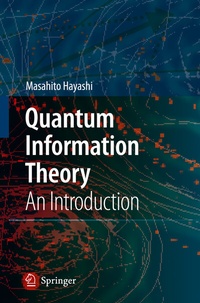
Quantum Information
Description

Recently, quantum information theory has been developing through a fusion of results from various research fields. This requires that understanding of basic results on diverse topics, and derived from different disciplinary perspectives, is required for appreciating the overall picture. Intended to merge key topics from both the information-theoretic and quantum- mechanical viewpoints, this graduate-level textbook provides a unified viewpoint of quantum information theory and lucid explanations of those basic results, so that the reader fundamentally grasps advances and challenges. For example, advanced topics in quantum communication such as quantum teleportation, superdense coding, quantum state transmission (quantum error-correction), and quantum encryption especially benefit from this unified approach. Unlike earlier treatments, the text requires knowledge of only linear algebra, probability theory, and quantum mechanics, while it treats the topics of quantum hypothesis testingand the discrimination of quantum states, and quantum channel coding (message transmission) with the minimal amount of math needed to convey their essence. Solving the more than 240 exercises provides readers with practice that not only enriches their knowledge of quantum information theory, but also can equip them with the techniques necessary for pursuing their own research in this field.
Reviews / Votes
"Quantum Information: An Introduction by Masahito Hayashi provides much more than merely an introduction to this active area of study. The text is a thorough mathematical foundation upon which graduate students and early career researchers alike can build the knowledge and skills required to pursue their own research in the field. . I will be gladly recommending this text to any researcher wishing to enter the field, from graduate student through to professor." (N. Oxtoby, Contemporary Physic, Vol. 49 (01),January-February, 2008)
"The book under review is, without a doubt, the most comprehensive textbook to date on quantum information theory. . This comprehensive and theorem-heavy approach makes the booka valuable reference for those working in the field of quantum information. . This book could be used in a graduate course in quantum information theory . . an extremely helpful work, and I am glad that it is available." (Todd A. Brun, Mathematical Reviews, Issue 2007 b)
More details
Other editions
Additional editions
Person
1990-1994 Faculty of Science, Kyoto Univ.
1994-1996 Master course, Depart of Mathematics, Graduate School of Science,
Kyoto Univ.
1996-1999 Doctor course, Depart of Mathematics, Graduate School of Science,
Kyoto Univ.
1999 March Ph. D. in Mathematics
1998-2000 Research Fellow of the Japan Society for the Promotion of
Science.
2000-2003 Researcher
Lab. for Mathematical Neuroscience (Amari's Lab.),
Brain Science Institute, RIKEN
2003- Head of Research Section
ERATO, Quantum Computation and Information Project,
Japan Science and Technology Agency (JST)
2004- Adjunct Associate Professor
Graduate School of Information Science and Technology
The University of Tokyo
Editorial Bord, International Journal of Quantum Information,
World Scientific (2002-).
Guest Editor, Special Issue of EQIS'03 conference
in International Journal of Quantum Information.
Editor of "Asymptotic Theory of Quantum Statistical Inference: Selected papers" published by World Scientific, 542 pages (2005).
