

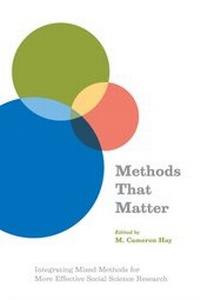
Methods That Matter
Integrating Mixed Methods for More Effective Social Science Research
1st Edition
Published on 5. May 2016
443 pages
978-0-226-32883-6 (ISBN)
Available for download
Description

To do research that really makes a difference-the authors of this book argue-social scientists need questions and methods that reflect the complexity of the world. Bringing together a consortium of voices across a variety of fields, Methods that Matter offers compelling and successful examples of mixed methods research that do just that. In case after case, the researchers here break out of the traditional methodological silos that have long separated social science disciplines in order to better describe the intricacies of our personal and social worlds.???????????Historically, the largest division between social science methods has been that between quantitative and qualitative measures. For people trained in psychology or sociology, the bias has been toward the former, using surveys and experiments that yield readily comparable numerical results. For people trained in anthropology, it has been toward the latter, using ethnographic observations and interviews that offer richer nuances of meaning but are difficult to compare across societies. Discussing their own endeavors to combine the quantitative with the qualitative, the authors invite readers into a conversation about the best designs and practices of mixed methodologies to stimulate creative ideas and find new pathways of insight. The result is an engaging exploration of a promising new approach to the social sciences.?
More details
Other editions
Additional editions
M. Cameron Hay
Methods That Matter
Integrating Mixed Methods for More Effective Social Science Research
Book
05/2016
University of Chicago Press
€38.38
Shipment within 10-20 days
M. Cameron Hay
Methods That Matter
Integrating Mixed Methods for More Effective Social Science Research
Book
05/2016
University of Chicago Press
€112.66
Article not available at the moment
Content
- Intro
- Contents
- Preface: Applying Methods That Matter
- Acknowledgments
- Part One. Methods and Theory for More Holistic Human Sciences
- 1. Repairing the Fractured Social Sciences: An Introduction from a Historical Point of View - Robert A. Levine
- 2. Ecocultural Theory: Foundations and Applications - Carol M. Worthman
- Part Two. Discovering Mixed Methods
- 3. Ethnography in Need of Numbers: Mixing Methods to Build Partnerships and Understand Tigers - M. Cameron Hay
- 4. Crunching Numbers, Listening to Voices, and Looking at the Brain to Understand Family Relationships among Immigrant Families - Andrew J. Fuligni
- 5. "It Depends": The First Law of Education Research and Development - Ronald Gallimore
- Part Three. Mixed Methods to Explore Cultural Variability
- 6. The Soft Side of Hard Data in the Study of Cultural Values - Richard A. Shweder
- 7. Images of Infancy: The Interplay of Biological Predispositions and Cultural Philosophies as an Arena for Mixed Methods Research - Heidi Keller
- 8. Beyond the Randomized Control Trial: Mixed Methods That Matter for Children's Healthy Development in Cultural Context - Sara Harkness and Charles M. Super
- 9. Methods to Inform Public Problems: Toward an Ecocultural Framing of Poverty - Edward D. Lowe
- Part Four. Mixed Methods and Collaborative Research
- 10. Collaborative Research on Emergent Literacy: Capturing Complex Mixed Methods Data and Tools for Their Integration and Analysis - Eli Lieber
- 11. Lessons Learned from Parents of Adults with Autism in India - Tamara C. Daley
- 12. What Makes for the Best Clinical Care? Using Trigger Films to Explore Better Integration of Guidelines and Experience - M. Cameron Hay, Thomas S. Weisner, and Saskia K. Subramanian
- Part Five. Mixed Methods and the Insights of Longitudinal Research
- 13. How Siblings Matter in Zinacantec Maya Child Development - Ashley E. Maynard
- 14. Why Mixed Methods Matter in Understanding Neighborhood Context and Child Maltreatment - Jill E. Korbin
- 15. Multiple Marginality: A Comparative Framework for Understanding Gangs - James Diego Vigil
- 16. "I Thought Delay Meant She Would Catch Up": Using Mixed Methods to Study Children with Early Developmental Delays and Their Families - Lucinda P. Bernheimer, Ronald Gallimore, and Barbara K. Keogh
- Part Six. Mixed Methods for Intervention and Policy-Driven Research
- 17. Mixed Methods in the Science of Understanding Antipoverty Policies for Families with Children: Four Case Studies - Aletha C. Huston, Greg J. Duncan, and Hirokazu Yoshikawa
- 18. Styles of Mothering, Methods of Engagement: Bridging Anthropology, Psychology, and Education to Inform Policy - Carolyn Pope Edwards
- 19. Intervention Research with Clients of Transgender Sex Workers: Finding Methods That Work with a Virtual Community - Brian L. Wilcox
- Part Seven. Why Mixed Methods?
- 20. Findings That Matter: A Commentary - Thomas S. Weisner
- Contributors
- Index

