

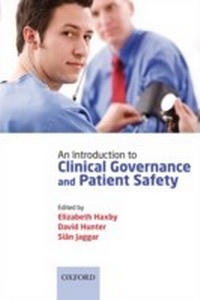
An Introduction to Clinical Governance and Patient Safety
1st Edition
Published on 16. September 2010
465 pages
978-0-19-101556-4 (ISBN)
Description

Clinical Governance is integral to healthcare and all doctors must have an understanding of both basic principles, and how to apply them in daily practice. Within the Clinical Governance framework, patient safety is the top priority for all healthcare organisations, with the prevention of avoidable harm a key goal. Traditionally medical training has concentrated on the acquisition of knowledge and skills related to diagnostic intervention and therapeutic procedures. The need to focus on non-technical aspects of clinical practice, including communication and team working, is now evident; ensuring tomorrow's staff are competent to function effectively in any healthcare facility.
This book provides a guide to how healthcare systems work; their structure, regulation and inspection, and key areas including risk management, resource effectiveness and wider aspects of knowledge management. Changing curricula at undergraduate level reflect this, but post-graduate training is lagging behind and does not always equip trainees appropriately for a hectic clinical environment. An Introduction to Clinical Governance and Patient Safety presents a simple overview of clinical governance in context, highlighting important principles required to function effectively in a pressurised healthcare environment. It is presented in short sections based on the original seven pillars of clinical governance. These have been expanded to include the fundamental principles of systems, team working, leadership, accountability, and ownership in healthcare, with examples from everyday practice. This format is designed to facilitate use as a 'pocket guide' which can be dipped into during the working day, as well as for general reading. Examples from all branches of medicine are presented to facilitate understanding. Contributors are taken from a broad base - from junior doctors to internationally recognised experts - ensuring issues are addressed from all perspectives.
More details
Other editions
Additional editions

Elizabeth Haxby | David Hunter | Sian Jaggar
An Introduction to Clinical Governance and Patient Safety
Software
01/2011
Oxford University Press, USA
€89.65
Article exhausted; check different version
Elizabeth Haxby | David Hunter | Sian Jaggar
An Introduction to Clinical Governance and Patient Safety
Book
09/2010
1st Edition
Oxford University Press
€111.60
Shipment within 15-20 days
Persons
Elizabeth Haxby was a consultant adult and paediatric cardiothoracic anaesthetist for four years until 2002 but now devotes her time solely to clinical risk management, patient safety and medico-legal work. She is a member of the Improvement faculty of the NHSIII and the faculty of the Leadership in Patient Safety programme. She is also a member of the Core team for Patient Safety First with a focus on Leadership and junior doctors. She lectures widely and has a particular interest in patient safety, consent, clinical risk assessment and evidence-based risk management as well as training. Her publications include papers on safety in clinical practice, particularly fibreoptic bronchoscopy for which she was an advisor to the European Respiratory Society Working Group, clinical risk management and training in risk management. She is an honorary senior lecture at the National Heart and Lung Institute and is currently studying for a Masters in Medical Ethics and Law.
Prior to his appointment to the Royal Brompton in 2002, David Hunter was a Consultant Anaesthetist at Guy's and St Thomas', London for 7 years, the last 3 years of which he was the Programme Director of the South Eastern School of Anaesthesia. Since arriving at the Royal Brompton he has developed his interest in clinical governance and patient safety. Since 2005 he has run regular multidisciplinary courses in Sedation for Non-anaesthetists and Patient Safety open to all in the region. He acted as an anaesthetic advisor to NCEPOD from 2005-8 for the report "The Heart of the Matter" looking at deaths following coronary artery bypass grafting. He is currently Director of Theatres, and Clinical Governance Lead for Anaesthesia and Intensive Care at the Royal Brompton, working to improve both efficiency and patient safety by highlighting the importance of human factors in safe practice. He is an honorary senior lecturer at the National Heart and Lung Institute.
Siân Jaggar has an interest in education, particularly in changing practice amongst multidisciplinary groups, and the barriers to this in the face of adequate evidence for change. She has developed programmes involving junior doctors, paramedical staff, managers and patient safety staff addressing these issues, and lectures both Nationally & Internationally. Her publications include papers on outcome prediction following cardio-respiratory interventions. She is an honorary senior lecturer at the National Heart and Lung Institute.
Content
- 1: Elizabeth Haxby and Sarah Hammond: Clinical governance and patient safety - an overview
- Section 1 - Risk Management
- 2: Suzette Woodward: Risk awareness
- 3: Elizabeth Haxby and Richard Hartopp: Risk identification
- 4: Alison Lovatt and Mel Johnson: Risk assessment
- 5: Mary Lane: Risk control
- 6: Elizabeth Haxby: Risk assurance
- 7: Ruth Symons: Complaints and claims
- 8: Gaynor Pickavance: Risk management standards
- Section 2 - Clinical Effectiveness
- 9: Henry McQuay: Evidence-based medicine
- 10: Peter Littlejohns: NICE and NSFs
- 11: Gillian Leng and Chris Connell: Clinical guidelines
- 12: David Hunter: Clinical audit
- 13: Paul Farquhar-Smith: Research governance
- 14: Carole Longson and Mirella Marlow: New interventional procedures
- 15: Helen Goodman: Integrated care pathways
- Section 3 - Strategic Effectiveness
- 16: Paul Williams: The Trust board
- 17: Gareth Goodier: Trust strategy and strategic planning
- 18: Heather Shearer: Capacity efficiency and targets
- 19: David James: Service provision
- 20: Tina Ferguson: Policies and procedures
- 21: Heather Shearer: Quality improvement
- 22: Richard Connett: Performance management
- Section 4 - Resource Effectiveness
- 23: Carole Johnson: Recruitment and retention
- 24: Sara Lightowlers and Andrew Rochford: Improving working lives
- 25: Judith Hulf and Kirstyn Shaw: Revalidation
- 26: Jerry Mitchell: Managing poor performance
- 27: Maria Cabrelli: Facilities - the hidden hospital
- 28: Stephen Squire: Equipment management
- Section 5 - Learning Effectiveness
- 29: Les Gemmell: Induction
- 30: Lesley Bromley: Training
- 31: Siân Jaggar: Continuing professional development
- 32: Hazel Adams: Competence
- 33: David Greaves and Peta Jane Eastland: Knowledge management
- 34: Simon Finney: Clinical information systems
- Section 6 - Patient Experience
- 35: Rachel Matthews: Patient and public involvement
- 36: Eve Cartwright: Patient advice and liaison
- 37: Jilla Bond: Patient consultation
- 38: Alison Wright: Patient feedback
- 39: Ruth Robertson: Patient choice
- 40: Claire Reid: Patient information
- 41: Deborah Trenchard: The expert patient
- Section 7 - Communication Effectiveness
- 42: Murray Anderson-Wallace: Communicating with the public
- 43: Nick Hunt: Communicating with commissioners
- 44: Angela Walsh: Clinical networks
- 45: Nick Coleman: Board communication
- 46: Robert Craig: Staff communication
- 47: Elizabeth Haxby: Communicating with patients
- Section 8 - Fundamental Principles
- 48: Edwin Borman: Accountability, safety and professionalism
- 49: Guy Hirst and Allan Goldman: Team working
- 50: Nelson Phillips: Leadership
- 51: Kieran Sweeney and Michael Williams: Complex systems and resilience
