

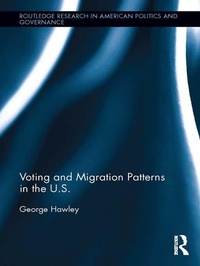
Voting and Migration Patterns in the U.S.
Published on 31. July 2013
204 pages
978-1-135-04404-6 (ISBN)
Description

In recent years, political scientists and journalists have taken a great interest in the question of whether the American electorate is "sorting" into communities based on partisan affiliation. That is, there is concern that American communities are becoming increasingly politically homogenous and this is because Americans are considering politics explicitly when determining where to live. Academics have since debated the degree to which this is a real phenomenon and, if it is, whether it has important normative implications. However, little empirical research has examined which factors turned some closely-contested counties into Republican enclaves and others into Democratic strongholds.
Examining individual and aggregate data and employing a large number of statistical methods, George Hawley explores the increasing political homogenization of small geographic units and explains the causal mechanisms driving this phenomenon as well as its consequences for individual political attitudes and behavior among residents residing in these geographic units. He argues that some partisans are self-selecting into communities of likeminded partisans, causing some areas to become overwhelmingly Republican and others to become overwhelmingly Democratic. The book also notes that the migratory patterns of Republicans and Democrats differ in systematic ways for other reasons, due to the different demographic and economic characteristics of these partisan groups.
At a time when many studies argue that a large percentage of the electorate is self-selecting into communities based on their political preferences, this bookshelf essential presents a much needed account on the different migratory patterns of Republicans and Democrats and how these patterns are shaping the geography of American politics.
Examining individual and aggregate data and employing a large number of statistical methods, George Hawley explores the increasing political homogenization of small geographic units and explains the causal mechanisms driving this phenomenon as well as its consequences for individual political attitudes and behavior among residents residing in these geographic units. He argues that some partisans are self-selecting into communities of likeminded partisans, causing some areas to become overwhelmingly Republican and others to become overwhelmingly Democratic. The book also notes that the migratory patterns of Republicans and Democrats differ in systematic ways for other reasons, due to the different demographic and economic characteristics of these partisan groups.
At a time when many studies argue that a large percentage of the electorate is self-selecting into communities based on their political preferences, this bookshelf essential presents a much needed account on the different migratory patterns of Republicans and Democrats and how these patterns are shaping the geography of American politics.
Reviews / Votes
"Where we choose to live is clearly affecting our politics. George Hawley tells how migration is shaping the vote by explaining why Americans live where they do today."-Bill Bishop, co-author of The Big Sort: Why the Clustering of Like-Minded America Is Tearing Us Apart
"George Hawley has made a major contribution to renewed interest in political demography with his new book. He ably reviews the recent literature that documents some of the most prominent consequences of 21st century demography. Hawley's analysis reveals how major demographic shifts in marriage and family formation, urban-rural divergence, and racial-ethnic population movement are important aspects of these political shifts. He demonstrates there is evidence that, for a growing number of Americans, the desire to live in neighborhoods where their social and political values are congruent with their neighbors is a contributing factor to the geographic polarization that now overlaps with partisan polarization in America. For scholars and citizens interested in the driving forces of political change in the United States, this book is a must-read."
-Richard W. Murray, University of Houston "Where we choose to live is clearly affecting our politics. George Hawley tells how migration is shaping the vote by explaining why Americans live where they do today."
-Bill Bishop, co-author of The Big Sort: Why the Clustering of Like-Minded America Is Tearing Us Apart
"George Hawley has made a major contribution to renewed interest in political demography with his new book. He ably reviews the recent literature that documents some of the most prominent consequences of 21st century demography. Hawley's analysis reveals how major demographic shifts in marriage and family formation, urban-rural divergence, and racial-ethnic population movement are important aspects of these political shifts. He demonstrates there is evidence that, for a growing number of Americans, the desire to live in neighborhoods where their social and political values are congruent with their neighbors is a contributing factor to the geographic polarization that now overlaps with partisan polarization in America. For scholars and citizens interested in the driving forces of political change in the United States, this book is a must-read."
-Richard W. Murray, University of Houston
More details
Series
Language
English
Place of publication
London
United Kingdom
Publishing group
Taylor & Francis Ltd
Target group
College/higher education
Product notice
Reflowable
Illustrations
20 s/w Abbildungen, 12 s/w Tabellen
12 Tables, black and white; 20 Illustrations, black and white
File size
2,83 MB
ISBN-13
978-1-135-04404-6 (9781135044046)
Copyright in bibliographic data and cover images is held by Nielsen Book Services Limited or by the publishers or by their respective licensors: all rights reserved.
Schweitzer Classification
Other editions
Additional editions
George Hawley
Voting and Migration Patterns in the U.S.
Book
09/2015
1st Edition
Routledge
€39.90
Shipment within 10-20 days
George Hawley
Voting and Migration Patterns in the U.S.
Book
07/2013
1st Edition
Routledge
€140.30
Shipment within 15-20 days
Person
George Hawley is Assistant Professor of Political Science at the University of Alabama. His research interests include demography, electoral behavior, political parties, immigration policy, and the U.S. Congress.
Content
Introduction. Part I: Migration and Partisan Self-Selection 1. Geographic Segregation in the United States 2. A Theory of Geographic Partisan Sorting 3. Geographic Partisan Sorting: Empirical Evidence Part II: Migration and Political Change 4. The Geography of Family Formation 5. Race and Migration as a Source of Political Diversity and Homogeneity 6. Occupation as a Source of Political Diversity and Homogeneity Part III: A Case Study 7: Harris County, TX: Political Segregation in the Nation's Largest Swing County. Conclusion
