

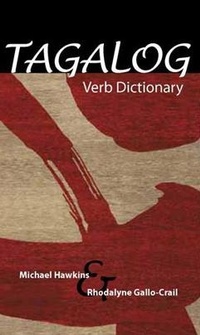
Tagalog Verb Dictionary
Published on 21. March 2011
182 pages
978-1-60909-022-7 (ISBN)
Description

This handy reference is a concise explanatory text and English-Tagalog/Tagalog-English verb guide designed to address and facilitate the most important aspect of Tagalog language learning-understanding and mastering the complex focal orientation of verbs. It is organized into an accessible pattern illustrating the primary conjugations that establish aspect and actor/object focus for each verb. These verbs are further enhanced by sample sentences demonstrating their usage and introducing common cultural contexts for effective communication. In addition to the verb guide, this text also provides a short history of Tagalog, an extensive explanation of verbal function in the language, and a number of learners' tips intended to ease and expedite the learning process. Taken together, these materials, along with a persistent willingness to engage the language, will facilitate a quick and effective path to fluency. Whether one is studying within the structured environment of a classroom or independently in their spare time, this book is designed to give special attention to the most critical aspects of Tagalog language learning. Tagalog Verb Dictionary's orderly and easily accessible layout and neat size make it the ideal companion for students, travelers, and anyone interested in fast fluency in the language.
Reviews / Votes
The book is a welcome addition to the field of Filipino language study. This reference text will be useful for classes that have undergraduate students, heritage and non-heritage, and graduate students who are learning the language to help their research. Individuals who have some background in the language may also use this book for self-study. Even Filipino native speakers may find this book helpful in fully understanding Tagalog verbs.- Dr. Leo Paz, Chair, Philippine Studies Department, City College of San Francisco
More details
Language
English
Place of publication
Ithaca
United States
Publishing group
Cornell University Press
Product notice
Reflowable
ISBN-13
978-1-60909-022-7 (9781609090227)
Copyright in bibliographic data and cover images is held by Nielsen Book Services Limited or by the publishers or by their respective licensors: all rights reserved.
Schweitzer Classification
Other editions
Additional editions
Michael C. Hawkins | Rhodalyne Gallo-Crail
Tagalog Verb Dictionary
Book
03/2011
Northern Illinois University Press
€18.50
Shipment within 3-4 weeks
Persons
Michael Hawkins is Assistant Professor of Asian History at Creighton University. Rhodalyne Gallo-Crail is an instructor in the department of foreign languages and Center for Southeast Asian Studies at Northern Illinois University.
Content
- Cover
- TAGALOG VERB DICTIONARY
- Title
- Copyright
- TABLE OF CONTENTS
- 1-Introduction
- 2-English-Tagalog Conjugation
- 3-English-Tagalog Sentences
- 4-Tagalog-English Conjugation
- 5-Tagalog-English Sentences
