

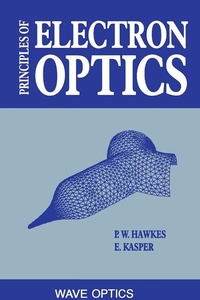
Principles of Electron Optics
Wave Optics
1st Edition
Published on 24. April 1996
700 pages
978-0-08-096242-9 (ISBN)
Description

Principles of Electron Optics
More details
Other editions
New editions
E-Book
12/2012
3rd Edition
Academic Press
€175.00
Available for download
Additional editions

P. W. Hawkes | Erich Kasper
Hawkes - Kasper Wave Optics V3
Book
04/1996
Academic Press
€56.99
Article exhausted; check different version
Persons
Peter Hawkes obtained his M.A. and Ph.D (and later, Sc.D.) from the University of Cambridge, where he subsequently held Fellowships of Peterhouse and of Churchill College. From 1959 - 1975, he worked in the electron microscope section of the Cavendish Laboratory in Cambridge, after which he joined the CNRS Laboratory of Electron Optics in Toulouse, of which he was Director in 1987. He was Founder-President of the European Microscopy Society and is a Fellow of the Microscopy and Optical Societies of America. He is a member of the editorial boards of several microscopy journals and serial editor of Advances in Electron Optics.Erwin Kasper studied physics at the Universities of Münster and Tübingen (Germany), where he obtained his PhD in 1965 and the habilitation to teach physics in 1969. After scientific spells in the University of Tucson, Arizona (1966) and in Munich (1970), he resumed his research and teaching in the Institute of Applied Physics, University of Tübingen, where he was later appointed professor. He lectured on general physics and especially on electron optics. The subject of his research was theoretical electron optics and related numerical methods on which he published numerous papers. After his retirement in 1997, he published a book on numerical field calculation (2001).
Content
- Front Cover
- Principles of Electron Optics: Wave Optics
- Copyright Page
- Contents
- Preface
- Chapter 54. Introduction
- 54.1 Organization of the subject
- 54.2 History
- PART XI - WAVE MECHANICS
- Chapter 55. The Schrödinger Equation
- 55.1 Introduction
- 55.2 Formulation of Schrödinger's equation
- 55.3 The continuity equation
- 55.4 The gauge transformation
- Chapter 56. The Relativistic Wave Equation
- 56.1 The Dirac equation
- 56.2 The scalar wave equation
- 56.3 Properties of the relativistic wave equation
- 56.4 Rigorous approach
- Chapter 57. The Eikonal Approximation
- 57.1 The product separation
- 57.2 The essential approximation
- 57.3 The variational principle
- 57.4 The calculation of eikonal functions
- 57.5 The calculation of wave amplitudes
- Chapter 58. Paraxial Wave Optics
- 58.1 The paraxial Schrödinger equation
- 58.2 Particular solution of the paraxial Schrödinger equation
- 58.3 Paraxial image formation
- Chapter 59. The General Theory of Electron Diffraction and Interference
- 59.1 Kirchhoff's general diffraction formula
- 59.2 Necessary simplifications
- 59.3 Fresnel and Fraunhofer diffraction
- 59.4 Electron diffraction in the presence of electromagnetic fields
- 59.5 Asymptotic diffraction formulae
- 59.6 The observability of diffraction and interference fringes
- Chapter 60. Elementary Diffraction Patterns
- 60.1 The object function
- 60.2 Rectangular structures
- 60.3 Circular structures
- 60.4 Caustic interferences
- 60.5 Diffraction disc with lens aberrations
- 60.6 The Rayleigh rule and criterion
- PART XII - ELECTRON INTERFERENCE AND ELECTRON HOLOGRAPHY
- Chapter 61. General Introduction
- Chapter 62. Principles of Interferometry
- 62.1 The electrostatic biprism
- 62.2 Quasi-homogeneous interference fringes
- 62.3 Coherence problems
- 62.4 The Aharonov-Bohm effect
- 62.5 Other electron interference studies
- Chapter 63. Principles of Holography
- 63.1 In-line holography
- 63.2 Off-axis holography: hologram formation in a two-beam interferometer
- 63.3 Reconstruction procedures
- 63.4 Further reading
- PART XIII - THEORY OF IMAGE FORMATION
- Chapter 64. General Introduction
- Chapter 65. Fundamentals of Transfer Theory
- 65.1 The integral transformation
- 65.2 Isoplanatism and Fourier transforms
- 65.3 The wave transfer function
- 65.4 Explicit formulae
- Chapter 66. The Theory of Bright-field Imaging
- 66.1 Image contrast for weak specimens
- 66.2 Spectral distributions of the illumination
- 66.3 Particular forms of the spectra
- 66.4 Optimum defocus and resolution limit
- 66.5 Extensions of the theory
- Chapter 67. Image Formation in the Scanning Transmission Electron Microscope
- 67.1 Introduction
- 67.2 Wave propagation in STEM
- 67.3 Detector geometry
- 67.4 Concluding remarks
- PART XIV - ELECTRON INTERACTIONS IN THIN SPECIMENS
- Chapter 68. Electron Interactions in Amorphous Specimens
- 68.1 Introduction
- 68.2 Definition of the elastic cross-sections
- 68.3 The first-order Born approximation for elastic scattering
- 68.4 The high-energy approximation
- 68.5 Partial wave analysis
- 68.6 Inelastic electron scattering
- 68.7 Plural and multiple electron scattering
- Chapter 69. Electron Interactions in Crystalline Specimens
- 69.1 Introduction
- 69.2 Fundamentals of crystallography
- 69.3 The periodic potential
- 69.4 Kinematic theory of electron scattering
- 69.5 General formulation of the dynamical theory
- 69.6 The two-beam case
- 69.7 Applications and extensions of the dynamical theory
- 69.8 Image simulation
- PART XV - DIGITAL IMAGE PROCESSING
- Chapter 70. Introduction
- 70.1 Organization of the subject
- 70.2 Image algebra
- 70.3 Notation
- Chapter 71. Acquisition, Sampling and Coding
- 71.1 Acquisition
- 71.2 Sampling
- 71.3 Quantization
- 71.4 Coding
- 71.5 Electron optical considerations
- Chapter 72. Enhancement
- 72.1 Operations on individual pixels
- 72.2 Linear filtering
- 72.3 Nonlinear filters
- 72.4 Image algebraic representation of enhancement
- 72.5 Enhancement in electron microscopy
- Chapter 73. Linear Restoration
- 73.1 Introduction
- 73.2 Extended Wiener filters
- 73.3 Filtering with constraints
- 73.4 Hoenders' procedure
- 73.5 Recursive filtering
- 73.6 Other approaches
- Chapter 74. Nonlinear Restoration
- 74.1 Introduction
- 74.2 Extended linear approximation
- 74.3 Multiple recordings (circular symmetry)
- 74.4 Analyticity
- 74.5 Maximum entropy and related probabilistic methods
- Chapter 75. Three-dimensional Reconstruction
- 75.1 Introduction
- 75.2 Methods
- 75.3 Pre-processing
- 75.4 Concluding remarks
- Chapter 76. Image Analysis
- 76.1 Introduction
- 76.2 Discrete geometry
- 76.3 Segmentation and feature extraction
- 76.4 Classification
- 76.5 Description
- 76.6 Further reading
- Chapter 77. Instrument Control and Instrumental Image Manipulation
- 77.1 Introduction
- 77.2 Measurement of microscope operating parameters
- 77.3 Control
- PART XVI - COHERENCE, BRIGHTNESS AND SPECTRAL FUNCTIONS
- Chapter 78. Coherence and the Brightness Functions
- 78.1 Introduction
- 78.2 Coherence
- 78.3 Radiometry
- 78.4 The brightness of partially coherent sources
- 78.5 Consequences for the van Cittert-Zernike theorem
- 78.6 Eigenfunction expansions of the coherence functions
- 78.7 The quasihomogeneous source
- 78.8 Brightness, coherence and quasihomogeneity
- 78.9 Temporal and spatial coherence
- 78.10 Related work
- Chapter 79. Instrumental Aspects of Coherence
- 79.1 Introduction
- 79.2 The propagation of coherence functions
- 79.3 Coherence and illumination
- Appendix
- Notes and References
- Index
