

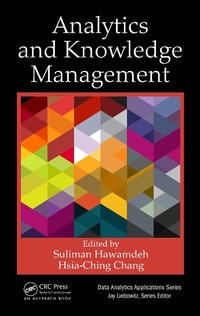
Analytics and Knowledge Management
1st Edition
Published on 6. August 2018
466 pages
978-1-351-80700-5 (ISBN)
Description

The process of transforming data into actionable knowledge is a complex process that requires the use of powerful machines and advanced analytics technique. Analytics and Knowledge Management examines the role of analytics in knowledge management and the integration of big data theories, methods, and techniques into an organizational knowledge management framework. Its chapters written by researchers and professionals provide insight into theories, models, techniques, and applications with case studies examining the use of analytics in organizations.
The process of transforming data into actionable knowledge is a complex process that requires the use of powerful machines and advanced analytics techniques. Analytics, on the other hand, is the examination, interpretation, and discovery of meaningful patterns, trends, and knowledge from data and textual information. It provides the basis for knowledge discovery and completes the cycle in which knowledge management and knowledge utilization happen. Organizations should develop knowledge focuses on data quality, application domain, selecting analytics techniques, and on how to take actions based on patterns and insights derived from analytics.
Case studies in the book explore how to perform analytics on social networking and user-based data to develop knowledge. One case explores analyze data from Twitter feeds. Another examines the analysis of data obtained through user feedback. One chapter introduces the definitions and processes of social media analytics from different perspectives as well as focuses on techniques and tools used for social media analytics.
Data visualization has a critical role in the advancement of modern data analytics, particularly in the field of business intelligence and analytics. It can guide managers in understanding market trends and customer purchasing patterns over time. The book illustrates various data visualization tools that can support answering different types of business questions to improve profits and customer relationships.
This insightful reference concludes with a chapter on the critical issue of cybersecurity. It examines the process of collecting and organizing data as well as reviewing various tools for text analysis and data analytics and discusses dealing with collections of large datasets and a great deal of diverse data types from legacy system to social networks platforms.
The process of transforming data into actionable knowledge is a complex process that requires the use of powerful machines and advanced analytics techniques. Analytics, on the other hand, is the examination, interpretation, and discovery of meaningful patterns, trends, and knowledge from data and textual information. It provides the basis for knowledge discovery and completes the cycle in which knowledge management and knowledge utilization happen. Organizations should develop knowledge focuses on data quality, application domain, selecting analytics techniques, and on how to take actions based on patterns and insights derived from analytics.
Case studies in the book explore how to perform analytics on social networking and user-based data to develop knowledge. One case explores analyze data from Twitter feeds. Another examines the analysis of data obtained through user feedback. One chapter introduces the definitions and processes of social media analytics from different perspectives as well as focuses on techniques and tools used for social media analytics.
Data visualization has a critical role in the advancement of modern data analytics, particularly in the field of business intelligence and analytics. It can guide managers in understanding market trends and customer purchasing patterns over time. The book illustrates various data visualization tools that can support answering different types of business questions to improve profits and customer relationships.
This insightful reference concludes with a chapter on the critical issue of cybersecurity. It examines the process of collecting and organizing data as well as reviewing various tools for text analysis and data analytics and discusses dealing with collections of large datasets and a great deal of diverse data types from legacy system to social networks platforms.
More details
Series
Edition
1. Auflage
Language
English
Place of publication
London
United Kingdom
Publishing group
Taylor & Francis Ltd
Target group
College/higher education
Illustrations
67 Tables, black and white; 10 Illustrations, color; 15 Illustrations, black and white
ISBN-13
978-1-351-80700-5 (9781351807005)
Copyright in bibliographic data and cover images is held by Nielsen Book Services Limited or by the publishers or by their respective licensors: all rights reserved.
Schweitzer Classification
Other editions
Additional editions
Suliman Hawamdeh | Hsia-Ching Chang
Analytics and Knowledge Management
Book
01/2023
1st Edition
Auerbach
€79.41
Shipment within 10-20 days
Suliman Hawamdeh | Hsia-Ching Chang
Analytics and Knowledge Management
Book
05/2018
1st Edition
CRC Press
€191.90
Shipment within 10-20 days
Persons
Suliman Hawamdeh is a professor and department chair of the Department of Information Science in the College of Information at the University of North Texas. He is the director of the Information Science PhD program, one of the largest interdisciplinary information science PhD programs in the country. He is the editor in chief of the Journal of Information and Knowledge Management (JIKM) and the editor of a book series on innovation and knowledge management published by World Scientific. Dr. Hawamdeh founded and directed several academic programs including the first Master of Science in Knowledge Management in Asia at the School of Communication and Information at Nanyang Technological University in Singapore. Dr. Hawamdeh has extensive industrial experience. He was the Managing Director of ITC Information Technology Consultant Ltd, a company that developed and marketed a line of software development products. He worked as a consultant to several organizations including NEC, Institute of Southeast Asian Studies, Petronas, and Shell. Dr. Hawamdeh has authored and edited several books on knowledge management including Information and Knowledge Society published by McGraw Hill and Knowledge Management: Cultivating the Knowledge Professionals Published by Chandos Publishing, as well as several edited and co-edited books published by World Scientific.
Hsia-Ching Chang is an assistant professor in the Department of Information Science, College of Information at the University of North Texas. She received her PhD in informatics and MS in information science from the University at Albany, State University of New York as well as her MA in public policy from the National Taipei University in Taiwan. Her research interests concentrate on data analytics, social media, cybersecurity, knowledge mapping, scientometrics, information architecture, and information interaction.
Hsia-Ching Chang is an assistant professor in the Department of Information Science, College of Information at the University of North Texas. She received her PhD in informatics and MS in information science from the University at Albany, State University of New York as well as her MA in public policy from the National Taipei University in Taiwan. Her research interests concentrate on data analytics, social media, cybersecurity, knowledge mapping, scientometrics, information architecture, and information interaction.
Content
1 Knowledge Management for Action-Oriented Analytics 2 Data Analytics Process: An Application Case on Predicting Student Attrition 3 Transforming Knowledge Sharing in Twitter-Based Communities Using Social Media Analytics 4 Data Analytics for Deriving Knowledge from User Feedback 5 Relating Big Data and Data Science to the Wider Concept of Knowledge Management 6 Fundamentals of Data Science for Future Data Scientists 7 Social Media Analytics 8 Transactional Value Analytics in Organizational Development 9 Data Visualization Practices and Principles 10 Analytics Using Machine Learning-Guided Simulations with Application to Healthcare Scenarios 11 Intangible Dynamics: Knowledge Assets in the Context of Big Data and Business Intelligence 12 Analyzing Data and Words-Guiding Principles and Lessons Learned 13 Data Analytics for Cyber Threat Intelligence
