

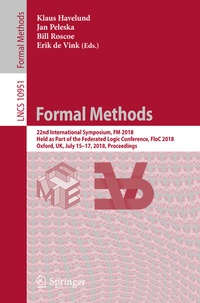
Formal Methods
22nd International Symposium, FM 2018, Held as Part of the Federated Logic Conference, FloC 2018, Oxford, UK, July 15-17, 2018, Proceedings
Published on 11. July 2018
XIV, 692 pages
978-3-319-95582-7 (ISBN)
Description

This book constitutes the refereed proceedings of the 22nd International Symposium on Formal Methods, FM 2018, held in Oxford, UK, in July 2018.
The 44 full papers presented together with 2 invited papers were carefully reviewed and selected from 110 submissions. They present formal methods for developing and evaluating systems. Examples include autonomous systems, robots, and cyber-physical systems in general. The papers cover a broad range of topics in the following areas: interdisciplinary formal methods; formal methods in practice; tools for formal methods; role of formal methods in software systems engineering; and theoretical foundations.
The 44 full papers presented together with 2 invited papers were carefully reviewed and selected from 110 submissions. They present formal methods for developing and evaluating systems. Examples include autonomous systems, robots, and cyber-physical systems in general. The papers cover a broad range of topics in the following areas: interdisciplinary formal methods; formal methods in practice; tools for formal methods; role of formal methods in software systems engineering; and theoretical foundations.
More details
Series
Language
English
Place of publication
Cham
Switzerland
Publishing group
Springer International Publishing
Target group
Professional and scholarly
Product notice
Reflowable
Illustrations
XIV, 692 p. 131 illus.
File size
26,44 MB
ISBN-13
978-3-319-95582-7 (9783319955827)
DOI
10.1007/978-3-319-95582-7
Schweitzer Classification
Other editions
Additional editions
Klaus Havelund | Jan Peleska | Bill Roscoe
Formal Methods
22nd International Symposium, FM 2018, Held as Part of the Federated Logic Conference, FloC 2018, Oxford, UK, July 15-17, 2018, Proceedings
Book
07/2018
Springer
€96.29
Shipment within 10-15 days
Content
- Intro
- Preface
- Organization
- Contents
- Invited Papers
- Processing Text for Privacy: An Information Flow Perspective
- 1 Introduction
- 2 Text Document Processing
- 2.1 Representing Documents for Topic Classification and Author Identification
- 2.2 Privacy Versus Utility
- 3 Channels, Secrets and Information Flow
- 3.1 Vulnerability Induced by Gain-Functions
- 3.2 Privacy Mechanisms as Channels
- 3.3 Attacks on Simple Confusability
- 3.4 Universal Confusability
- 3.5 Differential Privacy
- 3.6 Privacy Versus Utility
- 4 Generalised Differential Privacy and Obfuscation
- 4.1 Experiments
- 5 Conclusions and Future Work
- References
- 20Years of Real Real Time Model Validation
- 1 Introduction
- 2 The Uppaal Tool Suite
- 3 Verification
- 4 Testing
- 5 Planning, Scheduling and Synthesis
- 6 Lessons Learned
- References
- FM 2018 Main Conference
- Deadlock Detection for Actor-Based Coroutines
- 1 Introduction
- 2 The Programming Language
- 3 The Concrete System
- 4 The Abstract System
- 5 Correctness of Predicate Abstraction
- 6 Decidability of Deadlock Detection
- 7 Conclusion
- References
- An Algebraic Approach for Reasoning About Information Flow
- 1 Introduction
- 2 Preliminaries
- 3 Operators on Channel Composition
- 3.1 The Parallel Composition Operator
- 3.2 The Visible Choice Operator p
- 3.3 The Hidden Choice Operator p
- 3.4 A Compositional Description of the Dining Cryptographers
- 4 Algebraic Properties of Channel Operators
- 4.1 Properties Regarding Channel Operators
- 4.2 Properties Regarding Cascading
- 5 Information Leakage of Channel Operators
- 5.1 The Problem of Compositional Vulnerability
- 5.2 The Problem of Relative Monotonicity
- 6 Case Study: The Crowds Protocol
- 7 Related Work
- 8 Conclusions and Future Work
- References
- Towards `Verifying' a Water Treatment System
- 1 Introduction
- 2 Background
- 3 Our Approach
- 3.1 The Model
- 3.2 Learning Algorithm
- 3.3 Verification
- 3.4 Abstraction Refinement
- 3.5 Overall Algorithm
- 4 Case Study Results
- 5 Conclusion and Related Work
- References
- FSM Inference from Long Traces
- 1 Introduction
- 2 Definitions
- 3 Passive Inference
- 3.1 Problem Statement
- 3.2 Encoding as a SAT Problem
- 3.3 Auxiliary Variables
- 3.4 Symmetry Breaking
- 4 Incremental Inference
- 4.1 Prefix-Based Method
- 4.2 Suffix-Based Method
- 4.3 Discussion
- 5 Industrial Case Study
- 6 Conclusion
- References
- A Weakness Measure for GR(1) Formulae
- 1 Introduction
- 2 Related Work
- 3 Preliminaries
- 4 Problem Statement
- 5 Weakness Measure of GR(1) Formulae
- 5.1 Dimension of Invariants
- 5.2 Fairness and Fairness Complements
- 5.3 Dimension Pairs for GR(1) Formulae
- 5.4 Initial Conditions
- 6 Evaluation
- 7 Conclusion
- References
- Producing Explanations for Rich Logics
- 1 Introduction
- 2 The Propositional µ-Calculus
- 3 A µ-Calculus-Based Framework for Rich Explanations
- 3.1 Translation of ATL Models and Formulas to µ-calculus
- 3.2 µ-Calculus Explanations
- 3.3 Translating µ-Calculus Explanations
- 4 Implementation
- 5 Application to ATL
- 6 Related Work
- 7 Conclusion
- References
- The Compound Interest in Relaxing Punctuality
- 1 Introduction
- 2 Preliminaries
- 3 Metric Interval Regular Expressions
- 4 From MIRE to Deterministic Timed Automata
- 5 Metric Interval Dynamic Logic
- 6 From MIDL to Nondeterministic Timed Automata
- 7 Discussion
- References
- IPL: An Integration Property Language for Multi-model Cyber-physical Systems
- 1 Introduction
- 2 Motivating Integration Case
- 3 Related Work
- 4 Integration Property Language: Design
- 5 Integration Property Language: Details
- 5.1 Concepts and Preliminaries
- 5.2 Syntax
- 5.3 Semantics
- 5.4 Verification Algorithm
- 6 Evaluation
- 6.1 Case Study: Adaptive Mobile Robot
- 7 Discussion
- References
- Timed Epistemic Knowledge Bases for Social Networks
- 1 Introduction
- 2 A Timed Knowledge Based Logic
- 2.1 Syntax
- 2.2 Semantics
- 2.3 Model Checking KBLRT
- 2.4 Properties of the Framework
- 3 Writing Privacy Policies
- 4 Related Work and Concluding Remarks
- References
- Optimal and Robust Controller Synthesis
- 1 Introduction
- 2 Energy Timed Automata
- 3 Energy Timed Automata with Uncertainties
- 4 Case Study
- 5 Conclusion
- References
- Encoding Fairness in a Synchronous Concurrent Program Algebra
- 1 Introduction
- 2 Synchronous Concurrent Refinement Algebra
- 3 Properties of Iterations
- 4 Properties of fair
- 5 Properties of Fair and Concurrency
- 6 Properties of Fair Parallel
- 7 Conclusions
- References
- A Wide-Spectrum Language for Verification of Programs on Weak Memory Models
- 1 Introduction
- 2 Instruction Reordering in Weak Memory Models
- 2.1 Thread-Local Reorderings
- 2.2 Reordering and Forwarding Instructions
- 2.3 General Operational Rules for Reordering
- 2.4 Reasoning About Reorderings
- 3 Semantics
- 3.1 Formal Language
- 3.2 Operational Semantics
- 3.3 Reordering and Forwarding for ARM and POWER
- 4 Model Checking Concurrent Data Structures
- 4.1 Chase-Lev Deque
- 5 Related Work
- 6 Conclusion
- References
- Operational Semantics of a Weak Memory Model with Channel Synchronization
- 1 Introduction
- 2 Background
- 3 Abstract Syntax
- 4 Operational Semantics
- 4.1 Local States, Events, and Configurations
- 4.2 Reduction Steps
- 5 Strong Semantics
- 6 Relating the Strong and the Weak Semantics
- 6.1 The Strong Semantics Conditionally Simulates the Weak One
- 7 Related Work
- 8 Conclusion
- References
- Stepwise Development and Model Checking of a Distributed Interlocking System - Using RAISE
- 1 Introduction
- 1.1 Background
- 1.2 Contribution
- 1.3 Related Work
- 1.4 Paper Overview
- 2 Case Study
- 2.1 Engineering Concept
- 2.2 Overview of Formal Development
- 3 First Model
- 4 Second Model
- 5 Third Model
- 6 Verification
- 6.1 Model Checking
- 6.2 Other Verification Activities
- 7 Conclusion and Future Work
- References
- Resource-Aware Design for Reliable Autonomous Applications with Multiple Periods
- 1 Introduction
- 2 Related Work
- 3 The Motivating Example
- 4 Preliminaries
- 4.1 Atypical Task Graph
- 4.2 Communication Model
- 4.3 Active Redundancy Based Fault Tolerance
- 5 Reliable and Resource-Aware Design
- 5.1 Redundancy Optimization
- 5.2 Constraint Formalization and Resource Optimization
- 5.3 Implementation
- 6 Case Study
- 6.1 Redundancy Degree for Various Reliability Requirements
- 6.2 Resource Optimization Within Various Scenarios
- 6.3 Timing Constraint on Weak Dependency
- 7 Conclusion
- References
- Verifying Auto-generated C Code from Simulink
- 1 Introduction
- 2 The Case Studies
- 3 The BTC Tool
- 3.1 The BTC EmbeddedPlatform
- 4 Experience Report
- 4.1 Formalizing the Requirements
- 4.2 Formal Verification of Auto-generated Code
- 5 Reflections and Recommendations
- 5.1 Requirements
- 5.2 Code Verification
- 6 Conclusion
- References
- QFLan: A Tool for the Quantitative Analysis of Highly Reconfigurable Systems
- 1 Introduction
- 2 QFLan Architecture
- 3 QFLan at Work: Coffee Vending Machine
- 4 Outlook
- References
- Modular Verification of Programs with Effects and Effect Handlers in Coq
- 1 Introduction
- 2 Modelling Programs with Effects
- 2.1 Interface of Effects
- 2.2 Operational Semantics for Effects
- 2.3 The Program Monad
- 2.4 Components as Programs with Effects
- 3 Modular Verification of Programs with Effects
- 3.1 Definition
- 3.2 Compliance and Correctness
- 3.3 Proofs Techniques to Show Compliance for Components
- 4 Discussion
- 4.1 FreeSpec as a Methodology
- 4.2 FreeSpec as a Framework
- 5 Related Work
- 6 Conclusion and Future Work
- References
- Combining Tools for Optimization and Analysis of Floating-Point Computations
- 1 Introduction
- 2 Implementation
- 3 Experimental Results
- 4 Discussion
- References
- A Formally Verified Floating-Point Implementation of the Compact Position Reporting Algorithm
- 1 Introduction
- 2 The Compact Position Reporting Algorithm
- 2.1 Encoding
- 2.2 Local Decoding
- 2.3 Global Decoding
- 3 An Alternative Implementation of CPR
- 3.1 Alternative Encoding
- 3.2 Alternative Local Decoding
- 3.3 Alternative Global Decoding
- 4 Verification Approach
- 5 Related Work
- 6 Conclusion
- References
- Formal Verification of Automotive Simulink Controller Models: Empirical Technical Challenges, Evaluation and Recommendations
- 1 Introduction
- 2 The Case Study
- 2.1 Controller Model
- 2.2 Simulink Design Verifier
- 2.3 Goals
- 3 Feasibility Analysis
- 3.1 Preparation
- 3.2 Verification
- 3.3 Scalability
- 4 Lessons Learned
- 4.1 Specification
- 4.2 Model
- 4.3 Verification Tool
- 5 Conclusions and Discussion
- References
- Multi-robot LTL Planning Under Uncertainty
- 1 Introduction
- 2 Running Example
- 3 Modeling Partial Knowledge in a Robotic Application
- 4 Planning with Partial Knowledge
- 5 Algorithms
- 6 Evaluation
- 7 Related Work
- 8 Conclusions
- References
- Vector Barrier Certificates and Comparison Systems
- 1 Introduction
- 2 Fundamental Definitions
- 2.1 Systems of Ordinary Differential Equations
- 2.2 Safety Verification and Direct Methods
- 3 Barrier Certificates
- 3.1 Comparison System-Based Barrier Certificates
- 3.2 Comparison Systems
- 3.3 Comparison Principle Interpretation of Barrier Certificates
- 3.4 Invariant Set-Based Barrier Certificates
- 4 From Scalar to Vector Comparison Systems
- 4.1 Vector Lyapunov Functions
- 4.2 Vector Comparison Principle
- 4.3 Safety with Vector Barrier Certificates
- 4.4 Generating Vector Barrier Certificates Using SDP
- 5 Limitations and Outlook
- 6 Related Work
- 7 Conclusion
- References
- Timed Vacuity
- 1 Introduction
- 2 Preliminaries
- 2.1 TCTL, Timed Automata, and Timed Transition Systems
- 2.2 Timed Vacuity
- 3 TCTL+ and Its Model Checking
- 4 Satisfying a TCTL Formula Timed Vacuously
- 4.1 Complexity Results
- 4.2 Algorithms for Tightening TCTL Formulas
- 5 Ranking Vacuity Results
- 6 Conclusions
- References
- Falsification of Cyber-Physical Systems Using Deep Reinforcement Learning
- 1 Introduction
- 2 Preliminary
- 3 Our Approach
- 3.1 Overview of Our Algorithm
- 3.2 Reward Definition for Life-Long Property Falsification
- 4 Preliminary Results
- 5 Conclusion and Future Work
- References
- Dynamic Symbolic Verification of MPI Programs
- 1 Introduction
- 2 Overview
- 3 MPI Model and Execution Semantics
- 4 Encoding Rules
- 5 Design
- 5.1 Components
- 5.2 Deadlock Detection
- 5.3 Correctness and Termination
- 6 Implementation
- 6.1 Non-chronological Backtracking
- 6.2 Terminated Interleavings
- 7 Evaluation
- 8 Related Work
- 9 Conclusion and Future Work
- References
- To Compose, or Not to Compose, That Is the Question: An Analysis of Compositional State Space Generation
- 1 Introduction
- 2 Related Work
- 3 Background
- 4 Methodology
- 5 Results
- 5.1 Case and Subject Descriptions
- 5.2 Analysis
- 5.3 Threats to Validity
- 6 Conclusions
- References
- View Abstraction for Systems with Component Identities
- 1 Introduction
- 1.1 Related Work
- 2 The Framework
- 2.1 Systems
- 3 Using View Abstraction
- 4 Bounding the Number of Components
- 5 Using Symmetry
- 6 The Algorithm and Implementation
- 6.1 Prototype Implementation
- 7 Analysing Reference-Linked Data Structures
- 8 Conclusions
- References
- Compositional Reasoning for Shared-Variable Concurrent Programs
- 1 Introduction
- 2 Related Work
- 3 Succinct Automata
- 3.1 Syntax and Semantics
- 3.2 Parallel Composition
- 4 Compositional Reasoning for Succinct Automata
- 4.1 Safety Verification of Succinct Automata
- 4.2 Simulations of Succinct Automata
- 4.3 Safety Property Preservation Under Refinement
- 5 Automatic Verification of Succinct Automata
- 5.1 Generation of Succinct Automata
- 5.2 Refinement Checking Between Succinct Automata
- 6 Conclusions and Future Work
- References
- Statistical Model Checking of LLVM Code
- 1 Introduction
- 2 Lodin
- 3 Plasma-Lab
- 4 Conclusion
- References
- SDN-Actors: Modeling and Verification of SDN Programs
- 1 Introduction
- 2 Overview
- 2.1 Concurrency Errors in SDN Networks
- 2.2 Actor-Based Modeling of SDN Networks
- 3 SDN-Actors: An Actor Based Encoding of SDN Programs
- 3.1 Network Topology
- 3.2 The Switch and Host Classes
- 3.3 The Controller
- 3.4 Barriers
- 4 DPOR-Based Model Checking of SDN-Actors
- 4.1 DPOR-Based Model Checking in Actors
- 4.2 Entry-Level and Context-Sensitive Independence
- 4.3 Comparison of DPOR Reductions with Related Work
- 5 Checking SDN Properties in Case Studies
- 6 Conclusions and Related Work
- References
- CompoSAT: Specification-Guided Coverage for Model Finding
- 1 Introduction
- 2 Motivation and Example
- 3 Adapting Coverage to Model Finding
- 4 Foundations
- 4.1 Bounded Model Finding
- 4.2 Local Necessity and Provenance
- 5 Algorithmics of Coverage
- 5.1 Expansion
- 5.2 Canonicalization
- 5.3 Coverage and Subsumption
- 6 Implementation
- 7 Qualitative Use Case: Overconstraint
- 7.1 Detecting Overconstraint via Local Necessity
- 7.2 Highlighting Uncovered Constraints
- 8 Evaluation
- 8.1 Experimental Setup
- 8.2 RQ1: Do Small Ensembles Suffice?
- 8.3 RQ2: Is Enumeration Effective?
- 8.4 RQ3: Minimal Model Coverage
- 9 Related Work
- 10 Conclusion and Discussion
- References
- Approximate Partial Order Reduction
- 1 Introduction
- 2 Preliminaries
- 2.1 Transition Systems
- 2.2 Discrepancy Functions
- 2.3 Combining Sets of Discrepancy Functions
- 3 Independent Actions and Neighboring Executions
- 3.1 Approximately Independent Actions
- 3.2 (,)-trace Equivalent Discrepancy for Action Pairs
- 4 Effect of -independent Traces
- 4.1 -equivalent Traces
- 4.2 (0,)-trace Equivalent Discrepancy for Traces (on the Same Initial States)
- 4.3 (,)-trace Equivalent Discrepancy for Traces
- 5 Reachability with Approximate Partial Order Reduction
- 5.1 Earliest Equivalent Position of an Action in a Trace
- 5.2 Reachability Using (,)-trace Equivalent Discrepancy
- 6 Experimental Evaluation of Effectiveness
- 7 Conclusion
- References
- A Lightweight Deadlock Analysis for Programs with Threads and Reentrant Locks
- 1 Introduction
- 2 Lams and the Algorithm for Detecting Circularities
- 3 The Language and Its Semantics
- 4 Static Semantics
- 5 Remarks About the Analysis Technique
- 6 Related Works and Conclusions
- References
- Formal Specification and Verification of Dynamic Parametrized Architectures
- 1 Introduction
- 2 Related Work
- 3 An Example of a Dynamic Parametrized Architecture
- 4 Formal Specification of Dynamic Parametrized Architectures
- 4.1 Definitions
- 4.2 Logic for Systems of Parameters
- 5 Analysis with SMT-Based Model Checking
- 5.1 Background Notions on SMT-Based Model Checking
- 5.2 Encoding into SMT-Based Model Checking
- 6 Experimental Evaluation
- 6.1 Setup
- 6.2 Benchmarks and Results
- 7 Conclusions and Future Work
- References
- FM 2018 Industry Day
- From Formal Requirements to Highly Assured Software for Unmanned Aircraft Systems
- 1 Introduction
- 2 UAS Detect and Avoid
- 3 From DAIDALUS to ICAROUS
- 4 Conclusion
- References
- Interlocking Design Automation Using Prover Trident
- Abstract
- 1 Background
- 2 The Prover Trident Process
- 2.1 PiSPEC IP
- 2.2 Prover iLock
- 2.3 Prover Certifier
- 3 Results and Conclusions
- References
- Model-Based Testing for Avionics Systems
- 1 Introduction
- 2 Core Challenges
- 2.1 Application Parameters
- 2.2 Interface Modules
- 2.3 Test Scenarios
- 3 Conclusion
- References
- On Software Safety, Security, and Abstract Interpretation
- 1 Introduction
- 2 Security in Safety-Critical Systems
- 3 Proving the Absence of Defects
- 4 Conclusion
- References
- Variant Analysis with QL
- 1 Introduction
- 2 QL for Ad-hoc Variant Analysis
- 3 Variant Analysis from Building Blocks
- 4 Conclusion
- References
- Object-Oriented Security Proofs
- 1 Security as Object Equivalence
- 2 Reasoning About Object Equivalence
- 3 Some Specification Examples
- 4 Conclusion
- Z3 and SMT in Industrial R&D
- 1 Introduction
- 2 Driving Scenarios and Research Synergy
- 3 SMT-LIB - A Research Community
- 4 Tooling and Infrastructure
- 4.1 Development
- 4.2 Open Sourcing
- 5 Push, Pull and Confluences
- References
- Evidential and Continuous Integration of Software Verification Tools
- 1 Introduction
- 2 Verification Activities, Workflows and Patterns
- 3 Structure of the Integration Framework
- 4 Illustration
- 5 Conclusion
- References
- Disruptive Innovations for the Development and the Deployment of Fault-Free Software
- 1 Introduction
- 2 Software Modeling
- 3 Low Cost High Integrity Platform
- 4 Formal Data Validation
- 5 Conclusion and Perspectives
- References
- Author Index
