

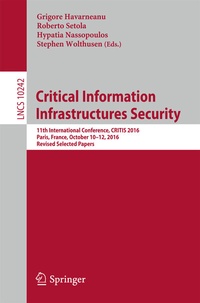
Critical Information Infrastructures Security
11th International Conference, CRITIS 2016, Paris, France, October 10-12, 2016, Revised Selected Papers
Published on 21. November 2017
XI, 348 pages
978-3-319-71368-7 (ISBN)
Description

This book constitutes the post-conference proceedings of the 11th International Conference on Critical Information Infrastructures Security, CRITIS 2016, held in Paris, France, in October 2016.
The 22 full papers and 8 short papers presented were carefully reviewed and selected from 58 submissions. They present the most recent innovations, trends, results, experiences and concerns in selected perspectives of critical information infrastructure protection covering the range from small-scale cyber-physical systems security via information infrastructures and their interaction with national and international infrastructures.
More details
Series
Edition
1st ed. 2017
Language
English
Place of publication
Cham
Switzerland
Publishing group
Springer International Publishing
Product notice
Reflowable
Illustrations
XI, 348 p. 103 illus.
File size
29,06 MB
ISBN-13
978-3-319-71368-7 (9783319713687)
DOI
10.1007/978-3-319-71368-7
Schweitzer Classification
Other editions
Additional editions
Grigore Havarneanu | Roberto Setola | Hypatia Nassopoulos
Critical Information Infrastructures Security
11th International Conference, CRITIS 2016, Paris, France, October 10-12, 2016, Revised Selected Papers
Book
11/2017
Springer
€53.49
Shipment within 10-15 days
Content
- Intro
- Preface
- Organization
- Contents
- Stealth Low-Level Manipulation of Programmable Logic Controllers I/O by Pin Control Exploitation
- 1 Introduction
- 2 Background
- 2.1 Pin Control Subsystem
- 2.2 How PLCs Control the Pins
- 3 Pin Control Attack
- 3.1 Security Concerns Regarding Pin Control
- 3.2 Pin Control Attack Details
- 3.3 Threat Model
- 4 A Pin Control Attack in Practice
- 4.1 Environment Setup
- 4.2 Attack Implementation
- 5 Discussion
- 5.1 Implications of Attack on the ICS
- 5.2 Detection of Pin Control Attack
- 6 Related Work
- 7 Conclusion
- References
- Developing a Cyber Incident Communication Management Exercise for CI Stakeholders
- 1 Introduction
- 1.1 Background
- 1.2 Case Study: Red Team - Blue Team Exercise
- 2 Communication Management Exercise for ICS Security (CME-ICS)
- 2.1 Peculiarity of Existing Japanese CIP Training
- 2.2 Discussion-Based Exercise
- 2.3 Theme of the Exercise: Communication Management
- 2.4 Scenario
- 2.5 Exercise Steps
- 2.6 Administration Staff
- 2.7 Pilot Exercises
- 3 Results and Discussion
- 3.1 Variation of Incident Management Structure
- 3.2 Results of the Survey
- 3.3 Discussion
- 3.4 Future Work: ``ICS-SIRT'' Exercise
- References
- On Auxiliary Entity Allocation Problem in Multi-layered Interdependent Critical Infrastructures
- 1 Introduction
- 2 Problem Formulation Using the Implicative Interdependency Model
- 3 Computational Complexity Analysis
- 3.1 Special Case: Problem Instance with One Minterm of Size One
- 3.2 General Case: Problem Instance with an Arbitrary Number of Minterms of Arbitrary Size
- 4 Solutions to the AEAP Problem
- 4.1 Optimal Solution to AEAP Problem
- 4.2 Heuristic Solution to the AEAP Problem
- 5 Experimental Results
- 6 Conclusion
- References
- Cyber Targets Water Management
- 1 Introduction
- 1.1 Use of Industrial Control Systems
- 1.2 Cyber Threats and Risk
- 1.3 Structure of This Paper
- 2 Related Work
- 3 A Benchmark of the Resilience of the ICS Environment
- 4 Observed ICS Security Dilemmas
- 5 Cyber Security Simulator for Water Management Control Systems
- 5.1 Deployment of Attack Scenarios
- 5.2 DESI Results
- 6 Conclusions and Future Work
- 6.1 Future Work
- References
- Integrated Safety and Security Risk Assessment Methods: A Survey of Key Characteristics and Applications
- 1 Introduction
- 2 Related Work
- 3 Review Methodology
- 4 Integrated Safety and Security Risk Assessment Methods
- 4.1 SAHARA Method
- 4.2 CHASSIS Method
- 4.3 FACT Graph Method
- 4.4 FMVEA Method
- 4.5 Unified Security and Safety Risk Assessment Method
- 4.6 Extended CFT Method
- 4.7 EFT Method
- 5 Analysis of Integrated Safety and Security Risk Assessment Methods
- 6 Conclusions and Future Work
- References
- Railway Station Surveillance System Design: A Real Application of an Optimal Coverage Approach
- Abstract
- 1 Introduction
- 2 Railway Station Surveillance and Sensor Placement Problem
- 3 Application of the Optimal Coverage Approach to a Real Case
- 3.1 Area of Interest and Input Data
- 3.2 Coverage Analysis and Coverage Matrix
- 3.3 Modeling of the Coverage Problem and Solution of the Model
- 4 Experimental Results
- 4.1 Set Covering Model
- 4.2 Maximal Covering Model
- 5 Conclusions
- References
- A Synthesis of Optimization Approaches for Tackling Critical Information Infrastructure Survivability
- Abstract
- 1 Introduction
- 2 Identifying Critical Network Components: Survivability-Oriented Interdiction Models
- 3 Enhancing Critical Network Survivability: Resource Allocation Strategy Models
- 3.1 Optimization Models for Protecting CII Physical Components
- 3.2 Optimization Models for CII Service Restoration
- 4 Planning Survivable Networks: Design Models
- 5 Future Research Suggestions
- 6 Conclusions
- References
- A Dataset to Support Research in the Design of Secure Water Treatment Systems
- 1 Introduction
- 2 Secure Water Treatment (SWaT)
- 2.1 Water Treatment Process
- 2.2 Communications
- 3 Attack Scenarios
- 4 Data Collection Process
- 4.1 Physical Properties
- 4.2 Network Traffic
- 4.3 Labelling Data
- 5 Conclusion
- References
- Human Vulnerability Mapping Facing Critical Service Disruptions for Crisis Managers
- Abstract
- 1 Introduction
- 2 Consequence Assessment
- 3 Modelling People Mobility
- 4 Results and Interests of Mapping Human Vulnerability
- 5 Improving Human Vulnerability Assessment
- 6 Conclusion
- Acknowledgments
- References
- A Methodology for Monitoring and Control Network Design
- 1 Introduction
- 2 Related Work
- 3 Asset Risk Assessment in ICS
- 3.1 Overview of the CAIA Approach
- 3.2 Risk Assessment Based on the Impact Measures
- 4 Optimal Control Network Design
- 5 Experimental Results
- 5.1 Results on the TEP
- 5.2 Results on the IEEE 14-Bus Electricity Grid
- 5.3 Results on the IEEE 300-Bus Electricity Grid Model
- 6 Conclusions
- References
- Effective Defence Against Zero-Day Exploits Using Bayesian Networks
- 1 Introduction
- 2 Modelling and Problem Representation
- 3 Case Study and Results
- 3.1 Case Study Settings
- 3.2 Results -- Deploying a Single Control
- 3.3 Results -- Deploying Combined Controls
- 4 Related Work
- 5 Conclusion and Future Work
- References
- Power Auctioning in Resource Constrained Micro-grids: Cases of Cheating
- 1 Introduction
- 2 Related Work
- 3 Decentralised Continuous Double Auction Model
- 4 Cheating CDA Attacks
- 4.1 Case 1: Victim Strategy Downgrade
- 4.2 Case 2: Collusion Attack
- 5 Sketch Countermeasures
- 6 Conclusions
- References
- Using Incentives to Foster Security Information Sharing and Cooperation: A General Theory and Application to Critical Infrastructure Protection
- 1 Introduction
- 2 Theoretical Framework and Propositions
- 2.1 Regulation Alone Cannot Solve the Free Rider Problem
- 2.2 Linking Incentives to Voluntary SIS
- 2.3 A Holistic and Multidisciplinary Approach
- 2.4 A Model Linking Incentives, Behavior, and SIS
- 2.5 Reciprocity Expectation
- 2.6 Value Expectation
- 2.7 Institutional Expectation
- 2.8 Reputation Expectation
- 2.9 The Moderating Role of Trust
- 3 Application of the Proposed Model to Critical Infrastructure Protection
- 3.1 The Swiss Reporting and Analysis Centre for Information Security
- 3.2 Reciprocity Expectation
- 3.3 Value Expectation
- 3.4 Institutional Expectation
- 3.5 Reputation Expectation
- 3.6 The Moderating Role of Trust
- 4 Discussion
- 5 Concluding Comments and Next Steps
- References
- Dynamic Risk Analyses and Dependency-Aware Root Cause Model for Critical Infrastructures
- 1 Introduction
- 2 Terminology
- 3 Risk Assessments Using the Dependency-Aware Root Cause (DARC) Model
- 4 Risk Taxonomy for Critical Infrastructures
- 4.1 Dependency Definition Language
- 4.2 Generating the Dependency Graph
- 5 The `Smart Grid Luxembourg' Use-Case
- 5.1 Compiling a Dependency-Aware Inventory
- 5.2 Threat Model
- 5.3 Generation of the Dependency Graph
- 5.4 Results
- 6 Conclusion and Future Work
- References
- Selecting Privacy Solutions to Prioritise Control in Smart Metering Systems
- 1 Introduction
- 2 Privacy and Automation Properties
- 3 Selecting Techniques: Analysis and Discussion
- 3.1 Analysis of Privacy Techniques
- 3.2 Discussion: Privacy vs. Control
- 4 Conclusions and Future Work
- References
- A Six-Step Model for Safety and Security Analysis of Cyber-Physical Systems
- 1 Introduction
- 2 Preliminaries and Background
- 2.1 CPS Safety and Security
- 2.2 GTST-MLD and the 3-Step Model
- 2.3 The SWaT System
- 3 Complex System Safety and Security Modeling: SSM
- 4 Summary and Conclusion
- References
- Availability Study of the Italian Electricity SCADA System in the Cloud
- 1 Introduction
- 1.1 The Hierarchical SCADA System
- 1.2 Cloud Deployments for a Nationwide SCADA System
- 2 Availability Computation in a Hierarchical SCADA Network
- 2.1 Availability Model for an Optical Network
- 2.2 Availability Computation
- 3 Availability Assessment in the SCADA System Managing the Italian Electricity Grid
- 4 Conclusion
- References
- Railway System Failure Scenario Analysis
- 1 Introduction
- 2 Failure Scenario Analysis: From Power Grid to Railway
- 2.1 NESCOR Failure Scenarios for the Energy Sector
- 2.2 Toward Railway Transportation Failure Scenarios
- 3 Sample Railway System Failure Scenarios
- 3.1 Compromised HMI Sends Malicious Commands to Devices
- 3.2 SCADA Firewall Fails and Critical Traffic Cannot Reach Devices
- 4 Analyzing Scenarios for a Railway System
- 4.1 Failure Scenario Analysis Tool
- 4.2 Case Study: Deploying SCADA Firewalls
- 4.3 Discussion
- 5 Related Work
- 6 Conclusion
- References
- Tamper Resistant Secure Digital Silo for Log Storage in Critical Infrastructures
- 1 Introduction
- 1.1 Contribution
- 1.2 Organization
- 2 Motivation
- 3 Background
- 3.1 Intel Software Guard Extensions (SGX)
- 3.2 Trusted Platform Module (TPM)
- 3.3 Enterprise Cryptographic Filesystem (eCryptfs)
- 3.4 Secure Block Device (SBD)
- 4 Design
- 5 Implementation and Evaluation
- 6 Conclusions and Future Work
- References
- Access Control and Availability Vulnerabilities in the ISO/IEC 61850 Substation Automation Protocol
- 1 Introduction
- 2 Related Work
- 3 Attack Taxonomy
- 3.1 An Attack on Access Control: Credential Intercept Attack
- 3.2 An Attack on Availability: Generic Workflow Event Amplification Attack
- 4 Conclusion
- References
- A Case Study Assessing the Effects of Cyber Attacks on a River Zonal Dispatcher
- 1 Introduction
- 2 Related Work
- 3 Background
- 4 Methodology
- 4.1 Attacks
- 4.2 Response
- 5 Experiment
- 6 Results and Analysis
- 6.1 Control of Device
- 6.2 Control of Router
- 6.3 Control of System via Backdoor Infection
- 7 Conclusion
- References
- Reliable Key Distribution in Smart Micro-Grids
- 1 Introduction
- 2 Related Work
- 3 Attack Model
- 4 Key Management Scheme
- 4.1 Smart Micro-Grid Architecture
- 4.2 Key Management
- 5 Complexity Analysis
- 6 Conclusions
- References
- Security Validation for Data Diode with Reverse Channel
- 1 Introduction
- 2 Background: Data Transfer Reliability of Data Diodes
- 3 Traffic One-Way System: Physical Unidirectional Data Transfer System with Reverse Channel
- 3.1 System Overview
- 3.2 Prototype Implementation
- 4 Security Testing of TOS
- 4.1 Attack Assumption
- 4.2 Validation Requirements
- 4.3 Unit Testing
- 4.4 Integration Testing
- 4.5 System Test
- 5 Applications
- 5.1 Field Experiment: Safe Usages of USB Memory Stick
- 5.2 Suggestion
- 6 Conclusion
- References
- Towards a Cybersecurity Game: Operation Digital Chameleon
- Abstract
- 1 Introduction
- 2 Method
- 3 The Game Design of "Operation Digital Chameleon"
- 3.1 The Target Group
- 3.2 The Board and the Teams
- 3.3 The Rules and the Game
- 3.4 The Debriefing
- 4 Results of "Operation Digital Chameleons" First Four Games
- 4.1 The Gaming Experience
- 4.2 Attack Vectors - The Attack Strategies
- 4.3 IT-Security Measures - the Defense Strategies
- 4.4 Learnings, Insights and Planned Behavioral Changes
- 5 Limitations, Discussion and Conclusion
- Acknowledgments
- References
- Cyber Security Investment in the Context of Disruptive Technologies: Extension of the Gordon-Loeb Model and Application to Critical Infrastructure Protection
- 1 Introduction
- 2 Extending the GL Model
- 3 Application to CIP
- 4 Concluding Comments
- References
- Behavioral Intentions and Threat Perception During Terrorist, Fire and Earthquake Scenarios
- Abstract
- 1 Introduction
- 2 Method
- 3 Results
- 4 Discussion
- Acknowledgment
- References
- An Operator-Driven Approach for Modeling Interdependencies in Critical Infrastructures Based on Crit ...
- Abstract
- 1 Introduction
- 2 Early Warning and Incident Response System for Operators
- 3 Identification of Critical Sector and Services
- 4 Interdependency Modeling
- 4.1 Background and Related Work
- 4.2 Model Structure Overview
- 5 System Dynamics Implementation
- 5.1 Disruption Characterization
- 5.2 Single Critical Infrastructure Dynamics
- 5.3 Interdependencies Assessment
- 6 Scenario Example
- 7 Discussion and Concluding Remarks
- Acknowledgments
- References
- Domain Specific Stateful Filtering with Worst-Case Bandwidth
- 1 Introduction
- 2 Classical Stateful Filtering
- 3 Towards SCADA Specific Filtering
- 4 Use-Case Example: An Electrical Disconnector
- 5 Conclusion
- References
- Securing SCADA Critical Network Against Internal and External Threats
- Abstract
- 1 Introduction
- 2 Related Work
- 2.1 Protecting Against Internal Threats
- 2.2 Protecting Against External Threats
- 2.3 Self-healing Technique
- 3 Proposed Secure SCADA Network Against Internal and External Threats
- 3.1 Proposed Intelligent Firewall to Secure Against External Threats
- 3.2 Proposed Approach to Secure Against Internal Threats
- 3.3 Advantages
- 4 Concluding and Future Works
- References
- Simulation of Cascading Outages in (Inter)-Dependent Services and Estimate of Their Societal Consequences
- 1 Introduction
- 2 RecSIM Model
- 3 Consequence Analysis
- 3.1 Service Continuity Index
- 3.2 Service Access Wealth Metric
- 4 Conclusions
- References
- Erratum to: Human Vulnerability Mapping Facing Critical Service Disruptions for Crisis Managers
- Erratum to: Chapter "Human Vulnerability Mapping Facing Critical Service Disruptions for Crisis Managers" in: G. Havarneanu et al. (Eds.): Critical Information Infrastructures Security, LNCS 10242, https://doi.org/10.1007/978-3-319-71368-7_9
- Author Index
