

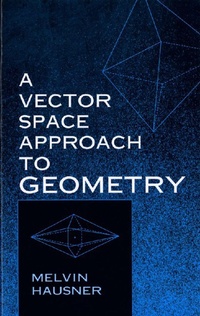
A Vector Space Approach to Geometry
Description

The effects of geometry and linear algebra on each other receive close attention in this examination of geometry's correlation with other branches of math and science. In-depth discussions include a review of systematic geometric motivations in vector space theory and matrix theory; the use of the center of mass in geometry, with an introduction to barycentric coordinates; axiomatic development of determinants in a chapter dealing with area and volume; and a careful consideration of the particle problem. 1965 edition.
More details
Other editions
Additional editions
Person
Content
1. The Center of Mass
1.1 Introduction
1.2 Some Physical Assumptions and Conventions
1.3 Physical Motivations in Geometry
1.4 Further Physical Motivations
1.5 An Axiomatic characterization of Center of Mass
1.6 An Algebraic Attack on Geometry
1.7 Painting a Triangle
1.8 Barycentric Coordinates
1.9 Some Algebraic Anticipation
1.10 Affine Geometry
2. Vector Algebra
2.1 Introduction
2.2 The Definition of Vector
2.3 Vector Addition
2.4 Scalar Multiplication
2.5 Physical and Other Applications
2.6 Geometric Applications
2.7 A Vector Approach to the Center of Mass
3. Vector Spaces and Subspaces
3.1 Introduction
3.2 Vector Spaces
3.3 Independence and Dimension
3.4 Some Examples of Vector Spaces: Coordinate Geometry
3.5 Further Examples
3.6 Affine Subspaces
3.7 Some Separation Theorems
3.8 Some Collinearity and Concurrence Theorems
3.9 The Invariance of Dimension
4. Length and Angle
4.1 Introduction
4.2 Geometric Definition of the Inner Product
4.3 Proofs Involving the Inner Product
4.4 The Metrix Axioms
4.5 Some Analytic Geometry
4.6 Orthogonal Subspaces
4.7 Skew Coordinates
5. Miscellaneous Applications
5.1 Introduction
5.2 The Method of Orthogonal Projections
5.3 Linear Equations: Three Views
5.4 A Useful Formula
5.5 Motion
5.6 A Minimum Principle
5.7 Function Spaces
6. Area and Volume
6.1 Introduction
6.2 Area in the Plane: An Axiom System
6.3 Area in the Plane: A Vector Formulation
6.4 Area of Polygons
6.5 Further Examples
6.6 Volumes in 3-Space
6.7 Area Equals Base Times Height
6.8 The Vector Product
6.9 Vector Areas
7. Further Generalizations
7.1 Introduction
7.2 Determinants
7.3 Some Theorems on Determinants
7.4 Even and Odd Permutations
7.5 Outer Products in n-Space
7.6 Some Topology
7.7 Areas of Curved Figures
8. Matrices and Linear Transformations
8.1 Introduction
8.2 Some Examples
8.3 Affine and Linear Transformations
8.4 The Matrix of a Linear Transformation
8.5 The Matrix of an Affine Transformation
8.6 Translations and Dilatations
8.7 The Reduction of an Affine Transformation to a Linear One
8.8 A Fixed Point Theorem with Probabilistic Implications
9. Area and Metric Considerations
9.1 Introduction
9.2 Determinants
9.3 Applications to Analytic Geometry
9.4 Orthogonal and Euclidean Transformations
9.5 Classification of Motions of the Plane
9.6 Classification of Motions of 3-Space
10. The Algebra of Matrices
10.1 Introduction
10.2 Multiplication of Matrices
10.3 Inverses
10.4 The Algebra of Matrices
10.5 Eigenvalues and Eigenvectors
10.6 Some Applications
10.7 Projections and Reflections
11. Groups
11.1 Introduction
11.2 Definitions and Examples
11.3 The "Erlangen Program"
11.4 Symmetry
11.5 Physical Applications of Symmetry
11.6 Abstract Groups
Index
