

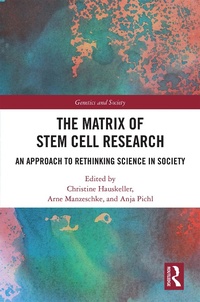
The Matrix of Stem Cell Research
An Approach to Rethinking Science in Society
1st Edition
Published on 25. July 2019
232 pages
978-1-351-59793-7 (ISBN)
Description

Stem cell research has been a problematic endeavour. For the past twenty years it has attracted moral controversies in both the public and the professional sphere. The research involves not only laboratories, clinics and people, but ethics, industries, jurisprudence, and markets. Today it contributes to the development of new therapies and affects increasingly many social arenas. The matrix approach introduced in this book offers a new understanding of this science in its relation to society. The contributions are multidisciplinary and intersectional, illustrating how agency and influence between science and society go both ways.
Conceptually, this volume presents a situated and reflexive approach for philosophy and sociology of the life sciences. The practices that are part of stem cell research are dispersed, and the concepts that tie them together are tenuous; there are persistent problems with the validation of findings, and the ontology of the stem cell is elusive. The array of applications shapes a growing bioeconomy that is dependent on patient donations of tissues and embryos, consumers, and industrial support. In this volume it is argued that this research now denotes not a specific field but a flexible web of intersecting practices, discourses, and agencies. To capture significant parts of this complex reality, this book presents recent findings from researchers, who have studied in-depth aspects of this matrix of stem cell research.
This volume presents state-of-the-art examinations from senior and junior scholars in disciplines from humanities and laboratory research to various social sciences, highlighting particular normative and epistemological intersections. The book will appeal to scholars as well as wider audiences interested in developments in life science and society interactions. The novel matrix approach and the accessible case studies make this an excellent resource for science and society courses.
Conceptually, this volume presents a situated and reflexive approach for philosophy and sociology of the life sciences. The practices that are part of stem cell research are dispersed, and the concepts that tie them together are tenuous; there are persistent problems with the validation of findings, and the ontology of the stem cell is elusive. The array of applications shapes a growing bioeconomy that is dependent on patient donations of tissues and embryos, consumers, and industrial support. In this volume it is argued that this research now denotes not a specific field but a flexible web of intersecting practices, discourses, and agencies. To capture significant parts of this complex reality, this book presents recent findings from researchers, who have studied in-depth aspects of this matrix of stem cell research.
This volume presents state-of-the-art examinations from senior and junior scholars in disciplines from humanities and laboratory research to various social sciences, highlighting particular normative and epistemological intersections. The book will appeal to scholars as well as wider audiences interested in developments in life science and society interactions. The novel matrix approach and the accessible case studies make this an excellent resource for science and society courses.
Reviews / Votes
"A scholarly, and profoundly interdisciplinary, approach to stem cell research that stands the conventional model of scientific development on its head. Far from offering only a secondary and peripheral commentary on more technical matters, questions of ethics, epistemology and socio-technical process are given proper significance. Cells and clinical practices, philosophy and social science flow together in this fascinating and very timely collection. As the editors convincingly argue, the social sciences and humanities do not simply study stem cell research. They also help configure it."Alan Irwin, Professor in the Department of Organization, Copenhagen Business School, Denmark
"Reducing stem cell research to issues of the moral status of embryos is not grasping its dimensions. This excellent interdisciplinary book highlights the central roles epistemic, social, ethical and political factors play in its formation and recent developments. An essential work for all who want to understand this life science in its societal complexity."
Ilhan Ilkilic, Professor of Health Sciences, Istanbul University, and Member of the German Ethics Council
"I think it is a most interesting book, providing new, innovative and very important perspective at stem cell research/science. It provides a panoramic account of the forces at play in its constitution: disciplines, techniques, specialties, commercial interests, medical concerns, ethical and political factors and more. It does so stressing complementarities and diversity in the dynamics of this wide variety of factors, without privileging one set of factors over another. A non-reductionist, comprehensive understanding of the development of contemporary science, and medical science in particular requires such a broad grasp."
Rob Hagendijk, Professor of STS, University of Amsterdam, The Netherlands
More details
Series
Edition
1. Auflage
Language
English
Place of publication
London
United Kingdom
Publishing group
Taylor & Francis Ltd
Target group
College/higher education
Product notice
Reflowable
Illustrations
1 Tables, black and white; 8 Line drawings, black and white; 8 Illustrations, black and white
ISBN-13
978-1-351-59793-7 (9781351597937)
Copyright in bibliographic data and cover images is held by Nielsen Book Services Limited or by the publishers or by their respective licensors: all rights reserved.
Schweitzer Classification
Other editions
Additional editions
Christine Hauskeller | Arne Manzeschke | Anja Pichl
The Matrix of Stem Cell Research
An Approach to Rethinking Science in Society
Book
03/2021
1st Edition
Routledge
€68.30
Shipment within 15-20 days
Christine Hauskeller | Arne Manzeschke | Anja Pichl
The Matrix of Stem Cell Research
An Approach to Rethinking Science in Society
Book
08/2019
1st Edition
Routledge
€215.40
Shipment within 10-20 days
Persons
Christine Hauskeller is Professor of Philosophy, teaching philosophy of science, bioethics, and feminist theory at the University of Exeter, UK. She conducts empirical philosophical studies on the processes of knowledge production in the life sciences and their intersections with different forms of valuation and normativity. Prof Hauskeller has published widely on stem cell research for the past twenty years and has led many projects on the subject area. Appointments to advisory and governance boards include the UK BBSRC Science and Society Panel, and the German Federal Government's Central Ethics Committee Stem Cell Research.
Arne Manzeschke is Professor of Anthropology and Ethics at the Lutheran University of Applied Sciences Nuremberg, Germany, Director of the Institute of Ethics and Anthropology in Health Care, President of Societas Ethica, European Society for research in ethics, and he is vice chairman of the Bavarian Ethics Commission on Preimplantation Genetic Diagnosis. Arne was a member of ForIPS - Bavarian Research Network Induced Pluripotent Stem Cells. He conducts ethical research in the field of bioethics and the ethics of technology, especially digitalization and the human-machine-interaction.
Anja Pichl is a doctoral student at Bielefeld University, Germany, in the DFG research training group 2073 Integrating Ethics and Epistemology of Scientific Research. Her dissertation investigates the limits of biological knowledge using the example of stem cell research. Together with Arne Manzeschke she organized an international and interdisciplinary summer school on pluripotent stem cells in 2015, funded by the German Federal Ministry of Education and Research (BMBF).
Arne Manzeschke is Professor of Anthropology and Ethics at the Lutheran University of Applied Sciences Nuremberg, Germany, Director of the Institute of Ethics and Anthropology in Health Care, President of Societas Ethica, European Society for research in ethics, and he is vice chairman of the Bavarian Ethics Commission on Preimplantation Genetic Diagnosis. Arne was a member of ForIPS - Bavarian Research Network Induced Pluripotent Stem Cells. He conducts ethical research in the field of bioethics and the ethics of technology, especially digitalization and the human-machine-interaction.
Anja Pichl is a doctoral student at Bielefeld University, Germany, in the DFG research training group 2073 Integrating Ethics and Epistemology of Scientific Research. Her dissertation investigates the limits of biological knowledge using the example of stem cell research. Together with Arne Manzeschke she organized an international and interdisciplinary summer school on pluripotent stem cells in 2015, funded by the German Federal Ministry of Education and Research (BMBF).
Content
1. Knowledge and Normativity: A Matrix of Disciplines and Practices 2. Big Promise, Big Business: The Socio-Cultural and Regulatory Dynamics of Stem Cell Tourism 3. The Bioeconomies of Stem Cell Research 4. Science, Ethics and Patents: Ethically-Motivated Barriers to the Patenting of the Results of Human Embryonic Stem Cell Research 5. Current Developments in Human Stem Cell Research and Clinical Translation 6. In-vivo Reprogramming: A New Era in Regenerative Medicine 7. Modeling Human Neurodegeneration Using Induced Pluripotent Stem Cells 8. Stem Cell Biology: A Conceptual Overview 9. What Keeps an Outdated Stem Cell Concept Alive? A Search for Traces in Science and Society 10. Mapping Laboratories and Pinpointing Intentions: The Entanglement of Audit and Reproducibility in the STAP Case 11. The Ethics of Embryonic Stem Cell Research in Turkey: Exploring the Moral Reasoning of Muslim Scholars 12. Balancing Social Justice and Risk Management in the Governance of Gene Drive Technology: Lessons from Stem Cell Research
