

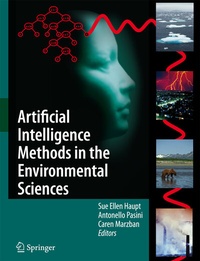
Artificial Intelligence Methods in the Environmental Sciences
Description

How can environmental scientists and engineers use the increasing amount of available data to enhance our understanding of planet Earth, its systems and processes? This book describes various potential approaches based on artificial intelligence (AI) techniques, including neural networks, decision trees, genetic algorithms and fuzzy logic.
Part I contains a series of tutorials describing the methods and the important considerations in applying them. In Part II, many practical examples illustrate the power of these techniques on actual environmental problems.
International experts bring to life ways to apply AI to problems in the environmental sciences. While one culture entwines ideas with a thread, another links them with a red line. Thus, a "red thread" ties the book together, weaving a tapestry that pictures the 'natural' data-driven AI methods in the light of the more traditional modeling techniques, and demonstrating the power of these data-based methods.
More details
Other editions
Additional editions
Persons
Dr. Sue Ellen Haupt is Head of the Department of Atmospheric and Oceanic Physics at the Applied Research Laboratory of The Pennsylvania State University and Associate Professor of Meteorology. She received her Ph.D. in Atmospheric Science from the University of Michigan, M.S. in Mechanical Engineering from Worcester Polytechnic Institute and B.S. in Meteorology from Penn State. In addition to PSU, she has worked at New England Electric System, the National Center for Atmospheric Research, University of Colorado/Boulder, University of Nevada, Reno, and Utah State University. Her research emphasizes applying novel numerical techniques to environmental and fluid dynamics problems.
Dr. Antonello Pasini is a senior researcher at the Institute of Atmospheric Pollution of the National Research Council in Rome, Italy. He received his Italian Laurea in Physics from University of Bologna and specialized in atmospheric physics and meteorology at the Italian Met Service according to WMO criteria. He is an expert of complex systems and neural network modelling and applies his studies to several environmental problems, with a particular emphasis to climate change applications.
Dr. Caren Marzban is a senior physicist at the Applied Physics Laboratory, and an instructor at the Department of Statistics, University of Washington. He received his Ph.D. in theoretical physics from the University of North Carolina, at Chapel Hill. The early segment of his research career was in quantum gravity and string theory, but then he saw the light and began learning and applying statistics and machine learning techniques to any problem he can get his hands on.
