

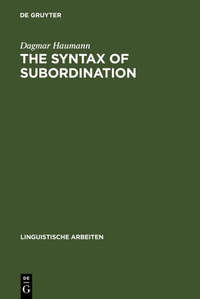
The Syntax of Subordination
Description

This study is concerned with the categorial status of subordinating conjunctions and the internal and external structure of subordinate clauses. Starting out from the categorizations of subordinating conjunctions that prevail in recent generative linguistic theory, namely complementizers and prepositions, and from the division of syntactic categories into lexical and functional ones, the author investigates the lexical and grammatical properties of subordinating conjunctions which are held to account for both the distribution and the architecture of subordinate clauses. Central to this study is the relation between the category subordinating conjunction, the licensing of its projection and the licensing of its complement and specifier position.
Part I is concerned with subordination in early Generative Grammar, the rise of the category C and the categorization of subordinating conjunctions. Part II focuses on recent conceptions of phrase structure, the inventory of syntactic categories, the lexical-functional dichotomy and syntactic movement. Part III is concerned with the lexical properties of complementizers (C), prepositions (P), and a third category of subordinating conjunctions (Subcon) which conflates properties of Cs and Ps. This categorization of subordinating conjunctions is arrived at on the basis of the distribution of the phrases they head and the mechanisms by which these elements license their complement and specifier. Cs, as typical functional heads, license both theirs complement and their specifier on the basis of feature checking mechanisms; Ps, as typical lexical heads, license these positions by theta-marking them. Within SubconP the complement is licensed by feature checking as within CP, and the specifier is licensed by theta-marking as within PP.
More details
Other editions
Additional editions
Content
- Intro
- Acknowledgements
- Introduction
- Part I Early Generative Grammar, the Rise of Category C and the Categorization of Subordinating Conjunctions
- 1 Subordination in Early Generative Grammar - Recursiveness
- 1.1 Phrase Structure
- 1.2 Summary
- 2 Complementizers
- 2.1 Complementizers: Transformations and Phrase Structure Rules
- 2.2 Towards Uniform Sentence Structure
- 2.3 Summary
- 3 Subordinating Conjunctions - A Question of Categorization
- 3.1 Subordinating Conjunctions in Traditional Grammar
- 3.2 Subordinating Conjunctions as Complementizers
- 3.3 Subordinating Conjunctions as Prepositions
- 3.4 Summary
- Part II Recent Conceptions of Phrase Structure
- 4 Phrase Structure
- 4.1 From Rules to Representations - Setting the Theoretical Background
- 4.2 The Inventory of Syntactic Categories
- 4.3 Summary
- 5 Clause Structure
- 5.1 Split-Infl
- 5.2 Arguments for Reordering T and Agr and for Two More Functional Heads between C and VP
- 5.3 Movement in Matrix Clauses - A Typology of Movement
- 5.4 Summary
- Part III Lexical Properties of Complementizers, Prepositions and Subordinating Conjunctions
- 6 Lexical Properties of Complementizers and Properties of Category C
- 6.1 Complementizers
- 6.2 That
- 6.3 If
- 6.4 Whether
- 6.5 For
- 6.6 Summary
- 7 Lexical Properties of Prepositions
- 7.1 Lexical Prepositions and Their Projections
- 7.2 Summary
- 8 Subordinating Conjunctions Straddle the Dividing Line between the Lexical and the Functional Universe
- 8.1 Subordinating Conjunctions and Their Complement
- 8.2 The Specifier Position of SubconP
- 8.3 The Functional Architecture Dominating SubconP
- 8.4 Summary
- 9 Conclusion
- 10 Bibliography
