

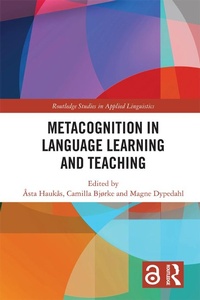
Metacognition in Language Learning and Teaching
Published on 14. June 2018
284 pages
978-1-351-04913-9 (ISBN)
Description

The Open Access version of this book, available at https://www.taylorfrancis.com/books/e/9781351049139, has been made available under a Creative Commons Attribution-Non Commercial-No Derivatives 4.0 license.
This volume offers an exhaustive look at the latest research on metacognition in language learning and teaching. While other works have explored certain notions of metacognition in language learning and teaching, this book, divided into theoretical and empirical chapters, looks at metacognition from a variety of perspectives, including metalinguistic and multilingual awareness, and language learning and teaching in L2 and L3 settings, and explores a range of studies from around the world. This allows the volume to highlight a diverse set of methodological approaches, including blogging, screen recording software, automatic translation programs, language corpora, classroom interventions, and interviews, and subsequently, to demonstrate the value of metacognition research and how insights from such findings can contribute to a greater understanding of language learning and language teaching processes more generally. This innovative collection is an essential resource for students and scholars in language teaching pedagogy, and applied linguistics.
This volume offers an exhaustive look at the latest research on metacognition in language learning and teaching. While other works have explored certain notions of metacognition in language learning and teaching, this book, divided into theoretical and empirical chapters, looks at metacognition from a variety of perspectives, including metalinguistic and multilingual awareness, and language learning and teaching in L2 and L3 settings, and explores a range of studies from around the world. This allows the volume to highlight a diverse set of methodological approaches, including blogging, screen recording software, automatic translation programs, language corpora, classroom interventions, and interviews, and subsequently, to demonstrate the value of metacognition research and how insights from such findings can contribute to a greater understanding of language learning and language teaching processes more generally. This innovative collection is an essential resource for students and scholars in language teaching pedagogy, and applied linguistics.
More details
Series
Language
English
Place of publication
London
United Kingdom
Publishing group
Taylor & Francis Ltd
Target group
College/higher education
Illustrations
22 Tables, black and white
File size
1,21 MB
ISBN-13
978-1-351-04913-9 (9781351049139)
Copyright in bibliographic data and cover images is held by Nielsen Book Services Limited or by the publishers or by their respective licensors: all rights reserved.
Schweitzer Classification
Other editions
Additional editions
Asta Haukas | Camilla Bjorke | Magne Dypedahl
Metacognition in Language Learning and Teaching
Book
08/2020
1st Edition
Routledge
€68.00
Shipment within 15-20 days
Asta Haukas | Camilla Bjorke | Magne Dypedahl
Metacognition in Language Learning and Teaching
Book
06/2018
Routledge
€206.70
Shipment within 10-20 days
Persons
Camilla Bjorke is Associate Professor of Foreign Language Pedagogy in the Faculty of Business, Languages, and Social Sciences, Ostfold University College, Norway.
Magne Dypedahl is Associate Professor of English in the Faculty of Humanities, Sports and Educational Science at the University of South-Eastern Norway.
Asta Haukas is Professor of Applied Linguistics and Foreign Language Pedagogy at the Department of Foreign Languages, University of Bergen, Norway.
Magne Dypedahl is Associate Professor of English in the Faculty of Humanities, Sports and Educational Science at the University of South-Eastern Norway.
Asta Haukas is Professor of Applied Linguistics and Foreign Language Pedagogy at the Department of Foreign Languages, University of Bergen, Norway.
Content
1. Introduction Asta Haukas, Camilla Bjorke and Magne Dypedahl
Part I
2. Metacognition in Language Learning and Teaching: an Overview Asta Haukas
3. Metacognition in Multilingual Learning: a DMM Perspective Ulrike Jessner
4. A Metacognitive Approach to Intercultural Learning in Language Teacher Education Magne Dypedahl
Part II
5. Using Machine-Translated Texts to Generate L3 Learners' Metalinguistic Talk Eva Thue Vold
6. Language Contrasts, Language Learners and Metacognition: Focus on Norwegian Advanced Learners of English Hilde Hasselgard
7. Metacognitive Knowledge about Writing in a Foreign Language: a Case Study Yvonne Knospe
8. "In German I have to think about it more than I do in English": The Foreign Language Classroom as a Key Context for Developing Transferable Metacognitive Writing Strategies Karen Forbes
9. Validating a Questionnaire on EFL Writers' Metacognitive Awareness of Writing Strategies in Multimedia Environments Lawrence Jun Zhang and Tony Limin Qin
10. Exploring Communication Strategy Use and Metacognitive Awareness in the EFL Classroom Henrik Bohn and Gro-Anita Myklevold
11. Reflecting on Educational Experiences: an Analysis of two Migrant Students' Stories Ragnar Arntzen and Odd Eriksen
Part III
12. "Emotion Recollected in Tranquillity": Blogging for Metacognition in Language Teacher Education Linda Fisher
13. Teaching Metacognitively: Adaptive Inside-Out Thinking in the Language Classroom Phil Hiver and George E.K. Whitehead
Part I
2. Metacognition in Language Learning and Teaching: an Overview Asta Haukas
3. Metacognition in Multilingual Learning: a DMM Perspective Ulrike Jessner
4. A Metacognitive Approach to Intercultural Learning in Language Teacher Education Magne Dypedahl
Part II
5. Using Machine-Translated Texts to Generate L3 Learners' Metalinguistic Talk Eva Thue Vold
6. Language Contrasts, Language Learners and Metacognition: Focus on Norwegian Advanced Learners of English Hilde Hasselgard
7. Metacognitive Knowledge about Writing in a Foreign Language: a Case Study Yvonne Knospe
8. "In German I have to think about it more than I do in English": The Foreign Language Classroom as a Key Context for Developing Transferable Metacognitive Writing Strategies Karen Forbes
9. Validating a Questionnaire on EFL Writers' Metacognitive Awareness of Writing Strategies in Multimedia Environments Lawrence Jun Zhang and Tony Limin Qin
10. Exploring Communication Strategy Use and Metacognitive Awareness in the EFL Classroom Henrik Bohn and Gro-Anita Myklevold
11. Reflecting on Educational Experiences: an Analysis of two Migrant Students' Stories Ragnar Arntzen and Odd Eriksen
Part III
12. "Emotion Recollected in Tranquillity": Blogging for Metacognition in Language Teacher Education Linda Fisher
13. Teaching Metacognitively: Adaptive Inside-Out Thinking in the Language Classroom Phil Hiver and George E.K. Whitehead
