

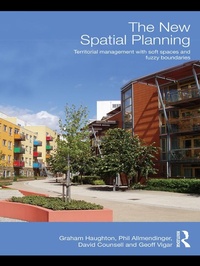
The New Spatial Planning
Territorial Management with Soft Spaces and Fuzzy Boundaries
Published on 4. December 2009
288 pages
978-1-135-21078-6 (ISBN)
Description

Spatial planning, strongly advocated by government and the profession, is intended to be more holistic, more strategic, more inclusive, more integrative and more attuned to sustainable development than previous approaches. In what the authors refer to as the New Spatial Planning, there is a fairly rapidly evolving maturity and sophistication in how strategies are developed and produced. Crucially, the authors argue that the reworked boundaries of spatial planning means that to understand it we need to look as much outside the formal system of practices of 'planning' as within it.
Using a rich empirical resource base, this book takes a critical look at recent practices to see whether the new spatial planning is having the kinds of impacts its advocates would wish. Contributing to theoretical debates in planning, state restructuring and governance, it also outlines and critiques the contemporary practice of spatial planning. This book will have a place on the shelves of researchers and students interested in urban/regional studies, politics and planning studies.
Using a rich empirical resource base, this book takes a critical look at recent practices to see whether the new spatial planning is having the kinds of impacts its advocates would wish. Contributing to theoretical debates in planning, state restructuring and governance, it also outlines and critiques the contemporary practice of spatial planning. This book will have a place on the shelves of researchers and students interested in urban/regional studies, politics and planning studies.
More details
Language
English
Place of publication
London
United Kingdom
Publishing group
Taylor & Francis Ltd
Target group
Professional and scholarly
Product notice
Reflowable
Illustrations
8 s/w Tabellen, 21 s/w Photographien bzw. Rasterbilder, 6 s/w Zeichnungen
8 Tables, black and white; 6 Line drawings, black and white; 21 Halftones, black and white
File size
4,28 MB
ISBN-13
978-1-135-21078-6 (9781135210786)
Copyright in bibliographic data and cover images is held by Nielsen Book Services Limited or by the publishers or by their respective licensors: all rights reserved.
Schweitzer Classification
Other editions
Additional editions
Graham Haughton | Philip Allmendinger | David Counsell
The New Spatial Planning
Territorial Management with Soft Spaces and Fuzzy Boundaries
Book
11/2009
1st Edition
Routledge
€262.40
Shipment within 15-20 days
Graham Haughton | Philip Allmendinger | David Counsell
The New Spatial Planning
Territorial Management with Soft Spaces and Fuzzy Boundaries
Book
11/2009
1st Edition
Routledge
€83.90
Shipment within 15-20 days
Persons
Graham Haughton is Professor of Human Geography at the University of Hull. His research is in the areas of spatial planning, sustainable urban development, local and regional economic development, and urban and regional regeneration.
Philip Allmendinger is Professor of Land Economy at the University of Cambridge. His research is in the area of planning and development.
David Counsell is Lecturer in Planning and Sustainable Development at University College Cork. His research is in spatial planning, sustainable development and planning and environmental planning.
Geoff Vigar is Director of the Global Urban Research Unit at the University of Newcastle. His research focuses on governance explored through analyses of both spatial planning practice and infrastructure policy.
Philip Allmendinger is Professor of Land Economy at the University of Cambridge. His research is in the area of planning and development.
David Counsell is Lecturer in Planning and Sustainable Development at University College Cork. His research is in spatial planning, sustainable development and planning and environmental planning.
Geoff Vigar is Director of the Global Urban Research Unit at the University of Newcastle. His research focuses on governance explored through analyses of both spatial planning practice and infrastructure policy.
Content
Preface 1. The New Spatial Planning: Territorial Management and Devolution 2. Rethinking Planning: State Restructuring, Devolution and Spatial Strategies 3. Irish Spatial Planning and the Cork Experience 4. Spatial Planning in Northern Ireland and the Emergent North West Region of Ireland 5. Spatial Planning in a Devolved Scotland 6. The Wales Spatial Plan and Improving Policy Integration 7. English Spatial Planning and Dealing with Growth in the Leeds City Region 8. Congested Governance and the London Thames Gateway 9. A New Spatial Planning?
