

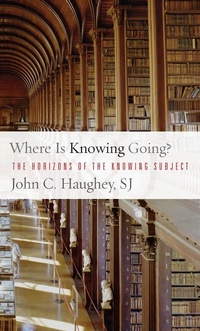
Where Is Knowing Going?
Description

Catholic institutions of higher learning are at a crossroads: How can they remain true to their roots while recognizing that many of their administrations, faculties, and student bodies have little connection with the tradition? How can these institutions remain competitive while maintaining a relationship to the Church?
During the past several years Catholic theologian John C. Haughey, SJ, has conducted groundbreaking research on these questions. He has done this in tandem with a team of Catholic scholars from around the United States. Haughey has also conducted numerous workshops with faculty at a dozen Catholic colleges and universities to learn firsthand about their research and teaching aspirations. Those relationships and conversations provide the foundation for this book's many insights.
In Where Is Knowing Going? Haughey explores what constitutes the Catholic identity of Catholic colleges and universities. Going beyond a doctrinal understanding of Catholic identity to one that engages and is engaged by the intellectual tradition of Catholicism, Haughey does not find that the issue of Catholic identity is adequately dealt with by marketing the distinctive identities of institutions in terms of their founding religious orders or saints. He provides a sure-handed process whereby the pursuits of individual faculty can be better aligned with the formal mission of the institution.
More details
Other editions
Additional editions
Person
John C. Haughey, SJ, is a senior fellow at Woodstock Theological Center, Georgetown University.
Content
Preface
1. What the Mission Looks Like From Below
2. A Further Beholding
3. Engaging Otherness
4. Catholicity: Its Scope and Contents
5. The Catholic Intellectual Tradition: Part I
6. The Catholic Intellectual Tradition: Part II
7. An Invitation
8. Where is Knowing Going?
9. Worship and the Catholic Identity of the Campus
10. Ex corde ecclesiae, Its Strengths and Limitations
Afterword
Appendixes
A An Autobiographical Note on Prayer
B The Categorical and the Transcendental
C Catholic-Muslim Forum
D A Contrasting Optic
