

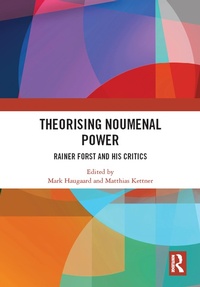
Theorising Noumenal Power
Rainer Forst and his Critics
1st Edition
Published on 9. June 2020
170 pages
978-1-000-05123-0 (ISBN)
Description

Theorising Noumenal Power is a critical engagement with Rainer Forst's theory of what he calls "noumenal power." Forst is the most significant younger generation critical theorist of the Frankfurt School, and his critics include several of the most influential contemporary political power theorists.
The concept of noumenal power locates the sources of social and political power in the space of reasons or justifications - using a normatively neutral account of "justification." To exercise power, on that account, means to be able to determine, use, close or open up the space of justifications for others. Going back to Kant, the social subject is theorized as a reasoning being who confers legitimacy upon political structures based upon the cognitive faculty of justification. As argued by Max Weber, authority is the foundation of political institutions and authority presupposes a belief in legitimacy. On the one hand such beliefs can be distorted, as in ideology, or they can be based upon a process of reasoned justification relative to normatively desirable principles. Critiquing the former, while building upon the latter, serves as the foundation for theorising just democratic politic institutions. For Forst's critics, a key theme is how to differentiate ideological (bad) justification, typically based upon emotion, from normatively right democratic reasoning. Other important themes are the analysis of structural domination or the use of threats or other means of exercising power.
The debate in this volume constitutes an exciting new way of re-thinking the foundations of ideology, political power, democracy and justice. Providing a state-of-the-art discussion concerning the relationship between political power and justification Theorising Noumenal Power is essential for students and scholars interested in the theoretical foundations of political power, democracy and justice. The chapters were originally published in the Journal of Political Power.
The concept of noumenal power locates the sources of social and political power in the space of reasons or justifications - using a normatively neutral account of "justification." To exercise power, on that account, means to be able to determine, use, close or open up the space of justifications for others. Going back to Kant, the social subject is theorized as a reasoning being who confers legitimacy upon political structures based upon the cognitive faculty of justification. As argued by Max Weber, authority is the foundation of political institutions and authority presupposes a belief in legitimacy. On the one hand such beliefs can be distorted, as in ideology, or they can be based upon a process of reasoned justification relative to normatively desirable principles. Critiquing the former, while building upon the latter, serves as the foundation for theorising just democratic politic institutions. For Forst's critics, a key theme is how to differentiate ideological (bad) justification, typically based upon emotion, from normatively right democratic reasoning. Other important themes are the analysis of structural domination or the use of threats or other means of exercising power.
The debate in this volume constitutes an exciting new way of re-thinking the foundations of ideology, political power, democracy and justice. Providing a state-of-the-art discussion concerning the relationship between political power and justification Theorising Noumenal Power is essential for students and scholars interested in the theoretical foundations of political power, democracy and justice. The chapters were originally published in the Journal of Political Power.
More details
Edition
1. Auflage
Language
English
Place of publication
London
United Kingdom
Publishing group
Taylor & Francis Ltd
Target group
College/higher education
ISBN-13
978-1-000-05123-0 (9781000051230)
Copyright in bibliographic data and cover images is held by Nielsen Book Services Limited or by the publishers or by their respective licensors: all rights reserved.
Schweitzer Classification
Other editions
Additional editions
Book
06/2024
1st Edition
Routledge
€75.79
Shipment within 10-20 days
Book
03/2020
1st Edition
Routledge
€205.90
Shipment within 15-20 days
Persons
Mark Haugaard is Professor of Political Science and Sociology at the National University of Ireland, Galway, Ireland. He is the founder editor of the Journal of Political Power and the book series, Social and Political Power. He has published extensively upon political power and his most recent publication is The Four Dimensions of Power, 2020.
Matthias Kettner is Professor of Philosophy at Witten/Herdecke University, Germany. He has published widely on discourse ethics, applied ethics, and the philosophy of psychoanalysis.
Matthias Kettner is Professor of Philosophy at Witten/Herdecke University, Germany. He has published widely on discourse ethics, applied ethics, and the philosophy of psychoanalysis.
Content
Noumenal power: an editorial Mark Haugaard, Matthias Kettner 1. The seductive force of 'noumenal power': a new path (or impasse) for critical theory? Simon Susen 2. Noumenal power: concept and explanation Steven Lukes 3. On structural power Clarissa Rile Hayward 4. Relational, structural and systemic forms of power: the 'right to justification' confronting three types of domination Albena Azmanova 5. A broad definition of agential power Pablo Gilabert 6. Justification and the four dimensions of power Mark Haugaard 7. The forstian bargain: overrationalizing the power of reasons Matthias Kettner 8. Noumenal power revisited: reply to critics Rainer Forst
