

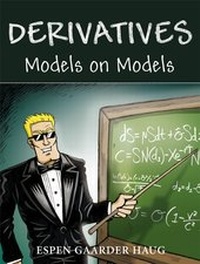
Derivatives Models on Models
Description

More details
Other editions
Additional editions
Person
Content
Author's "Disclaimer" ix
Introduction x
Derivatives Models on Models xv
Nassim Taleb on Black Swans 1
Chapter 1 The Discovery of Fat-Tails in Price Data 17
Edward Thorp on Gambling and Trading 27
Chapter 2 Option Pricing and Hedging from Theory to Practice: Know Your Weapon III 33
1 The Partly Ignored and Forgotten History 34
2 Discrete Dynamic Delta Hedging under Geometric Brownian Motion 44
3 Dynamic Delta Hedging Under Jump-Diffusion 50
4 Equilibrium Models 54
5 Portfolio Construction and Options Against Options 55
6 Conclusions 63
Alan Lewis on Stochastic Volatility and Jumps 71
Chapter 3 Back to Basics: A New Approach to the Discrete Dividend Problem 79
Together with Jørgen Haug and Alan Lewis
1 Introduction 79
2 General Solution 82
3 Dividend Models 87
4 Applications 89
Emanuel Derman the Wall Street Quant 101
Chapter 4 Closed Form Valuation of American Barrier Options 115
1 Analytical Valuation of American Barrier Options 115
2 Numerical Comparison 116
3 Conclusion 118
Peter Carr, The Wall Street Wizard of Option Symmetry and Volatility 121
Chapter 5 Valuation of Complex Barrier Options Using Barrier Symmetry 129
1 Plain Vanilla Put-Call Symmetry 129
2 Barrier Put-Call Symmetry 130
3 Simple, Intuitive and Accurate Valuation of Double Barrier Options 132
4 Static Hedging in the Real World 137
5 Conclusion 138
Granger on Cointegration 141
Chapter 6 Knock-in/out Margrabe 145
with Jørgen Haug
1 Margrabe Options 145
2 Knock-in/out Margrabe Options 146
3 Applications 147
Stephen Ross on APT 153
Chapter 7 Resetting Strikes, Barriers and Time 157
with Jørgen Haug
1 Introduction 157
2 Reset Strike Barrier Options 160
3 Reset Barrier Options 161
4 Resetting Time 162
5 Conclusion 163
Bruno Dupire the Stochastic Wall Street Quant 167
Chapter 8 Asian Pyramid Power 177
with Jørgen Haug and William Margrabe
1 Celia in Derivativesland 177
2 Calibrating to the Term Structure of Volatility 180
3 From Geometric to Arithmetic 184
4 The Dollars 185
Eduardo Schwartz: the Yoga Master of Mathematical Finance 191
Chapter 9 Practical Valuation of Power Derivatives 197
1 Introduction 197
2 Energy Swaps/Forwards 199
3 Power Options 202
4 Still, What About Fat-Tails? 209
Aaron Brown on Gambling, Poker and Trading 211
Chapter 10 A Look in the Antimatter Mirror 223
1 Garbage in, Garbage Out? 223
2 Conclusion 227
Knut Aase on Catastrophes and Financial Economics 231
Chapter 11 Negative Volatility and the Survival of the Western Financial Markets 239
Knut K. Aase
1 Introduction 239
2 Negative Volatility - A Direct Approach 240
3 The Value of a European Call Option for any Value - Positive or Negative - of the Volatility 240
4 Negative Volatility - The Haug interpretation 242
5 Chaotic Behavior from Deterministic Dynamics 242
6 Conclusions 243
Elie Ayache on Option Trading and Modeling 247
Chapter 12 Frozen Time Arbitrage 267
1 Time Measure Arbitrage 268
2 Time Travel Arbitrage 269
3 Conclusion 273
Haug on Wilmott and Wilmott on Wilmott 277
Chapter 13 Space-time Finance The Relativity Theory's Implications for Mathematical Finance 287
1 Introduction 287
2 Time dilation 290
3 Advanced stage of Space-time Finance 292
4 Space-time Uncertainty 293
5 Is High Speed Velocity Possible? 295
6 Black-Scholes in Special Relativity 299
7 Relativity and Fat-Tailed Distributions 301
8 General Relativity and Space-time Finance 302
9 Was Einstein Right? 305
10 Traveling Back in Time Using Wormholes 307
11 Conclusion 308
Andrei Khrennikov on Negative Probabilities 317
Chapter 14 Why so Negative about Negative Probabilities? 323
1 The History of Negative Probability 323
2 Negative Probabilities in Quantitative Finance 324
3 Getting the Negative Probabilities to Really Work in Your Favor 327
4 Hidden Variables in Finance 328
5 The Future of Negative Probabilities in Quantitative Finance 329
6 Appendix: Negative Probabilities in CRR Equivalent Trinomial Tree 330
David Bates on Crash and Jumps 335
Chapter 15 Hidden Conditions and Coin Flip Blow Up's 343
1 Blowing Up 343
2 Coin Flip Blow Up's 344
Peter Jáckel on Monte Carlo Simulation 349
Index 359
Introduction
"Derivatives: Models on Models" is a different book about quantitative finance. In many ways it is two books in one, first of all it contains a series of interviews with some of the world's top modelers, researchers, quants, quant-traders, gamblers and philosophers from Wall Street and academia. On the top of this you get a series of technical chapters covering valuation methods on stocks paying discrete dividend, Asian options, American barrier options, Complex barrier options, reset options, and electricity derivatives. The book doesn't stop there it also takes you into the tails of your imagination and discusses ideas like negative probabilities and space-time finance.
The title "Derivatives: Models on Models" deserves some explanation. It was my former co-worker Dr John Stevenson1 a great model trader in J.P. Morgan that first came up with the idea of the book title "Models on Models", a title I later changed to "Derivatives: Models on Models". First of all the book is about derivatives models; quantitative finance, option valuation, hedging, and some non-traditional topics in finance like negative probabilities and space-time finance.
"Models on Models" has multiple implications. First of all models are only models and derivatives models are themselves based typically on more fundamental underlying models. For example most derivatives models are based on classic probability theory, that itself is a model that we often take for granted. Many models are based on the assumption of Gaussian distribution (including many of my own formulas). Some of the biggest mistakes in trading and modeling are done because we forget that our models are typically also based on some implicit non-stated assumptions. Typically such models work well (or at least to some degree) most of the time, but then sooner or later the hidden conditions will show up and often cause unexpected problems.
"Models on Models" also points back at the many interesting interviews with many of the world's top modelers and their views on their models: Clive Granger, Emanuel Derman, Edward Thorp, Peter Carr, Aaron Brown, David Bates, Andrei Khrennikov, Elie Ayache, Peter Jäckel, Alan Lewis, Paul Wilmott, Eduardo Schwartz, Knut Aase, Bruno Dupire, Nassim Taleb, and Stephen Ross, all share their great wisdom on quantitative models, trading, gambling and philosophy about modeling. These interesting and fascinating interviews are spread throughout the book. These are modelers with very different backgrounds and personalities; it has been a great pleasure to learn from them through their publications, presentations, and in particular through the interviews for this book. All of these great people stand on their own, and are in no way directly related to my articles if not so stated except in the few cases when some of them are co-authors, Some of them like my work, some of them disagree strongly with me, compared to many of these giants of quantitative finance I am only a footnote, but either you like it or not a footnote that is growing in size!
"Models on Models" also reflects upon early often "forgotten" research and knowledge. The current quantitative finance models are in almost every case extensions that are based on early wisdom and knowledge. Many of the techniques used in finance have their background in physics, engineering, probability theory and ancient wisdom. Many of these theories have developed over thousands of years. It is easy to forget this when working with valuing some advanced derivatives instruments.2
For making it easy to remember the importance of understanding models is based on models. This concept is illustrated in an artistic photo in the centre section of the book. After seeing beautiful quantitative finance models painted on beautiful photo models you will hopefully never forget the importance of "Models on Models". Even if the model and the underlying model potential look extremely elegant and beautiful, this does not mean that the surface and the explicitly stated assumption of the model tells the truth about real market behavior. I have myself spent considerable time as a derivatives trader and have seen many of the differences between how the model worked in theory and practice, and I am still learning, it is a life long process. Many of us love beauty and elegance, even if we naturally know beauty and elegance is far from everything. Personally I love the beauty of closed form solutions, but they have their limitations. The beautiful surface of a model says little about how the model actually behaves in practice. Derivatives models are only models and nothing more, often beautiful and elegant on the surface but the real market is much more complex and much more interesting than the model alone, the art of quantitative trading is the understanding of the interaction between the market and the models, and in particular the shortcomings of the model.
The truth about derivatives models as well as photo models is more like this; the first time you see a derivatives model you think it is beautiful and elegant and you fall in love with it. Then when you know the model better, you learn its complexity and that the beautiful and elegant surface is only part of the reality. The more you learn about the model versus reality, the complexities, the weaknesses and strengths the more you tend to like the model despite its weaknesses. Not because it makes the model better, but you know how to get around its shortcomings. Knowing the weaknesses of a model is your best strength in applying the model to the market. Academics and researchers falling blindly in love with the mathematical beauty and elegance of their models without rigorously testing it out on market data, without listening to people with trading experience are like someone falling in love with a photo of a super-model, it has often little to do with the multidimensional reality. A great modeler or trader will test the model against market data, talk with experienced traders and always be open for discussion, and most important will see how the model works over many years in the market. Love based on outer beauty can sometimes be a good start, but only love based on a deep understanding of the weaknesses, strengths and complexities of a model and its interaction with reality can make love last.
Just like fashion models anyone that has followed mathematical finance for some time must also have noticed how fashion here changes over time. In the 1970s to the mid 1980s equity derivatives were in fashion. In the 1980s and early 1990s interest rate modeling was in fashion, every researcher and modeler tried to come up with benchmark yield curve models. In the 1990s exotic options and energy derivatives came into fashion. In late 1990s and until now modeling credit derivatives has been in fashion. It is hard to predict what fashion will be next and when it will end. As the derivatives business has grown dramatically and also the number of people in it, there now tend to be several fashions going on at the same time. The quants and the modelers have a few similarities with fashion designers, sometimes disliking each other's style, design and product. A good modeler should however in my view be open to at least discussing his own work with modelers in the opposite fashion camp. Too often modelers fall in love with their own view of the world (I do it all the time), I guess this is why science has always evolved through paradigm changes, and I don't think that things are any different now, the human brain is more or less unchanged over thousands of years.
Even if this book covers some "serious" ideas and valuation models I see no reason why this cannot be combined with humor and fun. The great sense of humor of the many great researchers and quants interviewed is just one example. To make the book more entertaining I have also added a section filled with comic ships and quant related artistic photos, I hope and think that some of you will like it.
First of all I would like to thank the great modelers, quants, researchers, philosophers, gamblers and traders that shared their knowledge, wisdom and their views through the interviews presented in this book.
I would like to give a special thanks to, Jørgen Haug, Alan Lewis and William Margrabe who I was lucky to have as co-authors in a few of the chapters. Even if this book (besides the interviews) mostly is personal ego trip I have also included a chapter by Professor Knut Aase that is closely related to the subject of one of my chapters.
I am also grateful for interesting discussions, comments and suggestions by Alexander Adam-chuk, Gabriel Barton, Christophe Bahadoran, Nicole Branger, Aaron Brown, Peter Carr, Peter Clark, Jin-chuan Duan, Tom Farmen, Stein Erik Fleten, Edwin Fisk, Omar Foda, Gordon Fraser, Stein Frydenberg, Ronald R. Hatch, Steen Koekebakker, John Logie, Xingmin Lu, Hicham Mouline, Svein-Arne Persson, John Ping Shu, Samuel Siren, Gunnar Stensland, Erik Stettler, Svein Stokke, Dan Tudball, James Ward, Sjur Westgaard, Lennart Widlund, Nico van der Wijst and Jiang Xiao Zhong.
I had great fun working with the very talented photographers Amber Gray and Julian Bern-stein doing some artistic "Models on Models" shots for this book. For the comic strips I am grateful to the multi-talented Sebastian Conley. The comic strips began by me drafting the story, then Sebastian drew it by hand (black and white) and improved my stories before using computer software to add colors and special effects. Also special thanks are due to my very artistic friend Wenling Wang for her painting "The...
