

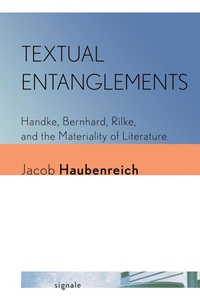
Textual Entanglements
Handke, Bernhard, Rilke, and the Materiality of Literature
Published on 15. May 2025
330 pages
978-1-5017-8114-8 (ISBN)
Description

Textual Entanglements explores how the material processes of writing manifest in the published works of three twentieth-century Austrian authors: Peter Handke, Thomas Bernhard, and Rainer Maria Rilke. These authors left behind material traces of their writing processes, whether in notebooks, piles of disorganized typewritten sheets, or manuscript fragments. The materials do not merely act as containers for their texts: They spill into the semantic content of the writing, becoming entangled in it. The idiosyncratic materials and methods of the writing process do not disappear when the work enters print.
Examining these material traces, Textual Entanglements contends that we cannot fully understand these texts' semantic dynamics without considering the material circumstances of their production. Jacob Haubenreich reads Handke, Bernhard, and Rilke to argue that the materiality of textual production opens up a broader semiotic field in which meaning can be created. Haubenreich's book offers a theoretical framework and methodological models for integrating analysis of textual materiality into literary analysis in ways that expand the boundaries of literary interpretation.
Examining these material traces, Textual Entanglements contends that we cannot fully understand these texts' semantic dynamics without considering the material circumstances of their production. Jacob Haubenreich reads Handke, Bernhard, and Rilke to argue that the materiality of textual production opens up a broader semiotic field in which meaning can be created. Haubenreich's book offers a theoretical framework and methodological models for integrating analysis of textual materiality into literary analysis in ways that expand the boundaries of literary interpretation.
More details
Series
Language
English
Place of publication
Ithaca
United States
Publishing group
Cornell University Press
Illustrations
62 color halftones - 62 Halftones, color
File size
69,56 MB
ISBN-13
978-1-5017-8114-8 (9781501781148)
Copyright in bibliographic data and cover images is held by Nielsen Book Services Limited or by the publishers or by their respective licensors: all rights reserved.
Schweitzer Classification
Other editions
Additional editions
Book
05/2025
Cornell University Press and Cornell University Library
€37.50
Available immediately
Book
05/2025
Cornell University Press and Cornell University Library
€178.27
Shipment within 15-20 days
Person
Jacob Haubenreich is Assistant Professor of German at Johns Hopkins University.
Content
0. Introduction
1. Handke's Slow Making
2. Bernhard's Destructive Production
3. Rilke's Embodied Figuration
Epilogue: Studying Material Process in the Age of Digitization
1. Handke's Slow Making
2. Bernhard's Destructive Production
3. Rilke's Embodied Figuration
Epilogue: Studying Material Process in the Age of Digitization
