

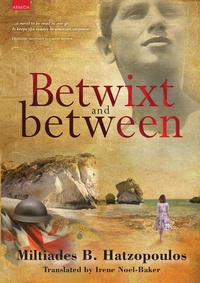
Betwixt and between
Description

Short-listed for the 2014 London Hellenic Prize
The touching story of a teenager who struggles with the eternal problems of adolescence, Betwixt & Between is a coming of age historical novel set in a politically divided country.
While the era of British colonialism in Cyprus is coming to a violent end, Dimitri tries to come to terms with the consequences of the political turmoil on his own life. Strengthened by his passion for medieval poetry and his love for the history of his island, he sets out to balance the Cypriot and English elements in his daily life. His quest for answers is complicated by romantic love for his British friend Anne and his physical attraction to his father's maid Phrossou. Balancing between different identities, religion and communities, his personal search becomes symbolic of his country's turbulent political situation.
A nostalgic story about family, love and friendship, Betwixt & Between is a powerful novel about the psychology of an adolescent torn between different worlds, and about the complexities of life and love in the social and historical mosaic of 1950's colonial Cyprus. It is a beautifully-observed, historically-informed novel by the celebrated Greek historian and novelist.
Praise for this novel
Perhaps one of the most tender stories written about the years '55-'59, seen through the eyes of a youth who wavers between spirituality and patriotism, between his admiration for T.S. Eliot and the sacrifice of Karaolis, a young resistance fighter. The end of the novel is remarkable, unexpected and fatefully ironic.
Anna Marangou - Politis Newspaper - April 26 2009
The scientific community recognises the long-standing devotion of Miltiades Hatzopoulos to science and research. He is a historian and fellow of the French Academy, director of the Research Centre for Greek and Roman Antiquity and vice president of the National Research Foundation. He has astounded everyone, however, by his involvement with literature and his first novel, has charmed readers both in Greece and in Cyprus, where the novel takes place a little before and a little after the beginning of the liberation struggle in 1955.
Olga Sella - Kathimerini Newspaper - 3 May 2009
His astonishing descriptions of the topography, particularly of Nicosia but also of the medieval monuments of Kyrenia and Famagusta, reveal the author's deep knowledge and love for the island and its people.
Vassiliki Christi - Diavaseme.gr (the Greek literary website "Read Me") - 15 June 2009
You see before you the entire social mosaic of Cyprus in the '50s. And also the political life and the character of the people, Greeks, Turks and British. As far as the style is concerned, it is one of the best novels that I have read lately.
Apostolos Diamantis - Eleftherotypia Sunday supplement - 6 June 2009
This is a novel to be read in one go. A charming narrative, coherent in its construction, with a well-finished depiction of character and a plot which takes unexpected turns. It keeps the reader in constant suspense.
Georgos Georgis - Diavazo (monthly literary review) - September 2009
All prices
More details
Other editions
Additional editions

Persons
Content
Chapter 2 Vita Nuova
Dimitri was an admirer of Cavafy. But he was not particularly inspired by the poet's dictum in the poem, "Do What You Can", during that particular summer. Since he could not live his life as he wished, what did it matter if he cheapened it by "too much contact with the crowd, too much posturing and idle chatter". It was not that he had given in to his father, at least not in the beginning. As far as he was concerned, he would do anything but give in. But since he was not naturally violent or rebellious, he had adopted a method of passive resistance.
Dimitri had not the strength openly to contest the parameters that his father set him. But without stepping beyond them, he could interpret the rules that had been imposed upon him in his own way. His father could marry Jenny as much as he liked, but Dimitri would never think of her as his mother. His heart was full of memories of Eleni, and a longing for Maria. He would spend time with Johnny and Laeta, but only to make use of their social circle so as not to feel a stranger when he went to the English School. His real friends would always be Paris, Iason and Nikos, Evdoxia, Aspasia, Christina, and even little Fanny - whether he was able to see them or not - and never ever Johnny and Laeta with their pretentious Cypriot friends. He would go to the English School, but his school would always be the Pancypriot. Dimitri kept these and other similar decisions well hidden. His real thoughts and real loves he would keep to himself.
That summer, a party of young English people, a rare exception to the relics of the British Empire residing there, had sought refuge at The Dome from the furnace which was the capital in summer; meanwhile their parents worked on in their various government offices or businesses in Nicosia. Almost all the young people had come on holiday from England, where they were boarders in private schools. Only one of them went to the English School in Nicosia, in the class below Johnny. Since Dimitri was condemned to associate with anyone other than his real friends, he preferred the genuine British article to its Cypriot replica. But unfortunately he would still have to make use of the children of the Cypriot contractor in order to gain an entrée to the English at the hotel.
Dimitri's earlier dealings with English people of his own age had not left him with a good impression. He had been just four or five years old, it had been during the war, and they were waiting for the house they had bought to be refurbished. His parents had temporarily rented the basement of a large villa, in the neighbourhood of Ayios Andreas. An English major with his wife and son lived on the floor above them. Dimitri was full of admiration for the black nameplate on the door, with a royal British crest and the name of its distinguished tenant fixed onto the garden gate. The major wore brown polished boots, a thin blond moustache, and carried a stick under his arm: all equally impressive to Dimitri.
However well-cut his own father's suit may have been, and however spotless the white handkerchief in his breast pocket, however elegant the half-open rosebud in the buttonhole of his lapel, none of these things could compare, in Dimitri's eyes, with the austere elegance of the khaki uniform. His playmate, Tim, had toys which came, together with all his parents' household possessions, directly from England. They looked incomparably more solid than Dimitri's toys, which had been made exclusively on the island, at a time when the war had limited its imported goods to absolute essentials. Dimitri was not jealous, but he couldn't help admiring the clockwork cars, the electric train, the swords and guns made of solid wood and metal belonging to his young neighbour. They all looked strikingly real next to his own, which might have been bought at a panegyri, a local fair. When Tim's mother invited him to play with her son upstairs, it had come as a true revelation. Dimitri would never forget the mysterious smell of the food and drink, of their wooden and leather furniture, and especially the sight of stuffed trophies: stags', gazelles' and wild goats' heads, ranged along the walls of the drawing room. It had nothing in common with his own family's saloni. Even the silver on the low tables was different: severe geometric designs and uniform sleek metal, instead of the intricate arabesques of their own local silverware.
Dimitri sailed along ecstatically in the blissful environment of Tim's house. He felt that he would rather consent to any sacrifice than have to be removed from such a fascinating, exotic world. By the time he had to leave, reluctantly, with his mother, who had come to collect him in time for his evening bath, Dimitri had determined to work out a way of obtaining permanent access to the earthly paradise upstairs. In his little four- or five-year-old head, he conceived the notion that he might suggest a mutual exchange of language lessons. He could teach Tim Greek and Tim could teach him English. He was so persistent that on the following day, his mother, despite her reservations as to how it would be received, agreed to communicate the idea to Tim.
"Why should I want to learn Greek?" was the spontaneous - and to Dimitri extremely traumatic - response. He became aware for the first time that relations between the English and the Cypriots on the island were essentially unequal. The Cypriots might admire, they might want to imitate and often even to love their rulers; for the English a reciprocal attitude to the Cypriots was simply inconceivable. And yet the Major and his wife were obviously the best sort of people, polite to Dimitri's parents and commendable, if just for the fact that they had invited him to play with their son. It had only been a few years since the wife of a higher colonial official had vouchsafed the remark that in the fourteen years she had lived in Cyprus, no 'native' had ever set foot in her house. An impenetrable wall had continued to separate the two nations.
Since then, for more than ten years, Dimitri had taken his lesson to heart. He had protected himself from a repetition of that unbearably humiliating experience and avoided every kind of association with the English. Now, however, he was in a mood to put the question of his inequality to the test, to go and mingle as an equal with the new young representatives of the Herrenvolk at the hotel.
As a first step, he condescended to keep company with the young Neophytou. Since he was intrinsically honest with himself, he was secretly forced to admit that despite their snobbery and bad taste, evident in their adopting, without question, anything that was English and more generally foreign, they weren't bad children. Johnny was cheerful and good-natured. He had no interests beyond sporting prowess and dancing, the mastery of which he skilfully pursued, in order more easily to approach members of the opposite sex. But Laeta, beneath her superficial vanity, concealed a genuine interest in literature, and this formed a point of contact with Dimitri.
The three of them were sitting on the veranda of the hotel one Saturday evening and Dimitri was questioning his cosmopolitan companions about Alexandria, the city of his beloved Cavafy. Just then the young English party appeared, on their way back from the beach. Johnny waved them over, and they took chairs from nearby tables and came to sit for a while, and have a drink before going up to change in their rooms. Laeta made the necessary introductions.
The English party consisted of Sarah Wilson, a girl of about twenty, with brown hair, and Andrew, her twelve-year-old brother; two strikingly beautiful blonde girls the same age as Dimitri, Joan Beresforth and Ellie Huntington, and Anthony McBaine, a red-haired boy also his own age. Dimitri learnt later that Anthony was at the English school. The others were all at boarding schools in England, except for Sarah, who had finished school, and then spent two years in Kenya. She was about to go to university.
The conversation turned to plans for the evening's entertainment: Johnny suggested that they go to the Country Club. The latest hit singles had arrived there, apparently, and they would be able to dance. Everyone agreed immediately, except for Dimitri, who was always careful to ask his father's permission first.
Mr Dorides was of course thrilled that Dimitri had at last decided to abandon his self-inflicted isolation, and join the very social milieu that he was, quite properly, destined to inhabit. Not only did his father give permission, he gave him extra monetary reinforcement as well, in the shape of five shillings; or rather 250 mils - the new name of the freshly minted coinage, strangely decorated with boats and grapes, which was replacing Richard I's familiar lions.
As the last rays of sun vanished from above the...
