

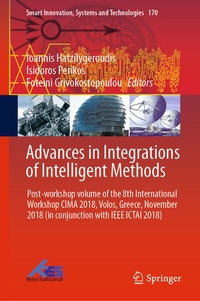
Advances in Integrations of Intelligent Methods
Description

More details
Other editions
Additional editions
Persons
Dr. Ioannis Hatzilygeroudis received his Diploma in Mechanical & Electrical Engineering from the National Technical University of Athens (NTUA), Greece; his M.Sc. in Information Technology and his PhD in Artificial Intelligence from the University of Nottingham, UK. Currently he is a Professor at the Department of Computer Engineering and Informatics, University of Patras, Greece. He is an Associate Editor-in-Chief of the International Journal of Artificial Intelligence Tools (IJAIT). He has also been member of the PCs of over 100 AI related conferences. He has published over 120 papers in international journals, edited volumes and proceedings. His main research interests are: artificial intelligence, knowledge representation, expert systems, knowledge engineering, machine learning, intelligent educational systems, intelligent e-learning, sentiment analysis. He is member of IEEE, ACM, AIED Society and the Hellenic Artificial Intelligence society (EETN).
Dr. Isidoros Perikos received his Diploma of Computer Engineer in 2008 and his MSc and Ph.D. in Computer Science from the Department of Computer Engineering and Informatics, University of Patras, in 2010 and 2016 respectively. His main research interests include artificial intelligence, natural language processing, machine learning and affective computing. He has published over 60 papers in international journals, conferences and workshops proceedings. He has participated in several national and European R&D projects. He is a member of IEEE, ACM and the Hellenic Artificial Intelligence society.
Dr. Foteini Grivokostopoulou received her Degree in applied mathematics from the University of Crete in 2006, the MSc in Mathematics of Computation and Decision Making in 2010 from the University of Patras and Ph.D. in Computer Science from the Department of Computer Engineering and Informatics, University of Patras in 2016. She is currently a Post-Doctoral Researcher at the ArtificialIntelligence Group of the Department of Computer Engineering and Informatics. Her research interests are in the fields of Artificial Intelligence, Machine Learning, Intelligent Tutoring Systems, Integration of ICT & Semantic Web Technologies in e-Learning and Educational Data Mining. She has published more than 50 papers in international conferences and journals. She is a member of IEEE and the Artificial Intelligence in Education (AIED) Society.
Content
Aligning Learning Materials and Assessment with Course Learning Outcomes in MOOCs using Data Mining Techniques.- Edge-Centric Queries Stream Management based on an Ensemble Model.- Bitcoin Price Prediction Combining Data and Text Mining.- Towards New Evaluation Metrics for Relational Learning.- Color Models for Skin Lesions Classification from Dermatoscopic Images.- Methods of Statistical Analysis and Machine Learning for the Evaluation of Generated Hardware and Firmware Designs.- Genetic Algorithms for Creating Large Job Shop Dispatching Rules.
