

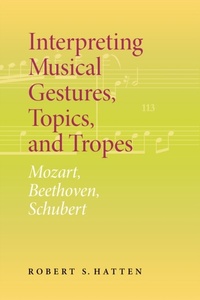
Interpreting Musical Gestures, Topics, and Tropes
Mozart, Beethoven, Schubert
1st Edition
Published on 4. September 2017
376 pages
978-0-253-03027-6 (ISBN)
Description

"Robert Hatten's new book is a worthy successor to his Musical Meaning in Beethoven, which established him as a front-rank scholar . . . in questions of musical meaning. . . . [B]oth how he approaches musical works and what he says about them are timely and to the point. Musical scholars in both musicology and theory will find much of value here, and will find their notions of musical meaning challenged and expanded." -Patrick McCreless
This book continues to develop the semiotic theory of musical meaning presented in Robert S. Hatten's first book, Musical Meaning in Beethoven (IUP, 1994). In addition to expanding theories of markedness, topics, and tropes, Hatten offers a fresh contribution to the understanding of musical gestures, as grounded in biological, psychological, cultural, and music-stylistic competencies. By focusing on gestures, topics, tropes, and their interaction in the music of Mozart, Beethoven, and Schubert, Hatten demonstrates the power and elegance of synthetic structures and emergent meanings within a changing Viennese Classical style.
Musical Meaning and Interpretation-Robert S. Hatten, editor
This book continues to develop the semiotic theory of musical meaning presented in Robert S. Hatten's first book, Musical Meaning in Beethoven (IUP, 1994). In addition to expanding theories of markedness, topics, and tropes, Hatten offers a fresh contribution to the understanding of musical gestures, as grounded in biological, psychological, cultural, and music-stylistic competencies. By focusing on gestures, topics, tropes, and their interaction in the music of Mozart, Beethoven, and Schubert, Hatten demonstrates the power and elegance of synthetic structures and emergent meanings within a changing Viennese Classical style.
Musical Meaning and Interpretation-Robert S. Hatten, editor
All prices
More details
Language
English
Place of publication
Bloomington, IN
United States
Target group
Professional and scholarly
Product notice
Reflowable
Illustrations
69 figures, 1 bibliog., 1 index
ISBN-13
978-0-253-03027-6 (9780253030276)
Copyright in bibliographic data and cover images is held by Nielsen Book Services Limited or by the publishers or by their respective licensors: all rights reserved.
Schweitzer Classification
Other editions
Additional editions
Book
09/2017
Indiana University Press
€47.90
Shipment within 10-20 days
Book
11/2004
Indiana University Press
€53.23
Shipment within 10-20 days
Person
Robert S. Hatten is Professor of Music Theory at the University of Texas at Austin. He is author of Musical Meaning in Beethoven: Markedness, Correlation, and Interpretation.
Content
Acknowledgments
Introduction
Part I. Markedness, Topics, and Tropes
1. Semiotic Grounding in Markedness and Style: Interpreting a Style Type in the Opening of Beethoven's Ghost Trio, Op. 70, no. 1
2. Expressive Doubling, Topics, Tropes, and Shifts in Level of Discourse: Interpreting the Third Movement of Beethoven's String Quartet in B-flat Major, Op. 130
3. From Topic to Premise and Mode: The Pastoral in Schubert's Piano Sonata in G Major, D. 894
4. The Troping of Topics, Genres, and Forms: Bach, Mozart, Beethoven, Schubert, Schumann, Brahms, Bruckner, Mahler
Part II. Musical Gesture
Introduction to Part II
5. Foundational Principles of Human Gesture
6. Toward a Theory of Musical Gesture
7. Stylistic Types and Strategic Functions of Gestures
8. Thematic Gesture in Schubert: The Piano Sonatas in A Major, D. 959, and A Minor, D. 784
9. Thematic Gesture in Beethoven: Sonata for Piano and Cello in C Major, Op. 102, no. 1
10. Gestural Troping and Agency
Conclusion to Part II
Part III. Continuity and Discontinuity
Introduction to Part III
11. From Gestural Continuity to Continuity as Premise
12. Discontinuity and Beyond
Conclusion
Notes
Bibliography
Index of Names and Works
Index of Concepts
Introduction
Part I. Markedness, Topics, and Tropes
1. Semiotic Grounding in Markedness and Style: Interpreting a Style Type in the Opening of Beethoven's Ghost Trio, Op. 70, no. 1
2. Expressive Doubling, Topics, Tropes, and Shifts in Level of Discourse: Interpreting the Third Movement of Beethoven's String Quartet in B-flat Major, Op. 130
3. From Topic to Premise and Mode: The Pastoral in Schubert's Piano Sonata in G Major, D. 894
4. The Troping of Topics, Genres, and Forms: Bach, Mozart, Beethoven, Schubert, Schumann, Brahms, Bruckner, Mahler
Part II. Musical Gesture
Introduction to Part II
5. Foundational Principles of Human Gesture
6. Toward a Theory of Musical Gesture
7. Stylistic Types and Strategic Functions of Gestures
8. Thematic Gesture in Schubert: The Piano Sonatas in A Major, D. 959, and A Minor, D. 784
9. Thematic Gesture in Beethoven: Sonata for Piano and Cello in C Major, Op. 102, no. 1
10. Gestural Troping and Agency
Conclusion to Part II
Part III. Continuity and Discontinuity
Introduction to Part III
11. From Gestural Continuity to Continuity as Premise
12. Discontinuity and Beyond
Conclusion
Notes
Bibliography
Index of Names and Works
Index of Concepts
