

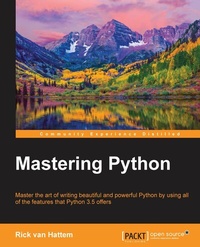
Mastering Python
Master the art of writing beautiful and powerful Python by using all of the features that Python 3.5 offers
1st Edition
Published on 3. June 2024
486 pages
978-1-78528-913-2 (ISBN)
Description

Master the art of writing beautiful and powerful Python by using all of the features that Python 3.5 offersKey Features - Become familiar with the most important and advanced parts of the Python code style
- Learn the trickier aspects of Python and put it in a structured context for deeper understanding of the language
- Offers an expert's-eye overview of how these advanced tasks fit together in Python as a whole along with practical examples
Book DescriptionPython is a dynamic programming language. It is known for its high readability and hence it is often the first language learned by new programmers. Python being multi-paradigm, it can be used to achieve the same thing in different ways and it is compatible across different platforms. Even if you find writing Python code easy, writing code that is efficient, easy to maintain, and reuse is not so straightforward. This book is an authoritative guide that will help you learn new advanced methods in a clear and contextualised way. It starts off by creating a project-specific environment using venv, introducing you to different Pythonic syntax and common pitfalls before moving on to cover the functional features in Python. It covers how to create different decorators, generators, and metaclasses. It also introduces you to functools.wraps and coroutines and how they work. Later on you will learn to use asyncio module for asynchronous clients and servers. You will also get familiar with different testing systems such as py.test, doctest, and unittest, and debugging tools such as Python debugger and faulthandler. You will learn to optimize application performance so that it works efficiently across multiple machines and Python versions. Finally, it will teach you how to access C functions with a simple Python call. By the end of the book, you will be able to write more advanced scripts and take on bigger challenges.What you will learn - Create a virtualenv and start a new project
- Understand how and when to use the functional programming paradigm
- Get familiar with the different ways the decorators can be written in
- Understand the power of generators and coroutines without digressing into lambda calculus
- Create metaclasses and how it makes working with Python far easier
- Generate HTML documentation out of documents and code using Sphinx
- Learn how to track and optimize application performance, both memory and cpu
- Use the multiprocessing library, not just locally but also across multiple machines
- Get a basic understanding of packaging and creating your own libraries/applications
Who this book is forAlmost anyone can learn to write working script and create high quality code but they might lack a structured understanding of what it means to be 'Pythonic'. If you are a Python programmer who wants to code efficiently by getting the syntax and usage of a few intricate Python techniques exactly right, this book is for you.
- Learn the trickier aspects of Python and put it in a structured context for deeper understanding of the language
- Offers an expert's-eye overview of how these advanced tasks fit together in Python as a whole along with practical examples
Book DescriptionPython is a dynamic programming language. It is known for its high readability and hence it is often the first language learned by new programmers. Python being multi-paradigm, it can be used to achieve the same thing in different ways and it is compatible across different platforms. Even if you find writing Python code easy, writing code that is efficient, easy to maintain, and reuse is not so straightforward. This book is an authoritative guide that will help you learn new advanced methods in a clear and contextualised way. It starts off by creating a project-specific environment using venv, introducing you to different Pythonic syntax and common pitfalls before moving on to cover the functional features in Python. It covers how to create different decorators, generators, and metaclasses. It also introduces you to functools.wraps and coroutines and how they work. Later on you will learn to use asyncio module for asynchronous clients and servers. You will also get familiar with different testing systems such as py.test, doctest, and unittest, and debugging tools such as Python debugger and faulthandler. You will learn to optimize application performance so that it works efficiently across multiple machines and Python versions. Finally, it will teach you how to access C functions with a simple Python call. By the end of the book, you will be able to write more advanced scripts and take on bigger challenges.What you will learn - Create a virtualenv and start a new project
- Understand how and when to use the functional programming paradigm
- Get familiar with the different ways the decorators can be written in
- Understand the power of generators and coroutines without digressing into lambda calculus
- Create metaclasses and how it makes working with Python far easier
- Generate HTML documentation out of documents and code using Sphinx
- Learn how to track and optimize application performance, both memory and cpu
- Use the multiprocessing library, not just locally but also across multiple machines
- Get a basic understanding of packaging and creating your own libraries/applications
Who this book is forAlmost anyone can learn to write working script and create high quality code but they might lack a structured understanding of what it means to be 'Pythonic'. If you are a Python programmer who wants to code efficiently by getting the syntax and usage of a few intricate Python techniques exactly right, this book is for you.
All prices
More details
Other editions
Additional editions
Rick van Hattem | Igor Milovanovic
Mastering Python
Book
04/2016
Packt Publishing
€52.60
Shipment within 3-4 weeks
Person
Hattem Rick van :
Rick van Hattem is an experienced programmer, entrepreneur, Stack Overflow veteran, and software/database architect with more than 20 years of programming experience, including 15 years with Python. He has extensive experience with high-performance architecture featuring large amounts of concurrent users and/or data. Rick has founded several start-ups and has consulted many companies, including a few Y Combinator start-ups and several large businesses
Rick van Hattem is an experienced programmer, entrepreneur, Stack Overflow veteran, and software/database architect with more than 20 years of programming experience, including 15 years with Python. He has extensive experience with high-performance architecture featuring large amounts of concurrent users and/or data. Rick has founded several start-ups and has consulted many companies, including a few Y Combinator start-ups and several large businesses
Content
Table of Contents - Getting started, one environment per project
- Pythonic syntax, common pitfalls and style guide
- Containers and collections
- Functional programming, readability versus brevity
- Decorators, enabling code reuse by decorating
- Generators and coroutines, infinity, one step at a time
- Async IO, multithreading without threads
- Metaclasses, making classes (not instances) smarter
- Documentation, reStructuredText, Napoleon and how to use Sphinx
- Testing and logging, preparing for bugs
- Debugging, solving the bugs
- Performance, tracking and reducing your memory and cpu usage
- Multiprocessing, when a single cpu core is not enough
- Extensions in C/C++, system calls and C/C++ libraries
- Packaging, creating your own libraries/applications
- Pythonic syntax, common pitfalls and style guide
- Containers and collections
- Functional programming, readability versus brevity
- Decorators, enabling code reuse by decorating
- Generators and coroutines, infinity, one step at a time
- Async IO, multithreading without threads
- Metaclasses, making classes (not instances) smarter
- Documentation, reStructuredText, Napoleon and how to use Sphinx
- Testing and logging, preparing for bugs
- Debugging, solving the bugs
- Performance, tracking and reducing your memory and cpu usage
- Multiprocessing, when a single cpu core is not enough
- Extensions in C/C++, system calls and C/C++ libraries
- Packaging, creating your own libraries/applications

