

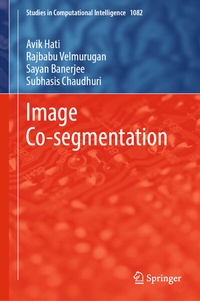
Image Co-segmentation
Description

This book presents and analyzes methods to perform image co-segmentation. In this book, the authors describe efficient solutions to this problem ensuring robustness and accuracy, and provide theoretical analysis for the same. Six different methods for image co-segmentation are presented. These methods use concepts from statistical mode detection, subgraph matching, latent class graph, region growing, graph CNN, conditional encoder-decoder network, meta-learning, conditional variational encoder-decoder, and attention mechanisms. The authors have included several block diagrams and illustrative examples for the ease of readers. This book is a highly useful resource to researchers and academicians not only in the specific area of image co-segmentation but also in related areas of image processing, graph neural networks, statistical learning, and few-shot learning.
More details
Other editions
Additional editions
Persons
Rajbabu Velmurugan is a Professor in the Department of Electrical Engineering, Indian Institute of Technology Bombay. He received his Ph.D. in Electrical and Computer Engineering from Georgia Institute of Technology, USA, in 2007. He was in L&T, India, from 1995 to 1996 and in the MathWorks, USA, from 1998 to 2001. He joined IIT Bombay in 2007. His research interests are broadly in signal processing, inverse problems with application in image and audio processing such as blind deconvolution and source separation, low-level image processing and video analysis, speech enhancement using multi-microphone arrays, and developing efficient hardware systems for signal processing applications.
Sayan Banerjee received his B.Tech. degree in Electrical Engineering from the West Bengal University of Technology, India, in 2012 and M.E. degree in Electrical Engineering from Jadavpur University, Kolkata, in 2015. Currently, he is completingdoctoral studies at the Indian Institute of Technology Bombay. His research areas include image processing, computer vision, and machine learning.
Prof. Subhasis Chaudhuri received his B.Tech. degree in Electronics and Electrical Communication Engineering from the Indian Institute of Technology Kharagpur in 1985. He received his M.Sc. and Ph.D. degrees, both in Electrical Engineering, from the University of Calgary, Canada, and the University of California, San Diego, respectively. He joined the Department of Electrical Engineering at the Indian Institute of Technology Bombay, Mumbai, in 1990 as Assistant Professor and is currently serving as KN Bajaj Chair Professor and Director of the institute. He has also served as Head of the Department, Dean (International Relations), and Deputy Director. He has also served as Visiting Professor at the University of Erlangen-Nuremberg, Technical University of Munich, University of Paris XI, Hong Kong Baptist University,and National University of Singapore. He is Fellow of IEEE and the science and engineering academies in India. He is Recipient of the Dr. Vikram Sarabhai Research Award (2001), the Swarnajayanti Fellowship (2003), the S.S. Bhatnagar Prize in engineering sciences (2004), GD Birla Award (2010), and the ACCS Research Award (2021). He is Co-author of the books Depth from Defocus: A Real Aperture Imaging Approach , Motion-Free Super-Resolution , Blind Image Deconvolution: Methods and Convergence , and Kinesthetic Perception: A Machine Learning Approach , all published by Springer, New York (NY). He is an Associate Editor for the International Journal of Computer Vision . His primary areas of research include image processing and computational haptics.
