

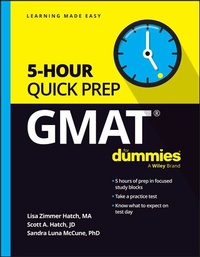
GMAT 5-Hour Quick Prep For Dummies
Description

Fast, focused test prep to help you rock the new GMAT
GMAT 5-Hour Quick Prep For Dummies is the fastest way to prep for test-day success on the notoriously difficult MBA grad school admissions exam. Calm your jitters with an overview of test content, know what to expect on the day of the exam, and take a short-form practice test with detailed explanations of the answers. You'll get the full rundown on the brand new GMAT Focus test, too. This one-of-a-kind study guide is broken down into study blocks that you can tackle in 5 hours - all at once or over a few days. Then, the night before the test, review tips and reminders to make test day a breeze. Let this Dummies Quick Prep program put you on the fast track toward a calm and confident GMAT exam day.
- Know what to expect on the GMAT exam, including the content and test format
- Work through example questions for writing, quantitative, verbal, reading, and analytical skills
- Reinforce what you know with a short sample test that includes detailed answers
- Improve your chances of getting into the business school you want with a great score on the GMAT
GMAT 5-Hour Quick Prep For Dummies is perfect for future business and management students preparing to take the new GMAT Focus and looking for a fast, focused study guide.
More details
Other editions
Additional editions
Persons
Lisa Zimmer Hatch, MA, and Scott A. Hatch, JD, help students excel on standardized tests. They have authored numerous test-prep texts and curricula.
Sandra Luna McCune, PhD, is professor emeritus at Stephen F. Austin State University. She's currently an author and statistics consultant.
Content
Start Here 1
About This Book 1
Foolish Assumptions 1
Icons Used in This Book 2
Where to Go from Here 2
Block 1: GMAT Overview in 20 Minutes 3
Signing Up for the GMAT 3
Deciding where to take the test 3
Registering for the GMAT 4
Knowing What's on the Test 4
Checking out how the GMAT is structured 5
Knowing what you're being tested for 5
Navigating the computerized test 6
Preparing for the GMAT 7
Getting Up to Speed on GMAT Scoring 8
Interpreting your score 8
Deciding whether to retake the test 9
Block 2: Vanquishing the Verbal Section 11
Acing the Reading Comprehension Questions 11
Knowing what reading comprehension questions look like 11
Approaching reading passages 12
Sticking to the subject: Types of passages 13
Approaching reading comprehension questions 14
Reading comprehension practice questions with answer explanations 20
Sharpening Your Critical Reasoning Skills 25
Focusing on "critical" concepts: An overview 25
Making a case: Essentials of informal logic 26
Thinking inside the box: Question types 29
Stalking your prey: How to approach each question type 30
Critical reasoning practice questions and answer explanations 41
Block 3: Conquering the Quantitative Section 47
Juggling Numbers and Operations 47
Just your type: Kinds of numbers 47
It's not brain surgery: Basic operations 48
Working with bases and exponents 52
Checking out the ancestry: Roots 54
Following the order of operations 55
Splitting up: Fractions, decimals, and percents 56
Making comparisons: Ratios and proportions 61
Playing the numbers: Scientific notation 62
Considering All the Variables: Algebra 63
Defining the elements: Algebraic terminology 63
Mastering algebraic operations 65
Extracting information: Factoring polynomials 70
Minding your Ps and Qs: Functions 71
Putting on your thinking cap: Problem solving 75
Seeing is believing: The coordinate plane 87
Slip-sliding away: Slope and linear equations 89
Manipulating Statistics and Sets 91
Joining a clique: Groups 92
Setting up sets 93
Dealing with permutations and combinations 94
Meeting in the middle: Mean, median, and mode 97
Solving range and standard deviation problems 99
Predicting the future: Probability 101
Tackling Problem-Solving Questions 105
Block 4: Excelling on the Data Insights Section 107
Knowing What to Expect: Four Key Integrated Reasoning Question Types 107
Understanding what the IR questions are all about 107
Approaching each question type 110
Extracting Insights from Graphic Data 122
Mastering graphics-focused questions with five simple steps 122
Translating information in tables 123
Making comparisons with bar graphs 123
Honing in on histograms 126
Looking at line graphs 127
Perusing stem-and-leaf plots 130
Clarifying circle graphs (also known as pie charts) 130
Venturing into Venn diagrams 131
Taking on Data Sufficiency Questions 133
You don't need the solution to find the answer 133
Steps to approaching data sufficiency questions 134
Block 5: Taking a (Shortened) Practice Test 139
Section 1: Data Insights 140
Section 2: Quantitative 145
Section 3: Verbal 148
Answer and Explanations 152
Section 1: Data Insights 152
Section 2: Quantitative 155
Section 3: Verbal 159
Answer Key 162
Block 6: Ten Tips for Scoring Higher on the GMAT 163
Pace Yourself 163
Guess and Move On 164
Take Advantage of the Review and Edit Option 164
Finish It! Completing Each Section 164
Give Each Question Equal Treatment 165
Make Time for the Last Ten Questions 165
Use the Process of Elimination to Improve Your Odds 166
Maintain Your Focus 166
Take Time to Read the Questions 166
Don't Sink All Your Time into the Hard Questions 167
Index 169
Block 2
Vanquishing the Verbal Section
The Verbal section of the GMAT mixes reading comprehension questions with critical reasoning questions - about half and half. In this block, we explain how to approach a variety of questions in both categories and present you with plenty of sample reading passages and questions to help you gain valuable practice.
Acing the Reading Comprehension Questions
Reading comprehension questions are designed to test how well you understand unfamiliar reading material. But you're probably less concerned with the reason these passages are included on the GMAT than you are with getting through all that reading and question-answering with enough time remaining to confront those pesky critical reasoning questions. What you need is a proven strategy. And in this section, we deliver by introducing you to the types of passages and questions you'll encounter and telling you how to deal with them.
Knowing what reading comprehension questions look like
When the GMAT presents you with a reading comprehension question, you'll see a split screen with an article passage on the left and a question with five answer choices on the right. Although every passage has more than one question (usually, passages have about three to four questions), only one question pops up at a time. You read the passage (which contains about 350 words), click on the choice that best answers the question, and confirm your answer. As soon as you confirm your answer, another question pops up on the right side of the screen. The passage remains on the left. Sometimes a question refers to a particular part of the passage. For these questions, the GMAT highlights the portion of the passage you need to focus on to answer the question.
Approaching reading passages
Reading comprehension questions don't ask you to do anything particularly unfamiliar. You've probably been reading passages and answering multiple-choice questions about them since you were in elementary school. If you're having difficulty answering reading comprehension questions correctly, don't worry: Your reading skills are likely fine. You're probably just not familiar with the specific way you have to read for the GMAT.
You have about two minutes to answer each reading comprehension question, and that includes the time for reading the passage. Generally, you shouldn't spend more than five minutes reading a passage before you answer its questions, so you have to read as efficiently as you can. You need a plan for getting through the passage in a way that allows you to answer questions correctly and quickly. When you read a passage, focus on the following elements:
- The passage's general theme
- The author's tone
- The way the author organizes the passage
Don't try to figure out the passage's minutiae while you're reading it. If you encounter a question about a tiny detail, you can go back and reread the relevant section.
Mastering the message: The main point
Generally, people write passages to inform or persuade. Most of the passages on the GMAT are informative rather than argumentative, and even the argumentative ones are pretty tame.
The main point of GMAT passages is often to discuss a topic, to inform the reader about a phenomenon, or to compare one idea to another. Rarely does a GMAT passage seek to condemn, criticize, or enthusiastically advocate a particular idea or position.
Because most authors present the main theme in the first paragraph or two, you'll probably figure it out in the first few seconds of your reading. If it's not clear in the first paragraphs, it probably appears in the last paragraph, where the author sums up the ideas. After you've figured out the author's overall theme, quickly jot down on your note board a word or two to help you remember the theme.
Absorbing the ambiance: Author's tone
In addition to understanding the author's main point, you need to know how the author feels about the issue. You get clues to the authors' tone or mood by the words they use. GMAT passages either inform the reader about something or try to persuade the reader to adopt the author's viewpoint. Informative passages are often more objective than persuasive ones, so the author's tone is usually neutral. Authors of persuasive passages may exhibit more emotion. You may sense that an author is critical, sarcastic, pessimistic, optimistic, or supportive. When you figure out how the author feels about the topic, write a short description on your note board, like objective, hopeful, or mildly critical. Knowing the tone of a passage helps you choose answers that exhibit the same tone or level of bias.
Don't let your personal opinions about a passage's subject matter influence your answer. Remind yourself that correct answers are true according to the passage or according to the author.
Finding the framework: The passage's outline
Knowing the structure of a passage is much more important than understanding its details. Instead of trying to comprehend everything the author says, focus on how the author lays out the information. Standard essay format includes an introduction with a thesis, two or three supporting paragraphs, and a conclusion. Many GMAT passages are excerpts from larger works, so they may not exhibit exact standard essay form, but they'll contain evidence of all three elements. As you read, determine the passage's overall point and the main points of each paragraph.
You may find it helpful to construct a mini-outline of the passage as you read it. Underneath the main theme, jot down a word or two on your note board that describes the type of information contained in each paragraph. Building an outline in your head or on your note board helps you know where in the passage you can find answers to questions about particular details. Doing so also helps you answer any questions that ask you how authors develop their points.
Even though you don't need to read and understand every detail of a passage before you answer its questions, we highly recommend that you scan the entire passage before you attempt the questions.
Sticking to the subject: Types of passages
You may think that because the GMAT measures your aptitude for MBA programs, its reading passages deal with subjects like marketing and economics. You're wrong. Although some of the passages do concern business matters, you'll also read about topics from the natural and social sciences. The GMAT wants to see how well you analyze a variety of topics, unfamiliar and familiar. In the following sections, we explore the types of reading passages found on the GMAT.
Experimenting with natural science passages
Physical and biological sciences mean big business. Some of the areas of commerce that depend on science include pharmaceuticals, computers, agriculture, the defense industry, household products, and materials manufacturing (such as plastics and polymers). These industries, taken together, exert a huge influence on people's lives and the nation's economy. Just think of this country without computers and pharmaceuticals, not to mention modern agriculture!
Note that reading comprehension questions don't assume that you have any previous knowledge in the subject. If you do come across a reading passage on chemistry and it's been 20 years since you've studied the periodic table, relax. The answer to every question is located somewhere in the passage.
When you come across a passage on a subject that you're familiar with, don't rely on your outside knowledge to answer the question! Make sure the answers you choose can be justified by information contained in the passage.
Natural science passages tend to be more objective and neutral than persuasive in tone. So usually the main theme of a natural science topic is to explain, describe, or inform about a scientific event.
Gathering in social circles: Social science passages
In addition to natural science passages, the GMAT presents passages about a different kind of science: social science, which includes topics like law, philosophy, history, political science, archeology, sociology, and psychology. The good news about social science passages is that their topics tend to crop up more in the news and in daily conversation than does, for example, physics! So you're more likely to be comfortable, if not necessarily familiar, with them.
Although passages about the social sciences are still mostly descriptive and informative, they're more likely to be persuasive than natural science passages, so you may see more variety in the kinds of tones these passages display.
Getting down to business passages
Business passages may be objective or persuasive and are generated from fields like economics, marketing, resource management, and accounting, among others. Finally, topics you're familiar with! You'll probably breeze right through most of these passages. But don't let familiarity with the topic serve as an excuse to slack off. You need your powers of concentration for every passage regardless of the topic.
If the passage is on a familiar subject, don't fall into the trap of using your own information to...
