

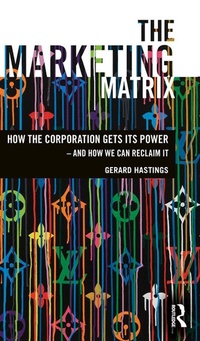
The Marketing Matrix
How the Corporation Gets Its Power - And How We Can Reclaim It
1st Edition
Published on 2. May 2013
224 pages
978-1-136-22892-6 (ISBN)
Description

In the hands of the corporate sector, marketing has turned us into spoilt, consumption-obsessed children who are simultaneously wrecking our bodies, psyches and planet. Given the fiduciary duties of the corporation, notions like consumer sovereignty, customer service and relationship building are just corrosive myths that seduce us into quiescence, whilst furnishing big business with unprecedented power. Corporate Social Responsibility, the ultimate oxymoron, and its country cousin, Cause Related Marketing, are just means of currying favour amongst our political leaders and further extending corporate power.
So it is time to fight back. As individuals we have enormous internal strength; collectively we have, and can again, change the world (indeed marketing itself is a function of humankind's capacity to cooperate to overcome difficulties and way predates its co-option by corporations). From the purpose and resilience Steinbeck's sharecroppers ('we're the people - we go on'), through Eisenhower's 'alert and knowledgeable citizenry' to Arundhati Roy's timely reminder about the wisdom of indigenous people 'are not relics of the past, but the guides to our future', there are lots of reasons for optimism. If these talents and strengths can be combined with serious moves to contain the corporate sector, it is possible to rethink our economic and social priorities. The book ends with a call to do just this.
This compelling and accessible book will be of interest across the social sciences and humanities - and indeed to anyone who has concerns about the current state of consumer society. It will also be particularly useful reading for those marketing students who'd prefer a critical perspective to the standard ritualization of their discipline.
So it is time to fight back. As individuals we have enormous internal strength; collectively we have, and can again, change the world (indeed marketing itself is a function of humankind's capacity to cooperate to overcome difficulties and way predates its co-option by corporations). From the purpose and resilience Steinbeck's sharecroppers ('we're the people - we go on'), through Eisenhower's 'alert and knowledgeable citizenry' to Arundhati Roy's timely reminder about the wisdom of indigenous people 'are not relics of the past, but the guides to our future', there are lots of reasons for optimism. If these talents and strengths can be combined with serious moves to contain the corporate sector, it is possible to rethink our economic and social priorities. The book ends with a call to do just this.
This compelling and accessible book will be of interest across the social sciences and humanities - and indeed to anyone who has concerns about the current state of consumer society. It will also be particularly useful reading for those marketing students who'd prefer a critical perspective to the standard ritualization of their discipline.
Reviews / Votes
'Gerard Hastings' masterful and ground breaking treatise on marketing is nothing short of a map out of the desert leading us all to Jericho. His challenge to the consumptive nature of the developed world and the unveiling of the "big lie", that the global corporate culture is working on the behalf of society, is nothing short of liberating...expect to be challenged...expect to be warned...then, expect to become hopeful...his prescription for healing is even more powerful than his diagnosis.'James H. Lindenberger, Director, Social Marketing Group, University of South Florida, USA
'The cowboy and robber economy is back. There are even business schools that teach students that the sole mission of business is to maximize shareholder value. Finance is everything. Branding, however hollow, is everything. In contrast the new marketing theory of the 3rd millennium puts stress on customer service and value-in-use which is in line with Gerard Hasting's thinking. He has written a daring book. He calls a spade a spade, totally contrary to what advertising and other marketing does. So the conventional marketer will hate it. If they keep reading they will find that Hastings makes sense. We need business, but a nation needs fair business, not just windfall for the few. Marketing is also a tool for creating welfare in society -- for everybody. Only then will business become efficient in the long run.'
Evert Gummesson, Emeritus Professor, Stockholm University School of Business, Sweden
'On the face of it, corporate marketing adds excitement and glamour to the most boring of everyday products and stimulates desire in the most jaded consumers. As consumers we are seduced by the power of this corporate apparatus with its seductive bargains, witty ads, myriad of choice with brand identity as the opiate of the people. As Hastings shows however, the powerful and ubiquitous behaviour change tools of modern marketing - i.e. 'the marketing matrix' - actually create a false and superficial society based on more and more private consumption and less and less wellbeing and real satisfaction. In his ground-breaking analysis and searing critique of corporate marketing, Hastings brilliantly explains how this 'matrix' works and also dedicates the second part of the book to setting out radical solutions for 'marketing as if people mattered'
Mike Saren, Professor of Marketing, University of Leicester, UK
'Gerard Hastings provokes long overdue debate and challenges us to consider the role commercial marketing has played in global catastrophes: deaths from tobacco, alcohol and junk food, among other problems. Yet he resists the temptation merely to demonise marketing and instead holds out the hope we might use the values that once underpinned marketing - reciprocity and mutual respect - to address these profound threats. If the fundamental re-evaluation of marketing that Hasting proposes succeeds, we might indeed understand the difference between being a consumer and a citizen, and take the first steps towards a sustainable, and more equitable, society.'
Janet Hoek, Professor of Marketing, University of Otago, New Zealand
'Wry, direct and disturbing. This book unceremoniously yanks the rug from beneath the feet of decades of marketing text books. It invites us gently, persuasively and passionately to take a long, hard and honest look at consumer capitalism. Drawing inspiration from John Steinbeck, Aldous Huxely, Dwight Eisenhower and Fritz Schumacher it calls for "full-on social change" through rethinking of economic and social systems and through co-ordinated community action. A "must-read" for anyone who cares about our future.'
Professor Agnes Nairn, co-author of "Consumer Kids"
'The Marketing Matrix is an in depth look at corporate marketing and how its power reaches into and limits our lives. As a marketing professor who has examined the inner workings of this power as wielded by alcohol, tobacco and food companies, Prof Hastings provides insight into the abuses of marketing and recommendations for how to combat them. The book is a grim reminder that, with few exceptions, customers, indeed, always come second.'
Craig Lefebvre, Social Marketer 'Gerard Hastings' masterful and ground breaking treatise on marketing is nothing short of a map out of the desert leading us all to Jericho. His challenge to the consumptive nature of the developed world and the unveiling of the "big lie", that the global corporate culture is working on the behalf of society, is nothing short of liberating...expect to be challenged...expect to be warned...then, expect to become hopeful...his prescription for healing is even more powerful than his diagnosis.'
James H. Lindenberger, Director, Social Marketing Group, University of South Florida
'The cowboy and robber economy is back. There are even business schools that teach students that the sole mission of business is to maximize shareholder value. Finance is everything. Branding, however hollow, is everything. In contrast the new marketing theory of the 3rd millennium puts stress on customer service and value-in-use which is in line with Gerard Hasting's thinking. He has written a daring book. He calls a spade a spade, totally contrary to what advertising and other marketing does. So the conventional marketer will hate it. If they keep reading they will find that Hastings makes sense. We need business, but a nation needs fair business, not just windfall for the few. Marketing is also a tool for creating welfare in society -- for everybody. Only then will business become efficient in the long run.'
Evert Gummesson, Emeritus Professor, Stockholm University School of Business, Sweden
More details
Language
English
Place of publication
London
United Kingdom
Publishing group
Taylor & Francis Ltd
Target group
College/higher education
Illustrations
5 s/w Abbildungen, 16 s/w Tabellen, 3 s/w Photographien bzw. Rasterbilder, 2 s/w Zeichnungen
16 Tables, black and white; 2 Line drawings, black and white; 3 Halftones, black and white; 5 Illustrations, black and white
File size
5,96 MB
ISBN-13
978-1-136-22892-6 (9781136228926)
Copyright in bibliographic data and cover images is held by Nielsen Book Services Limited or by the publishers or by their respective licensors: all rights reserved.
Schweitzer Classification
Other editions
Additional editions
Book
10/2012
1st Edition
Routledge
€230.65
Shipment within 15-20 days
Book
10/2012
1st Edition
Routledge
€94.38
Shipment within 15-20 days
Person
Gerard Hastings is Professor of Social Marketing at Stirling and The Open University. He worked in market research before beginning his academic career, which has focused on researching the impact of marketing on society -- especially the harm done by the alcohol, tobacoo and fast food industries. This has involved him in advising Government, working with policy makers both nationally and internationally and acting as an expert witness in litigation -- as well as publishing widely in both academic and popular outlets. His work also looks at the value of social marketing, and his first book was called Social Marketing: Why Should the Devil Have All the Best Tunes? He was awarded the OBE for services to health care in 2009.
Content
Part I: Out of Control 1. The Soft Power of Corporate Marketing 2. The Customer Always Comes Second 3. A Tyranny of Choice 4. Not Exactly Lying... 5. Suffer the Little Children 6. Digital Redemption? 7. A Very Mixed Blessing 8. Marketing to Power Part II: Solutions 9. In Search of Solutions 10. Power to the People 11. Marketing as if People Mattered
