

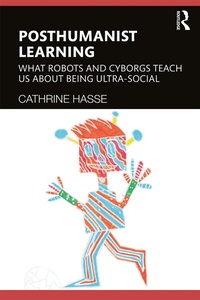
Posthumanist Learning
What Robots and Cyborgs Teach us About Being Ultra-social
1st Edition
Published on 3. January 2020
360 pages
978-1-317-29869-4 (ISBN)
Description

In this text Hasse presents a new, inclusive, posthuman learning theory, designed to keep up with the transformations of human learning resulting from new technological experiences, as well as considering the expanding role of cyborg devices and robots in learning. This ground-breaking book draws on research from across psychology, education, and anthropology to present a truly interdisciplinary examination of the relationship between technology, learning and humanity.
Posthumanism questions the self-evident status of human beings by exploring how technology is changing what can be categorised as "human". In this book, the author applies a posthumanist lens to traditional learning theory, challenging conventional understanding of what a human learner is, and considering how technological advances are changing how we think about this question. Throughout the book Hasse uses vignettes of her own research and that of other prominent academics to exemplify what technology can tell us about how we learn and how this can be observed in real-life settings.
Posthumanist Learning is essential reading for students and researchers of posthumanism and learning theory from a variety of backgrounds, including psychology, education, anthropology, robotics and philosophy.
Posthumanism questions the self-evident status of human beings by exploring how technology is changing what can be categorised as "human". In this book, the author applies a posthumanist lens to traditional learning theory, challenging conventional understanding of what a human learner is, and considering how technological advances are changing how we think about this question. Throughout the book Hasse uses vignettes of her own research and that of other prominent academics to exemplify what technology can tell us about how we learn and how this can be observed in real-life settings.
Posthumanist Learning is essential reading for students and researchers of posthumanism and learning theory from a variety of backgrounds, including psychology, education, anthropology, robotics and philosophy.
More details
Edition
1. Auflage
Language
English
Place of publication
London
United Kingdom
Publishing group
Taylor & Francis Ltd
Target group
College/higher education
Illustrations
10 s/w Abbildungen
2 Line drawings, black and white; 20 Halftones, black and white
ISBN-13
978-1-317-29869-4 (9781317298694)
Copyright in bibliographic data and cover images is held by Nielsen Book Services Limited or by the publishers or by their respective licensors: all rights reserved.
Schweitzer Classification
Other editions
Additional editions
Book
01/2020
1st Edition
Routledge
€73.60
Shipment within 10-20 days
Book
01/2020
1st Edition
Routledge
€207.20
Shipment within 10-20 days
Person
Cathrine Hasse is Professor of Cultural Anthropology and Learning at the University of Aarhus, Denmark.
Content
Foreword
Chapter 1: Introduction
Vignette 1 Jibo
Vignette 2 The robot is present
Chapter 2: Posthumanist learning in education
Vignette 3. The Lamentations of an Uneducated Daughter
Vignette 4: Fair in Kelly Writers House
Chapter 3 Emotional Collectives
Vignette 5: Meeting the Mars Path Finder
Vignette 6: Particle in cigar-entanglements
Chapter 4. Robots in a storied world
Vignette 7: Olimpia's yawns
Vignette 8: Telenoid in the lab
Chapter 5: The Materiality of Words
Vignette 9: Becoming physicists
Vignette 10: What robots are really like
Chapter 6: Socio-material concept formation
Vignette 11: Materialising robots
Chapter 7: Collective of collectives
Vignette 12. The Silent Drawing
Chapter 8: Learning with cyborg technology
Vignette 13: Feeling the world
Chapter 9: Extended mindful bodies
Vignette 14: The ship collective
Chapter 10: Sociality by Proxy
Vignette 15: Learning like Tay
Vignette 16: The clash of ultra-socials
Chapter 1: Introduction
Vignette 1 Jibo
Vignette 2 The robot is present
Chapter 2: Posthumanist learning in education
Vignette 3. The Lamentations of an Uneducated Daughter
Vignette 4: Fair in Kelly Writers House
Chapter 3 Emotional Collectives
Vignette 5: Meeting the Mars Path Finder
Vignette 6: Particle in cigar-entanglements
Chapter 4. Robots in a storied world
Vignette 7: Olimpia's yawns
Vignette 8: Telenoid in the lab
Chapter 5: The Materiality of Words
Vignette 9: Becoming physicists
Vignette 10: What robots are really like
Chapter 6: Socio-material concept formation
Vignette 11: Materialising robots
Chapter 7: Collective of collectives
Vignette 12. The Silent Drawing
Chapter 8: Learning with cyborg technology
Vignette 13: Feeling the world
Chapter 9: Extended mindful bodies
Vignette 14: The ship collective
Chapter 10: Sociality by Proxy
Vignette 15: Learning like Tay
Vignette 16: The clash of ultra-socials
