

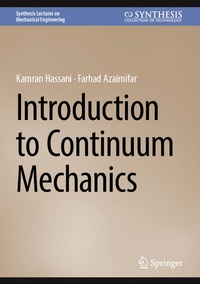
Introduction to Continuum Mechanics
Description

Continuum mechanics is the basis for static and dynamic analysis of two-dimensional structures and three-dimensional continua. Continuum mechanics is crucial because it provides a mathematical framework to understand and predict the behavior of deformable bodies (solids and fluids) by treating matter as a continuous medium, enabling analysis of stress, strain, and motion on a macroscopic scale
This book begins with a brief introduction to the concept of continuum environments in an easy to understand language. Then, mathematic relations and formulas, which are required for describing the main concepts are presented. The next chapters are dedicated to the topics of stress, strain, the continuum mechanics laws, elasticity, and viscoelasticity. The definitions and concepts are explained, and the governing laws are expressed mathematically. Complex mathematical formulations are presented in a way that allows students to understand the concepts. The book includes many examples to make it easier for students to learn and understand these topics. In the final chapter, some applications of continuum mechanics in the real world are mentioned.
More details
Other editions
Additional editions
Persons
Kamran Hassani is an associate professor at the School of Mechanical, Industrial, and Aeronautical Engineering of Witwatersrand University in Johannesburg, South Africa. Before that, he was an associate professor at the Department of Biomechanics of the Islamic Azad University in Tehran, Iran, and served as its head for 12 years. His research focuses on biomechanics, mainly cardiovascular engineering.
Farhad Azimifar is an assistant professor in the Department of Biomedical Engineering at the Faculty of Engineering and Technology in the Khorasgan Branch of the Islamic Azad University in Isfahan, Iran. His research fields are biomedical engineering (biomechanics), surgical robotics, and biomechatronics.
Content
Chapter 1: Introduction.- Chapter 2:Required Mathematics.- Chapter 3:Stress.- Chapter 4:Strain.- Chapter 5:The continuum mechanics laws.- Chapter 6:Elasticity.- Chapter 7: Viscoelasticity.- Chapter 8:Applications.
