

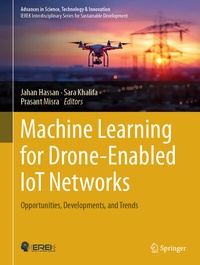
Machine Learning for Drone-Enabled IoT Networks
Description

This book aims to explore the latest developments, challenges, and opportunities in the application of machine learning techniques to enhance the performance and efficiency of IoT networks assisted by aerial unmanned vehicles (UAVs), commonly known as drones. The book aims to include cutting edge research and development on a number of areas within the topic including but not limited to: Machine learning algorithms for drone-enabled IoT networks Sensing and data collection with drones for IoT applications Data analysis and processing for IoT networks assisted by drones Energy-efficient and scalable solutions for drone-assisted IoT networks Security and privacy issues
in drone-enabled IoT networks Emerging trends and future directions in ML for drone-assisted IoT networks.
More details
Other editions
Additional editions
Persons
Dr. Jahan Hassan is a faculty member at Central Queensland University, holding both a Ph.D. and a Bachelor's degree in Computer Science from the University of New South Wales and Monash University, Australia, respectively. Her research focuses on drone-assisted IoT networks, machine learning, energy efficiency, and smart farming applications. Currently, she leads a grant-funded project on AI-assisted weed management, utilizing drone technology to enhance agricultural practices. She is a recipient of the Dean's award on research excellence, and several conference best paper awards. Jahan has made significant contributions to the research community, particularly in networking, machine learning, and drone technologies.
Dr. Sara Khalifa is an associate professor at Queensland University of Technology (QUT), specialising in ubiquitous sensing and edge computing for IoT applications. Her work focuses on improving energy efficiency in mobile sensing and developing lightweight machine learning for resource-constrained devices. Prior joining QUT, she was at CSIRO's Data61, where she pioneered "Energy Harvesting Sensing (EHS)," advancing energy-efficient sensing and creating new applications with significant funding and commercial interest. She earned her Ph.D. in Computer Science and Engineering from UNSW, with her dissertation awarded the 2017 John Makepeace Bennett Award by CORE.
Dr. Prasant Misra is a senior scientist at Tata Consultancy Services-Research and Visiting Faculty at the Robert Bosch Centre for CPS, IISc Bangalore. He received his Ph.D. in Computer Science and Engineering from UNSW Sydney and completed his Post-doctoral fellowship from RISE SICS (the Swedish Institute of Computer Science) Stockholm. His research is centered around modeling, optimization, and decision support for operations management of urban mobility and infrastructure systems.
Content
Machine learning algorithms for drone-enabled IoT networks.- Sensing and data collection with drones for IoT applications.- Data analysis and processing for IoT networks assisted by drones.- Energy-efficient and scalable solutions for drone-assisted IoT networks.- Security and privacy issues in drone-enabled IoT networks.- Emerging trends and future directions in ML for drone-assisted IoT networks.
