

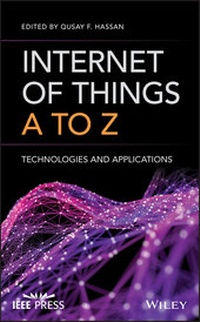
Internet of Things A to Z
Description

Internet of Things A to Z offers a holistic approach to the Internet of Things (IoT) model. The Internet of Things refers to uniquely identifiable objects and their virtual representations in an Internet-like structure. Recently, there has been a rapid growth in research on IoT communications and networks, that confirms the scalability and broad reach of the core concepts. With contributions from a panel of international experts, the text offers insight into the ideas, technologies, and applications of this subject.
The authors discuss recent developments in the field and the most current and emerging trends in IoT. In addition, the text is filled with examples of innovative applications and real-world case studies. Internet of Things A to Z fills the need for an up-to-date volume on the topic. This important book:
* Covers in great detail the core concepts, enabling technologies, and implications of the Internet of Things
* Addresses the business, social, and legal aspects of the Internet of Things
* Explores the critical topic of security and privacy challenges for both individuals and organizations
* Includes a discussion of advanced topics such as the need for standards and interoperability
* Contains contributions from an international group of experts in academia, industry, and research
Written for ICT researchers, industry professionals, and lifetime IT learners as well as academics and students, Internet of Things A to Z provides a much-needed and comprehensive resource to this burgeoning field.
More details
Other editions
Additional editions
Person
QUSAY F. HASSAN, PHD, is a systems analyst at the United States Agency for International Development in Cairo, Egypt, where he deals with large-scale and complex ICT systems. He has many years of both practical and research experience during which he has published several well-received publications, including his latest book Internet of Things: Challenges, Advances, and Applications. His varied research interests include IoT, SOA, high-performance computing, cloud computing, and grid computing. Dr. Hassan is a senior member of IEEE and a member of the editorial board of several associations.
Content
Preface xix
Acknowledgments xxv
Contributors xxvii
Part I Concepts and Perspectives 1
1 Introduction to the Internet of Things 3
Detlef Schoder
1.1 Introduction 3
1.2 Internet of Things Concepts 7
1.3 Who Works on the Internet of Things? 11
1.4 Internet of Things Framework 12
1.5 Information and Communication Technology Infrastructure 14
1.6 Derived Qualities of Modern ICT 31
1.7 Potential for Product, Process, and Business Model Innovations 34
1.8 Implications and Challenges 38
1.9 Conclusion 44
2 Environment, People, and Time as Factors in the Internet of Things Technical Revolution 51
Jan Sliwa
2.1 Introduction 51
2.2 Technical Revolutions 52
2.3 Cyber-Physical-Social Systems 54
2.4 Environment 56
2.5 Time 58
2.6 People 63
2.7 Cybersecurity 67
2.8 Reasoning from Data 69
2.9 Adaptable Self-Organizing Systems 70
2.10 Moral Things 72
2.11 Conclusion 74
Part II Enablers 77
3 An Overview of Enabling Technologies for the Internet of Things 79
Faisal Alsubaei, Abdullah Abuhussein, and Sajjan Shiva
3.1 Introduction 79
3.2 Overview of IoT Architecture 80
3.3 Enabling Technologies 81
3.4 IoT Platforms and Operating Systems 105
3.5 Conclusion 108
4 Cloud and Fog Computing in the Internet of Things 113
Daniel Happ
4.1 Introduction 113
4.2 IoT System Requirements 114
4.3 Cloud Computing in IoT 116
4.4 Fog Computing in IoT 122
4.5 Conclusion 131
5 RFID in the Internet of Things 135
Akaa Agbaeze Eteng, Sharul Kamal Abdul Rahim, and Chee Yen Leow
5.1 Introduction 135
5.2 Historical Perspective 135
5.3 RFID and the Internet of Things 137
5.4 Emergent Issues 144
5.5 Conclusion 146
6 A Tutorial Introduction to IoT Design and Prototyping with Examples 153
Manuel Meruje, Musa Gwani Samaila, Virginia N. L. Franqueira, Mário Marques Freire, and Pedro Ricardo Morais Inácio
6.1 Introduction 153
6.2 Main Features of IoT Hardware Development Platforms 154
6.3 Design and Prototyping of IoT Applications 169
6.4 Projects on IoT Applications 173
6.5 Conclusion 184
7 On Standardizing the Internet of Things and Its Applications 191
Kai Jakobs
7.1 Introduction 191
7.2 Current Status 193
7.3 The Standardization Environment 199
7.4 Standardization in Selected Application Areas 201
7.5 Discussion and Some Speculation 210
7.6 Conclusion 213
Part III Security Issues and Solutions 219
8 Security Mechanisms and Technologies for Constrained IoT Devices 221
Marco Tiloca and Shahid Raza
8.1 Introduction 221
8.2 Security in IoT Protocols and Technologies 222
8.3 Security Issues and Solutions 234
8.4 Conclusion 247
9 Blockchain-Based Security Solutions for IoT Systems 255
Göran Pulkkis, Jonny Karlsson, and Magnus Westerlund
9.1 Introduction 255
9.2 Regulatory Requirements 256
9.3 Blockchain Technology 259
9.4 Blockchains and IoT Systems 261
9.5 Examples of Blockchain-Based Security Solutions for IoT Systems 262
9.6 Challenges and Future Research 270
9.7 Conclusions 270
10 The Internet of Things and IT Auditing 275
John Shu, Jason M. Rosenberg, Shambhu Upadhyaya, and Hejamadi Raghav Rao
10.1 Introduction 275
10.2 Risks Associated with IoT 276
10.3 IT Auditing 279
10.4 Use Cases of IoT in IT Auditing 286
10.5 Protecting the Business Network 287
10.6 Conclusion 289
Part IV Application Domains 293
11 The Industrial Internet of Things 295
Alexander Willner
11.1 Introduction 295
11.2 Market Overview 296
11.3 Interoperability and Technologies 303
11.4 Alliances 309
11.5 Conclusions 314
12 Internet of Things Applications for Smart Cities 319
Daniel Minoli and Benedict Occhiogrosso
12.1 Introduction 319
12.2 IoT Applications for Smart Cities 321
12.3 Specific Smart City Applications 330
12.4 Optimal Enablement of Video and Multimedia Capabilities in IOT 338
12.5 Key Underlying Technologies for Smart Cities IOT Applications 340
12.6 Challenges and Future Research 349
12.7 Conclusion 350
13 Smart Connected Homes 359
Joseph Bugeja, Andreas Jacobsson, and Paul Davidsson
13.1 Introduction 359
13.2 The Smart Connected Home Domain 360
13.3 Smart Connected Home Systems 364
13.4 The Smart Connected Home Technologies 367
13.5 Smart Connected Home Architectures 375
13.6 Smart Connected Home Challenges and Research Directions 376
13.7 Conclusions 381
14 The Emerging "Energy Internet of Things" 385
Daniel Minoli and Benedict Occhiogrosso
14.1 Introduction 385
14.2 Power Management Trends and EIoT Support 390
14.3 Real-Life Power Management Optimization Approaches 410
14.4 Challenges and Future Directions 415
14.5 Conclusion 417
15 Implementing the Internet of Things for Renewable Energy 425
Lucas Finco and Daniel Minoli
15.1 Introduction 425
15.2 Managing the Impact of Sustainable Energy 426
15.3 EIoT Deployment 432
15.4 Industry Standards for EIoT 439
15.5 Security Considerations in EIoT and Clean Energy Environments 441
15.6 Conclusion 442
16 The Internet of Things and People in Health Care 447
Nancy L. Russo and Jeanette Eriksson
16.1 Introduction 447
16.2 The Smart Health Care Ecosystem 448
16.3 Dimensions of Internet of Things Applications in Health Care 453
16.4 Examples of IoT-Related Health Care Applications and Their Dimensions 458
16.5 Challenges 469
16.6 Conclusion 471
17 Internet of Things in Smart Ambulance and Emergency Medicine 475
Bernard Fong, A. C. M. Fong, and C. K. Li
17.1 Introduction 475
17.2 IoT in Emergency Medicine 477
17.3 Integration and Compatibility 486
17.4 Case Study: Chronic Obstructive Pulmonary Disease 492
17.5 Smart Ambulance Challenges 498
17.6 Conclusions 500
18 Internet of Things Applications for Agriculture 507
Lei Zhang, Ibibia K. Dabipi, and Willie L. Brown Jr.
18.1 Introduction 507
18.2 Internet of Things-Based Precision Agriculture 510
18.3 IoT Application in Agriculture Irrigation 512
18.4 IoT Application in Agriculture Fertilization 516
18.5 IoT Application in Crop Disease and Pest Management 518
18.6 IoT Application in Precision Livestock Farming 519
18.7 Conclusion 522
19 The Internet of Flying Things 529
Daniel Fernando Pigatto, Mariana Rodrigues, João Vitor de Carvalho Fontes, Alex Sandro Roschildt Pinto, James Smith, and Kalinka Regina Lucas Jaquie Castelo Branco
19.1 Introduction 529
19.2 Flying Things 530
19.3 The Internet of Flying Things 533
19.4 Challenges 542
19.5 Case Studies 549
19.6 Conclusions 557
Part V Relevant Sample Applications 563
20 An Internet of Things Approach to "Read" the Emotion of Children with Autism Spectrum Disorder 565
Tiffany Y. Tang and Pinata Winoto
20.1 Introduction 565
20.2 Background 567
20.3 Related Work 568
20.4 The Internet of Things Environment for Emotion Recognition 571
20.5 The Study and Discussions 580
20.6 Conclusions 586
21 A Low-Cost IoT Framework for Landslide Prediction and Risk Communication 593
Pratik Chaturvedi, Kamal Kishore Thakur, Naresh Mali, Venkata Uday Kala, Sudhakar Kumar, Srishti Yadav, and Varun Dutt
21.1 Introduction 593
21.2 Background 594
21.3 System Design and Implementation 595
21.4 Testing the IoT Framework 596
21.5 Results 603
21.6 Conclusions 605
Glossary 611
Author's Biography 625
Index 645
Preface
Information and communication technology (ICT) has always been dynamic and evolutionary in nature, leading to the continuous emergence of new technologies and business models. The recent advances in terms of available computing resources, software systems and communication networks, and the continuing miniaturization of hardware components have made it possible to integrate ICT into virtually anything, thus leading to the rise of a new computing paradigm known as the Internet of Things (IoT). The IoT aims at realizing an old dream of turning everyday objects into smart ones that are interconnected via the Internet and able to collect and exchange data and to make decisions autonomously. This additional "smartness" covers both the communication infrastructure and applications, including monitoring systems, industrial automation, and ultimately smart cities. In a recent report, Gartner estimates that there will be 11.2 billion connected devices in use in 2018 and 20.1 billion in 2020. 1 This clearly demonstrates the great potential and importance of this model and is also the motivation behind this book.
The potential of IoT is great and the possible applications of this model are countless. Therefore, uncovering the ins and outs of the IoT is crucial to both technology and business communities. This book seeks to provide a holistic coverage of the IoT model by presenting its principles, enabling technologies, and some of its numerous application domains. Important aspects such as the need for standardization, as well as security issues are also highlighted. The book also presents two sample applications showcasing how the discussed concepts and technologies can be leveraged and put to practical use to solve some real-world problems.
The book is a cohesive material that is composed of 21 chapters authored by several internationally renowned researchers and industry experts. Each chapter focuses on a specific subject and also provides the reader with the necessary background information, thus improving understandability and encouraging the reader to think further.
The book may be used as a textbook for both undergraduate and graduate students. It also comes in handy as a reference for researchers and IT professionals who are interested in IoT concepts, technologies, and possible applications. I hope the readers will enjoy reading this book as much as I enjoyed reviewing and editing the submissions.
Organization of the Book
The book is organized in a way that helps the reader to first grasp the concepts and then learn about key enabling technologies before moving to some potential applications. Although I would advise to read the entire book, most chapters are self-contained allowing the reader to focus on the topics they are interested in. Cross references between chapters are provided to help the reader to navigate between them.
This book is divided into five parts, each of which is devoted to a distinctive area.
Part I: Concepts and Perspectives
This part is composed of two chapters that cover the core concepts underlying the IoT, as well as its evolution and impacts.
Chapter 1 provides an introductory overview of the IoT, including its core conceptual ideas. The chapter also covers closely related concepts and paradigms, as well as a list of initiatives and organizations that contribute to their further development. In addition, the chapter structures the broad range of technical as well nontechnical aspects by presenting a four-layer framework that addresses the IoT's enabling technologies, derived qualities of modern ICT and how they are supporting the IoT, potential for new innovations based on the IoT ecosystem, and finally IoT implications and challenges.
Chapter 2 explores some very important aspects that are usually ignored or forgotten when talking about IoT. Specifically, the chapter addresses issues like the heterogeneity of objects utilized as well as the diversity of environments within which IoT systems run, how time is critical to IoT systems in terms of development and support, people involved in the IoT ecosystem, and new security challenges the IoT poses. It also looks at big data, and both the technical and the moral challenges that result from the adoption of such intelligent objects.
Part II: Enablers
This part comprises five chapters about various IoT enabling technologies that range from hardware items and communication technologies to data processing and storage to the emerging standards.
Chapter 3 gives a general overview of various enabling technologies of the IoT. The discussion of these technologies is based on their application and functionality in the IoT five-layer model. This includes hardware components, network technologies, middleware technologies, application services, and business-related technologies. Moreover, the chapter provides a brief overview of some of the key platforms and operating systems that are widely used in IoT environments.
Chapter 4 provides an introduction to cloud computing and fog computing, two of the key back-end technologies in IoT systems. The chapter highlights the importance of these two models and shows how they complement each other and work together. The chapter presents their advantages and disadvantages, as well as some examples of IoT applications where they can be used.
Chapter 5 introduces RFID, one of the core technologies in IoT systems, and describes the important role it plays. The chapter gives a brief history of RFID showing how it is linked with the emergence of the IoT and highlights some of its possible applications and implementation challenges.
Chapter 6 provides a tutorial that explains the design and development of IoT prototypes using Arduino and Raspberry Pi platforms. The chapter offers a guide that covers both the hardware and software aspects of these platforms for beginners who wish to learn about developing IoT applications. Detailed examples are provided to demonstrate how to implement IoT projects using these two platforms.
Chapter 7 looks at the development over the past 20 years of the standardization efforts for the IoT and four of its applications (and their respective predecessor technologies, if any) and at the links between them. The chapter speculates about the future of standardization in those domains based on what has been accomplished so far.
Part III: Security Issues and Solutions
This part provides three chapters about various security issues, technologies, and considerations in IoT environments.
Chapter 8 explores the main security protocols and technologies currently used in a typical IoT communication stack. This technically oriented chapter also discusses security issues in IoT environments and presents solutions enabled by research and standardization efforts to address them.
Chapter 9 introduces blockchain technology and how it can be leveraged to secure IoT systems and protect their data. The chapter provides some examples where blockchain-based solutions were proposed to secure IoT and gives an idea about integration challenges and current research efforts in this area.
Chapter 10 highlights the importance of IT auditing for organizations adopting the IoT. The chapter discusses the risks associated with the IoT and how routine and thorough IT auditing can prevent them. Risk identification and assessment, as well as audit considerations and policies are presented.
Part IV: Domains
This part is composed of nine chapters presenting various application domains where IoT technologies can be utilized. These chapters present the concepts, underlying technologies, implementation details, and advantages and challenges of such integration.
Chapter 11 represents a foundational chapter for this part as it gives an introduction to the use of IoT in several domains with focus on the Industrial Internet of Things (IIoT) showing how IoT can be leveraged in industrial fields of application. Two of the main initiatives in the IIoT are highlighted, namely, the Industrial Internet Consortium (IIC) and the Plattform Industrie 4.0.
Chapter 12 provides an overview of IoT applications for smart cities and how it can help in improving resource management. The technical aspects and general requirements of such solutions as well as the challenges the broad adoption of IoT faces in smart cities are presented.
Chapter 13 provides a contemporary overview of the IoT applications in smart homes, or what is called in the chapter as smart connected homes. The chapter presents the underlying technologies and architectures of smart connected homes, as well as the services they offer to householders. Both the technical and social challenges are also highlighted.
Chapter 14 addresses the integration of the IoT in the energy domain. The chapter provides a broad discussion of the motivations, approaches, and challenges of this integration and presents some specific applications including smart grid, green IoT, and smart lighting.
Chapter 15 continues the discussion made in Chapter 14 by highlighting various essential developments that are required for deploying and managing smart grids and renewable generation sources using IoT. The technical requirements, industry standards, and security concerns are addressed in this chapter.
Chapter 16 provides a comprehensive discussion on the integration of the IoT in patient-focused health applications. The chapter first describes the key elements of IoT-based health care ecosystems, and then explores the different types of...
