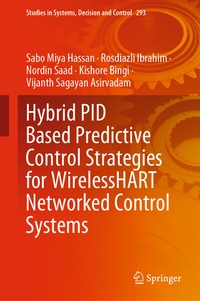
Hybrid PID Based Predictive Control Strategies for WirelessHART Networked Control Systems
Description

Recent advances in wireless technology have led to the emergence of industry standards such as WirelessHART. These strategies minimise the need for cumbersome cabling, thereby reducing costs. However, applying them involves the challenge of handling stochastic network delays, which can degrade control performance. To address this problem, commonly used simple PID could be employed. However, PID suffers from gain range limitations when used in a delayed environment. Furthermore, model-based controllers are complex and require exact models of the process and systematic system identification for implementation.
Therefore, to address these issues, the book proposes control strategies that retain the simplicity of PID in terms of ease of tuning and structure, while improving on the performance of the closed-loop system with regard to stochastic network delays and mismatches. Concretely, it proposes and discusses three strategies, namely: Setpoint Weighting (SW), Filtered Predictive PI (FPPI) and Optimal Fuzzy PID. In order to optimise some of these controllers, two novel hybrid optimisation algorithms combining the dynamism of the Bacterial Foraging Algorithm (BFA) and advantages of both the Spiral Dynamic Algorithm (SDA) and the Accelerated Particle Swarm Optimisation (APSO) have been used. The strategies proposed here can also be applied in stochastic control scenarios (not necessarily wireless) characterised by uncertainties.
This book will be useful to engineers and researchers in both industry and academia. In industry, it will be particularly useful to research and development efforts where PID controllers and wireless sensor networks (WSNs) involving both short and long term stochastic network delay are employed. Thus, it can be used for real-time control design in these areas. In the academic setting, the book will be useful for researchers, undergraduate and graduate students of instrumentation and control. It can also be used as referencematerial for teaching courses on predictive and adaptive controls and their application.More details
Other editions
Additional editions