

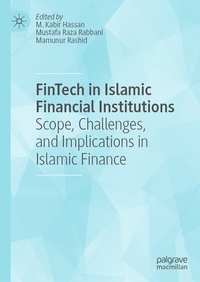
FinTech in Islamic Financial Institutions
Description

This book explores several challenges facing FinTech in Islamic financial institutions. Firstly, large banks and financial institutions in countries with updated and innovative technological channels will earn the technology arbitrage from FinTech. This 'size' puzzle may create a challenge for Islamic financial institutions that are of smaller size and from technologically less-developed countries. Secondly, while access to FinTech is getting broader day by day, usage of FinTech is still limited due to personal and governance-related limitations. Moreover, the level of awareness of the emerging FinTech services (i.e., bitcoin, blockchain, etc.) remains extremely poor even among the residents of technologically-advanced countries. Thirdly, use of FinTech by Islamic financial institutions is limited to Islamic banking, to users from developed countries, among young customers, and for a limited number of traditional banking services such as the deposits and payment services. Also,banks hope to use FinTech to increase the size of a new breed of technology-savvy depositors and loan customers to achieve economies of scale, which may help stabilize the banking sector. Automation in Islamic banks and the participation of Islamic financial institutions in blockchain and bitcoin domains require extensive research from Shariah-compliance as well as market and consumer-related grounds. With all the opportunities and challenges of FinTech-promoting inclusion, easier loan monitoring, and risk of Shariah non-compliance-this book explores the implications for Islamic financial institutions and will be of interest to scholars, researchers, and students of Islamic finance and financial technology.
More details
Other editions
Additional editions
Persons
M. Kabir Hassan is a Professor of Finance in the Department of Economics and Finance in the University of New Orleans, USA. He currently holds two endowed Chairs-Hibernia Professor of Economics and Finance, and Bank One Professor in Business. He is the winner of the 2016 Islamic Development Bank (IDB) Prize in Islamic Banking and Finance.
Mustafa Raza Rabbani is an Assistant Professor in the Department of Economics and Finance at the University of Bahrain and holds a PhD in Banking and Financial Services from Jamia Millia Islamia University, India.
Mamunur Rashid is a Senior Lecturer in Finance at the Christ Church Business School, Canterbury Christ Church University, UK. Prior to joining CCCU, he taught Finance at University Brunei Darussalam, the University of Nottingham, and East West University for more than 17 years.
