

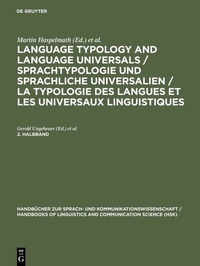
Language Typology and Language Universals 2.Teilband
An International Handbook / Ein internationales Handbuch / Manuel international
1st Edition
Published on 14. July 2008
X, 1002 pages
978-3-11-019426-5 (ISBN)
Description

No detailed description available for "Language Typology and Language Universals 2.Teilband".
More details
Series
Edition
Reprint 2017
Language
English
French
German
Place of publication
Berlin/Boston
Germany
Publishing group
de Gruyter Mouton
Target group
Professional and scholarly
US School Grade: College Graduate Student
Illustrations
Zahlr. Abb.
Num. figs.
File size
124,23 MB
ISBN-13
978-3-11-019426-5 (9783110194265)
Schweitzer Classification
Other editions
Additional editions
Martin Haspelmath | Ekkehard Koenig | Wulf Oesterreicher
Language Typology and Language Universals 2.Teilband
An International Handbook / Ein internationales Handbuch / Manuel international. Two volumes / Zwei Halbbände
Book
12/2001
1st Edition
De Gruyter Mouton
€540.00
Shipment within 7-9 days
Martin Haspelmath | Ekkehard König | Wulf Oesterreicher
Language Typology and Language Universals / Sprachtypologie und sprachliche... / Language Typology and Language Universals / Sprachtypologie und sprachliche.... 2. Halbband
Book
01/2001
1st Edition
De Gruyter Mouton
€759.00
Article exhausted; check different version
Content
1 - Contents / Inhalt / Contenu [Seite 5]
2 - X. Syntactic Typology / Syntaktische Typologie / Typologie syntaxique [Seite 11]
2.1 - 64. Word order typology [Seite 11]
2.1.1 - 1. Historical overview [Seite 11]
2.1.2 - 2. Heads [Seite 11]
2.1.3 - 3. Major constituents of the clause [Seite 21]
2.1.4 - 4. References [Seite 27]
2.2 - 65. Le marquage diffe´rentiel de l'objet [Seite 29]
2.2.1 - 1. Introduction [Seite 29]
2.2.2 - 2. Formes de la variation [Seite 30]
2.2.3 - 3. Corrélats de la variation [Seite 32]
2.2.4 - 4. Variations connexes [Seite 36]
2.2.5 - 5. Facteurs associés [Seite 38]
2.2.6 - 6. Abréviations spéciales [Seite 40]
2.2.7 - 7. Références [Seite 40]
2.3 - 66. Causatives [Seite 42]
2.3.1 - 1. Definitions [Seite 42]
2.3.2 - 2. Formal types of causatives [Seite 42]
2.3.3 - 3. Causative and related categories [Seite 44]
2.3.4 - 4. Syntax of causative constructions [Seite 45]
2.3.5 - 5. The semantics of causative verbs [Seite 47]
2.3.6 - 6. Diachronic sources of causative affixes [Seite 51]
2.3.7 - 7. Special abbreviations [Seite 51]
2.3.8 - 8. References [Seite 51]
2.4 - 67. The passive voice [Seite 55]
2.4.1 - 1. Introduction [Seite 55]
2.4.2 - 2. Morphology of the passive voice [Seite 56]
2.4.3 - 3. Syntax of the passive construction [Seite 58]
2.4.4 - 4. Functions of the passive voice [Seite 60]
2.4.5 - 5. Derived vs. basic status of the passive voice [Seite 64]
2.4.6 - 6. Cross-linguistic distribution of the passive voice [Seite 66]
2.4.7 - 7. The passive in relation to some other grammatical phenomena [Seite 66]
2.4.8 - 8. Special abbreviations [Seite 69]
2.4.9 - 9. References [Seite 69]
2.5 - 68. Verbal reflexives and the middle voice [Seite 72]
2.5.1 - 1. Verbal reflexives vs. reflexive pronouns [Seite 72]
2.5.2 - 2. Morphological types of verbal reflexives [Seite 73]
2.5.3 - 3. Syntactic types of verbal reflexives [Seite 74]
2.5.4 - 4. Polysemy of verbal reflexive markers [Seite 76]
2.5.5 - 5. Accounts of the polysemy [Seite 79]
2.5.6 - 6. Valence-increasing vs. valence-decreasing languages [Seite 82]
2.5.7 - 7. Special abbreviations [Seite 82]
2.5.8 - 8. References [Seite 82]
2.6 - 69. Resultative constructions [Seite 84]
2.6.1 - 1. Introduction [Seite 84]
2.6.2 - 2. Distinctions between the resultative and contiguous categories [Seite 86]
2.6.3 - 3. The resultative form [Seite 87]
2.6.4 - 4. Agent-oriented resultative [Seite 88]
2.6.5 - 5. Resultative proper and statives [Seite 89]
2.6.6 - 6. Principal resultative meanings [Seite 90]
2.6.7 - 7. Restrictions on resultative formation [Seite 91]
2.6.8 - 8. Polysemy of resultative markers [Seite 91]
2.6.9 - 9. The agentive complement (AC) with Patient-oriented resultatives [Seite 94]
2.6.10 - 10. Abbreviations [Seite 95]
2.6.11 - 11. References [Seite 95]
2.7 - 70. Existential constructions [Seite 97]
2.7.1 - 1. Overview [Seite 97]
2.7.2 - 2. Conventional analyses [Seite 97]
2.7.3 - 3. Extended view of the existential [Seite 98]
2.7.4 - 4. The locative proform [Seite 100]
2.7.5 - 5. The existential and the predicate locative [Seite 101]
2.7.6 - 6. A theoretical proposal [Seite 102]
2.7.7 - 7. The 'have' existential [Seite 106]
2.7.8 - 8. 'My helicopter is' [Seite 107]
2.7.9 - 9. Summary [Seite 108]
2.7.10 - 10. Special abbreviations [Seite 109]
2.7.11 - 11. References [Seite 109]
2.8 - 71. Predicative possession [Seite 110]
2.8.1 - 1. Definition of the domain [Seite 110]
2.8.2 - 2. Major types of predicative possession [Seite 110]
2.8.3 - 3. Transitivization [Seite 112]
2.8.4 - 4. Adjectivalization [Seite 113]
2.8.5 - 5. Correlations of the Possessive Typology [Seite 113]
2.8.6 - 6. References [Seite 115]
2.9 - 72. Adnominal possession [Seite 116]
2.9.1 - 1. Adnominal possession and possessive noun phrases: prototypical cases [Seite 116]
2.9.2 - 2. Structural types of possessive noun phrases [Seite 117]
2.9.3 - 3. Functions of possessors within PNPs and possessor-article incompatibility [Seite 120]
2.9.4 - 4. Splits in the possession area [Seite 121]
2.9.5 - 5. Grammaticalization patterns [Seite 123]
2.9.6 - 6. Connections with other grammatical phenomena [Seite 124]
2.9.7 - 7. Special abbreviations [Seite 125]
2.9.8 - 8. References [Seite 125]
2.10 - 73. Internal and external possessors [Seite 126]
2.10.1 - 1. Basic distinctions [Seite 126]
2.10.2 - 2. Typical properties of external possessors [Seite 128]
2.10.3 - 4. Areal patterns [Seite 133]
2.10.4 - 5. Theoretical issues [Seite 133]
2.10.5 - 6. References [Seite 134]
2.11 - 74. Complement clauses [Seite 135]
2.11.1 - 1. Introduction [Seite 135]
2.11.2 - 2. Complement clauses in view of finiteness and clause combining [Seite 135]
2.11.3 - 3. The semantics of complementation [Seite 138]
2.11.4 - 4. Diachronic aspects of complementation [Seite 142]
2.11.5 - 5. Distributional and other constraints on complement clauses: cross-linguistic variation [Seite 144]
2.11.6 - 6. Complement clauses and relative clauses: cross-linguistic distributional patterning [Seite 146]
2.11.7 - 7. Conclusion [Seite 147]
2.11.8 - 8. Special abbreviations [Seite 147]
2.11.9 - 9. References [Seite 147]
2.12 - 75. Comparative constructions [Seite 149]
2.12.1 - 1. Definition of the domain [Seite 149]
2.12.2 - 2. The comparison of inequality: parameters [Seite 149]
2.12.3 - 3. Predicate marking in comparative constructions [Seite 151]
2.12.4 - 4. Explanation of the typology of comparative constructions [Seite 151]
2.12.5 - 5. Comparison of equality [Seite 153]
2.12.6 - 6. Special abbreviations [Seite 153]
2.12.7 - 7. References [Seite 153]
2.13 - 76. Conditional constructions [Seite 154]
2.13.1 - 1. Introduction [Seite 154]
2.13.2 - 2. Conditionals in logic and linguistics [Seite 154]
2.13.3 - 3. Conditional markers [Seite 157]
2.13.4 - 4. Tense, aspect, mood, modality and polarity in conditionals [Seite 160]
2.13.5 - 5. "Conditionals are topics" [Seite 162]
2.13.6 - 7. Special abbreviations [Seite 164]
2.13.7 - 8. References [Seite 164]
2.14 - 77. Interrogative constructions [Seite 166]
2.14.1 - 1. Introduction [Seite 166]
2.14.2 - 2. Clause types and associated speech acts [Seite 167]
2.14.3 - 3. Types of interrogative constructions [Seite 167]
2.14.4 - 4. Polar interrogatives [Seite 168]
2.14.5 - 5. Constituent interrogatives [Seite 174]
2.14.6 - 6. Non-canonical uses of interrogative constructions [Seite 182]
2.14.7 - 7. Special abbreviations [Seite 183]
2.14.8 - 8. References [Seite 183]
2.15 - 78. Hortative constructions [Seite 184]
2.15.1 - 1. Hortative constructions: definition and calculus [Seite 184]
2.15.2 - 2. Classification of hortative constructions [Seite 185]
2.15.3 - 3. Interpretations of hortative constructions [Seite 186]
2.15.4 - 4. Semantics of verbs used in hortative constructions [Seite 187]
2.15.5 - 5. The imperative paradigm [Seite 188]
2.15.6 - 6. Description of the imperative paradigm [Seite 191]
2.15.7 - 7. Actual imperative paradigms as contrasted with the ideal imperative paradigm [Seite 193]
2.15.8 - 8. References [Seite 194]
2.16 - 79. Exclamative constructions [Seite 194]
2.16.1 - 1. Introduction [Seite 194]
2.16.2 - 2. The conceptual basis of the exclamative category [Seite 194]
2.16.3 - 3. The exclamative sentence type [Seite 197]
2.16.4 - 4. The cross-linguistic expression of exclamative meaning [Seite 198]
2.16.5 - 5. Conclusion [Seite 205]
2.16.6 - 6. References [Seite 205]
2.17 - 80. Dislocation [Seite 206]
2.17.1 - 1. Definition and terminology [Seite 206]
2.17.2 - 2. Dislocation and superficially similar constructions [Seite 208]
2.17.3 - 3. The structure of dislocation sentences [Seite 210]
2.17.4 - 4. The syntactic status of dislocated constituents [Seite 221]
2.17.5 - 5. Discourse functions of Left- Dislocation and Right-Dislocation [Seite 228]
2.17.6 - 6. Special abbreviations [Seite 232]
2.17.7 - 7. References [Seite 233]
2.18 - 81. Focus constructions [Seite 235]
2.18.1 - 1. The notion of focus construction [Seite 235]
2.18.2 - 2. The grammatical structure of focus constructions [Seite 244]
2.18.3 - 3. Focus marking and the grammaticalization of focus constructions [Seite 251]
2.18.4 - 4. References [Seite 256]
2.19 - 82. Noun phrase coordination [Seite 261]
2.19.1 - 1. Definition of the domain [Seite 261]
2.19.2 - 2. Variation within the Coordinate Strategy [Seite 262]
2.19.3 - 3. Variation within the Comitative Strategy [Seite 264]
2.19.4 - 4. AND-languages and WITH-languages [Seite 265]
2.19.5 - 5. Shift of WITH into AND [Seite 266]
2.19.6 - 6. References [Seite 267]
2.20 - 83. Converbs [Seite 268]
2.20.1 - 1. Definition and delimitation [Seite 268]
2.20.2 - 2. Types of converbal constructions [Seite 273]
2.20.3 - 3. Semantic and pragmatic functions [Seite 275]
2.20.4 - 4. Grammaticalization of converbs [Seite 276]
2.20.5 - 5. Areal and etymological considerations [Seite 276]
2.20.6 - 6. Correlating properties [Seite 277]
2.20.7 - 7. Special abbreviations [Seite 277]
2.20.8 - 8. References [Seite 277]
2.21 - 84. Reference maintenance in discourse [Seite 279]
2.21.1 - 1. Preliminaries [Seite 279]
2.21.2 - 2. Terminology [Seite 280]
2.21.3 - 3. Two types of linguistic devices employed in reference maintenance [Seite 281]
2.21.4 - 4. Primary referential devices: theory and typology [Seite 281]
2.21.5 - 5. A typology of subsidiary referential devices [Seite 285]
2.21.6 - 6. Pronominal systems [Seite 290]
2.21.7 - 7. Other aspects of reference maintenance in discourse [Seite 290]
2.21.8 - 8. Syntactic anaphora [Seite 291]
2.21.9 - 9. Locative and temporal reference and predicate anaphora [Seite 292]
2.21.10 - 10. Special abbreviations [Seite 293]
2.21.11 - 11. References [Seite 293]
3 - XI. Lexical typology / Lexikalische Typologie / La typologie lexicale [Seite 298]
3.1 - 85. Lexical typology from a cognitive and linguistic point of view [Seite 298]
3.1.1 - 1. Is there such a thing as lexical typology? [Seite 298]
3.1.2 - 2. Parameters of lexical typology [Seite 299]
3.1.3 - 3. Onomasiological perspective: paradigmatic axis: hierarchicalaspect [Seite 300]
3.1.4 - 4. Onomasiological perspective: paradigmatic axis: motivational aspect [Seite 312]
3.1.5 - 5. Onomasiological perspective: syntagmatic axis [Seite 324]
3.1.6 - 6. Semasiological perspective [Seite 328]
3.1.7 - 7. Concluding remarks [Seite 329]
3.1.8 - 8. References [Seite 329]
3.2 - 86. Lexical typology from an anthropological point of view [Seite 334]
3.2.1 - 1. Introduction [Seite 334]
3.2.2 - 2. Polysemy and overt marking [Seite 335]
3.2.3 - 3. Cultural and social correlates [Seite 336]
3.2.4 - 4. A survey of universal tendencies [Seite 337]
3.2.5 - 5. Implications for the study of language change [Seite 340]
3.2.6 - 6. Lexical acculturation and universal tendencies [Seite 340]
3.2.7 - 7. Absolute lexical universals [Seite 343]
3.2.8 - 8. Lexical typology and linguistic areas [Seite 343]
3.2.9 - 9. References [Seite 344]
3.3 - 87. Universal units in the lexicon [Seite 346]
3.3.1 - 1. Introduction [Seite 346]
3.3.2 - 2. A partial review of proposed universal lexical units [Seite 349]
3.3.3 - 3. Conclusions [Seite 357]
3.3.4 - 4. References [Seite 357]
3.4 - 88. Kin terms in grammar [Seite 359]
3.4.1 - 1. Terms and concepts [Seite 359]
3.4.2 - 2. Earlier research [Seite 362]
3.4.3 - 3. Abbreviations [Seite 368]
3.4.4 - 4. References [Seite 369]
3.5 - 89. Derivation [Seite 370]
3.5.1 - 1. Introduction [Seite 370]
3.5.2 - 2. The limits of derivation [Seite 370]
3.5.3 - 3. Morphological processes [Seite 375]
3.5.4 - 4. The semantics of derivation [Seite 377]
3.5.5 - 5. References [Seite 381]
3.6 - 90. Color terms [Seite 383]
3.6.1 - 1. Color ethnography [Seite 383]
3.6.2 - 2. Universals [Seite 387]
3.6.3 - 3. Types of relation between categories [Seite 388]
3.6.4 - 4. Types of relation within categories [Seite 404]
3.6.5 - 5. Literature [Seite 404]
3.7 - 91. Spatial dimension terms [Seite 407]
3.7.1 - 1. Defining the domain: phenomena and problems [Seite 407]
3.7.2 - 2. The semantics of Dimension Assignment [Seite 408]
3.7.3 - 3. The lexical field of SDTs: a typological approach [Seite 413]
3.7.4 - 4. Conclusions and extensions [Seite 424]
3.7.5 - 5. Symbols [Seite 429]
3.7.6 - 6. References [Seite 429]
3.8 - 92. Quantifiers [Seite 431]
3.8.1 - 1. Introduction [Seite 431]
3.8.2 - 2. Internal typologies [Seite 431]
3.8.3 - 3. External typologies [Seite 435]
3.8.4 - 4. Delimitation of quantification [Seite 446]
3.8.5 - 5. Special abbreviations [Seite 449]
3.8.6 - 6. References [Seite 449]
3.9 - 93. Verbs of perception [Seite 450]
3.9.1 - 1. The general structure of the semantic field [Seite 450]
3.9.2 - 2. Lexical typological markedness and the sense-modality hierarchy [Seite 453]
3.9.3 - 3. Realizations of the sense-modality hierarchy [Seite 453]
3.9.4 - 4. Languages with restricted sets of simple verbs [Seite 458]
3.9.5 - 5. The place of perception verbs in lexicon and grammar [Seite 459]
3.9.6 - 6. How explain the sense-modality hierarchy? [Seite 462]
3.9.7 - 7. Conclusion [Seite 463]
3.9.8 - 8. References [Seite 464]
4 - XII. Phonology-based typology / Typologie auf phonologischer Basis / Typologie du domaine phonologique [Seite 466]
4.1 - 94. Silbenstruktur [Seite 466]
4.1.1 - 1. Einleitung [Seite 466]
4.1.2 - 2. Basiseigenschaften, prosodische Eigenschaften [Seite 466]
4.1.3 - 3. Typologie der Lautverbindungen [Seite 467]
4.1.4 - 3.4. Zum syllabischen Wortbau [Seite 476]
4.1.5 - 4. Typologie des Silbengewichts [Seite 478]
4.1.6 - 5. Silbenstrukturmodelle [Seite 482]
4.1.7 - 6. Probleme [Seite 484]
4.1.8 - 7. Ausblick [Seite 488]
4.1.9 - 8. Abkürzungen [Seite 488]
4.1.10 - 9. Zitierte Literatur [Seite 488]
4.2 - 95. Phonologische Prozesse [Seite 492]
4.2.1 - 1. Der deskriptive Horizont [Seite 492]
4.2.2 - 2. Die sprachtheoretische Erschließung [Seite 493]
4.2.3 - 3. Der typologische Ertrag [Seite 499]
4.2.4 - 4. Präliminarien eines typologisch brauchbaren Prozessbegriffs [Seite 500]
4.2.5 - 5. Zitierte Literatur [Seite 501]
4.3 - 96. Metrical patterns [Seite 503]
4.3.1 - 1. Introduction [Seite 503]
4.3.2 - 2. The Syllable as a constituent [Seite 504]
4.3.3 - 3. The foot [Seite 508]
4.3.4 - 4. Typology and Metrical Structures [Seite 515]
4.3.5 - 5. Universals, implications and correlations [Seite 518]
4.3.6 - 6. Conclusion [Seite 521]
4.3.7 - 7. References [Seite 521]
4.4 - 97. Tone systems [Seite 523]
4.4.1 - 1. Defining "tone" [Seite 523]
4.4.2 - 2. Typologizing tone systems by phonological contrasts [Seite 524]
4.4.3 - 3. Typologizing tone systems by function [Seite 528]
4.4.4 - 4. Typologizing tone systems by tone rules [Seite 529]
4.4.5 - 5. Tone and/or accent [Seite 532]
4.4.6 - 6. Tone-marking conventions [Seite 535]
4.4.7 - 7. References [Seite 535]
4.5 - 98. Intonation [Seite 536]
4.5.1 - 1. Introduction [Seite 536]
4.5.2 - 3. Intonational typology [Seite 539]
4.5.3 - 4. Intonational phonetics [Seite 543]
4.5.4 - 5. References [Seite 544]
5 - XIII. Salient typological parameters / Typologisch besonders markante Parameter / Paramètres typologiques particulièrement saillants [Seite 547]
5.1 - 99. Silben- und akzentzählende Sprachen [Seite 547]
5.1.1 - 1. Allgemeines [Seite 547]
5.1.2 - 2. Die phonetischen Grundlagen [Seite 547]
5.1.3 - 3. Multifaktorielle Ansätze in der Phonetik [Seite 548]
5.1.4 - 4. Typologien auf der Basis prosodischer Konstituenten [Seite 549]
5.1.5 - 5. Einige phonologische Eigenschaften von Wort- und Silbensprachen [Seite 551]
5.1.6 - 6. Gesamteinschätzung [Seite 554]
5.1.7 - 7. Zitierte Literatur [Seite 554]
5.2 - 100. Finite vs. non finite languages [Seite 556]
5.2.1 - 1. Introduction [Seite 556]
5.2.2 - 2. Finiteness as a scalar phenomenon [Seite 556]
5.2.3 - 3. The concept of obligatoriness and the creation of the finite/non finite distinction [Seite 560]
5.2.4 - 4. Finite vs. non finite in Formal Linguistics [Seite 565]
5.2.5 - 5. Conclusion [Seite 567]
5.2.6 - 6. References [Seite 567]
5.3 - 101. Subject-oriented vs. subjectless languages [Seite 569]
5.3.1 - 1. Introduction [Seite 569]
5.3.2 - 2. The semantics of syntactic relations [Seite 570]
5.3.3 - 3. Languages without cumulative packaging of NPs [Seite 571]
5.3.4 - 4. Mono-pivotal (role-dominated) languages [Seite 572]
5.3.5 - 5. Multi-pivotal subjectless languages [Seite 575]
5.3.6 - 6. Pivotless languages [Seite 576]
5.3.7 - 7. Subject-oriented languages [Seite 576]
5.3.8 - 8. Subject-oriented and subjectless languages in diachronic perspective [Seite 578]
5.3.9 - 9. References [Seite 579]
5.4 - 102. Head-marking vs. dependent-marking languages [Seite 580]
5.4.1 - 1. Introduction [Seite 580]
5.4.2 - 2. Basic notions [Seite 581]
5.4.3 - 3. Some head-marking and dependent-marking patterns [Seite 582]
5.4.4 - 4. Applicability and distribution [Seite 583]
5.4.5 - 5. Correlations with other typological parameters [Seite 585]
5.4.6 - 6. Correlations with grammatical categories [Seite 586]
5.4.7 - 7. Relevance for historical and theoretical linguistics [Seite 587]
5.4.8 - 8. References [Seite 587]
5.5 - 103. Configurationality and polysynthesis [Seite 589]
5.5.1 - 1. Configurational and nonconfigurational languages [Seite 589]
5.5.2 - 2. Theories of nonconfigurationality [Seite 590]
5.5.3 - 3. Types of nonconfigurationality [Seite 593]
5.5.4 - 4. Polysynthesis and nonconfigurationality [Seite 595]
5.5.5 - 5. Special abbreviations [Seite 596]
5.5.6 - 6. References [Seite 597]
5.6 - 104. Discourse configurationality [Seite 598]
5.6.1 - 1. The notion of discourse configurationality [Seite 598]
5.6.2 - 2. Topic-prominence [Seite 598]
5.6.3 - 3. Focus prominence [Seite 605]
5.6.4 - 4. References [Seite 609]
6 - XIV. Typological characterization of language families and linguistic areas / Typologische Charakterisierung von Sprachfamilien und Sprachbünden / La caractéristique typologique de familles et d'aires linguistiques [Seite 612]
6.1 - 105. Principles of areal typology [Seite 612]
6.1.1 - 1. Introduction [Seite 612]
6.1.2 - 2. Critique of the notion of Sprachbund [Seite 613]
6.1.3 - 3. Migration and language shift [Seite 614]
6.1.4 - 4. Convenient fictions of areal linguistics and areal typology [Seite 616]
6.1.5 - 5. Areal typology and the science of geography [Seite 616]
6.1.6 - 6. Areal linguistics and sampling [Seite 617]
6.1.7 - 7. Sample areas [Seite 618]
6.1.8 - 8. The areal distribution of some major typological features [Seite 619]
6.1.9 - 9. Are statistical universals historical accidents? [Seite 623]
6.1.10 - 10. The areal dimension of grammaticalization [Seite 624]
6.1.11 - 11. References [Seite 626]
6.2 - 106. Arealtypologie und Dialektologie [Seite 627]
6.2.1 - 1. Einleitung [Seite 627]
6.2.2 - 2. Datengewinnung ("Sampling") in Arealtypologie und Sprachgeographie [Seite 628]
6.2.3 - 3. Partikuläre Datenauswertung [Seite 630]
6.2.4 - 4. Globale Datenauswertung [Seite 634]
6.2.5 - 5. Zusammenfassung und Perspektiven [Seite 639]
6.2.6 - 6. Literatur [Seite 640]
6.3 - 107. The European linguistic area: Standard Average European [Seite 648]
6.3.1 - 1. Introduction [Seite 648]
6.3.2 - 2. The major Standard Average European features [Seite 649]
6.3.3 - 3. Some further likely SAE features [Seite 657]
6.3.4 - 4. Degrees of membership in SAE [Seite 660]
6.3.5 - 5. How did SAE come into being? [Seite 662]
6.3.6 - 6. Abbreviations of language names [Seite 663]
6.3.7 - 7. References [Seite 663]
6.4 - 108. Aire linguistique balkanique [Seite 666]
6.4.1 - 1. Généralités [Seite 666]
6.4.2 - 2. Phonologie [Seite 667]
6.4.3 - 3. Système verbal [Seite 669]
6.4.4 - 4. Système nominal [Seite 672]
6.4.5 - 5. Autres unités [Seite 677]
6.4.6 - 6. Relations phrastiques [Seite 679]
6.4.7 - 7. Subordination [Seite 682]
6.4.8 - 8. Références [Seite 684]
6.5 - 109. Südasien als Sprachbund [Seite 685]
6.5.1 - 1. Einleitung [Seite 685]
6.5.2 - 2. Areale Charakteristika [Seite 686]
6.5.3 - 3. Methodische Probleme [Seite 689]
6.5.4 - 4. Die Frage der Abgrenzung [Seite 693]
6.5.5 - 5. Fazit [Seite 693]
6.5.6 - 6. Abkürzungen [Seite 694]
6.5.7 - 7. Zitierte Literatur [Seite 694]
6.6 - 110. Mesoamerica as a linguistic area [Seite 695]
6.6.1 - 1. Mesoamerica [Seite 695]
6.6.2 - 2. History [Seite 696]
6.6.3 - 3. Size and make-up [Seite 697]
6.6.4 - 4. Features [Seite 698]
6.6.5 - 5. Origins [Seite 705]
6.6.6 - 6. Conclusion [Seite 706]
6.6.7 - 7. References [Seite 707]
7 - XV. Diachronic aspects of language types and linguistic universals / Diachronische Aspekte von Sprachtypologie und Universalienforschung / Aspects diachroniques de la recherche typologique et universaliste [Seite 710]
7.1 - 111. Historizität - Sprachvariation, Sprachverschiedenheit, Sprachwandel [Seite 710]
7.1.1 - 1. Historizität: sprachtheoretische und wissenschaftstheoretische Vorbemerkungen [Seite 710]
7.1.2 - 2. Dimensionen der Historizität [Seite 714]
7.1.3 - 3. Sprachvariation: Varietäten und Diskurstraditionen [Seite 719]
7.1.4 - 4. Sprachverschiedenheit: Idiome, Sprachen, Sprachgruppen, Sprachtypen [Seite 726]
7.1.5 - 5. Sprachwandel: Innovationen, Übernahmen, Bahnen grammatischen und lexikalischen Wandels [Seite 732]
7.1.6 - 6. Historizität als Herausforderung [Seite 741]
7.1.7 - 7. Zitierte Literatur [Seite 742]
7.2 - 112. Pathways of lexicalization [Seite 752]
7.2.1 - 1. Introduction [Seite 752]
7.2.2 - 2. Lexical innovation and the types of conventionalization [Seite 752]
7.2.3 - 3. Lexicalization and grammaticalization [Seite 753]
7.2.4 - 4. Lexicalization as the conventionalization of complex words [Seite 754]
7.2.5 - 5. Degrees of idiomaticity [Seite 755]
7.2.6 - 6. Demotivation and formal reduction [Seite 756]
7.2.7 - 7. Further pathways of lexicalization [Seite 759]
7.2.8 - 8. Conclusion [Seite 762]
7.2.9 - 9. References [Seite 763]
7.3 - 113. Les processus de grammaticalisation [Seite 765]
7.3.1 - 1. Introduction [Seite 765]
7.3.2 - 2. Les opérations conceptuelles [Seite 765]
7.3.3 - 3. Les opérations formelles [Seite 771]
7.3.4 - 4. Les points de départ et les points d'arrivée [Seite 774]
7.3.5 - 5. Directionnalité de la grammaticalisation [Seite 778]
7.3.6 - 6. Conclusion [Seite 778]
7.3.7 - 7. Références [Seite 779]
7.4 - 114. Conceptions of typological change [Seite 780]
7.4.1 - 1. Preliminaries [Seite 780]
7.4.2 - 2. Morphology [Seite 780]
7.4.3 - 3. Word and constituent order [Seite 786]
7.4.4 - 4. Interrelations between morphology, linearization and syntactic rules [Seite 788]
7.4.5 - 5. Realignments and typological cyclicity [Seite 790]
7.4.6 - 6. Concluding remarks [Seite 793]
7.4.7 - 7. References [Seite 793]
7.5 - 115. Contact-induced typological change [Seite 796]
7.5.1 - 1. Introduction [Seite 796]
7.5.2 - 2. When should we expect typological change as a result of contact? [Seite 796]
7.5.3 - 3. What counts as typological change? [Seite 797]
7.5.4 - 4. Immediate typological effects [Seite 799]
7.5.5 - 5. Delayed typological effects [Seite 800]
7.5.6 - 6. Is language mixing typological change? [Seite 801]
7.5.7 - 7. Conclusion [Seite 803]
7.5.8 - 8. References [Seite 803]
7.6 - 116. Typology and universals of Pidginization [Seite 804]
7.6.1 - 1. Definitions [Seite 804]
7.6.2 - 2. Types of Pidgin universals [Seite 805]
7.6.3 - 3. The history of the study of Pidgin [Seite 805]
7.6.4 - 4. Current issues in Pidgin studies [Seite 806]
7.6.5 - 5. Conclusions [Seite 809]
7.6.6 - 6. References [Seite 809]
7.7 - 117. Creolization [Seite 812]
7.7.1 - 1. Introduction [Seite 812]
7.7.2 - 2. Delimination and processes of genesis [Seite 812]
7.7.3 - 3. Lexicon [Seite 813]
7.7.4 - 4. Grammatical categories [Seite 814]
7.7.5 - 5. Word order [Seite 816]
7.7.6 - 6. Serial verbs and prepositions [Seite 817]
7.7.7 - 7. Question words and reflexives [Seite 818]
7.7.8 - 8. Absence of inflection, passives, and the subject [Seite 819]
7.7.9 - 9. A creole type? [Seite 821]
7.7.10 - 10. References [Seite 822]
7.8 - 118. Typological changes in language obsolescence [Seite 824]
7.8.1 - 1. Introduction [Seite 824]
7.8.2 - 2. Terminological prerequisites [Seite 825]
7.8.3 - 3. Material loss: Simplification, reduction, and negative borrowing [Seite 826]
7.8.4 - 4. Material gain: Borrowing of substance and patterns [Seite 828]
7.8.5 - 5. Creative processes [Seite 829]
7.8.6 - 6. Language intertwining [Seite 831]
7.8.7 - 7. References [Seite 832]
7.9 - 119. 'Tote' Sprachen [Seite 834]
7.9.1 - 1. Einteilungsprinzipien für die Sprachen der Welt [Seite 834]
7.9.2 - 2. Der aktualgenetische Parameter [Seite 834]
7.9.3 - 3. Geschichte der biologischen Metaphern für Sprachen [Seite 837]
7.9.4 - 4. Traditionssprachen [Seite 838]
7.9.5 - 5. Traditionssprachen unter aktualgenetischem Aspekt [Seite 838]
7.9.6 - 6. Latein als lebende Sprache [Seite 839]
7.9.7 - 7. Latein in der Kommunikationskrise [Seite 840]
7.9.8 - 8. Latein als 'tote' Sprache [Seite 842]
7.9.9 - 9. Namenkundliches [Seite 844]
7.9.10 - 10. Griechisch als lebende und 'tote' Sprache [Seite 844]
7.9.11 - 11. 'Tote' Sprache und moderne Wissenschaft [Seite 844]
7.9.12 - 12. Zitierte Literatur [Seite 845]
7.10 - 120. From Latin to the Romance languages [Seite 847]
7.10.1 - 1. General orientation [Seite 847]
7.10.2 - 2. Selection of phenomena [Seite 848]
7.10.3 - 3. Morphological shifts [Seite 849]
7.10.4 - 4. Linearization in verb syntax [Seite 852]
7.10.5 - 5. Linearization in Non-Verb Sytax. Article [Seite 854]
7.10.6 - 6. Univerbation. Future and conditional [Seite 856]
7.10.7 - 7. Syntactic fixation [Seite 857]
7.10.8 - 8. Special Abbreviations [Seite 860]
7.10.9 - 9. References [Seite 860]
7.11 - 121. From Ancient Germanic to modern Germanic languages [Seite 862]
7.11.1 - 1. The Germanic languages [Seite 862]
7.11.2 - 2. Word order [Seite 862]
7.11.3 - 3. Grammatical relations [Seite 864]
7.11.4 - 4. Morphology [Seite 870]
7.11.5 - 5. Phonology [Seite 873]
7.11.6 - 6. Concluding remarks [Seite 874]
7.11.7 - 7. References [Seite 875]
7.12 - 122. Vom Alttürkischen zu den modernen Türksprachen [Seite 875]
7.12.1 - 1. Die Entwicklung des Türkischen [Seite 875]
7.12.2 - 2. Phonologische Entwicklung [Seite 879]
7.12.3 - 3. Morphologische Entwicklung [Seite 882]
7.12.4 - 4. Syntaktische und morphosyntaktische Entwicklung [Seite 889]
7.12.5 - 5. Lexikalische Entwicklung [Seite 895]
7.12.6 - 6. Spezielle Abkürzungen: [Seite 897]
7.12.7 - 7. Zitierte Literatur [Seite 897]
7.13 - 123. From Ancient Egyptian to Coptic [Seite 898]
7.13.1 - 1. The language of Ancient Egypt [Seite 898]
7.13.2 - 2. Phonology [Seite 899]
7.13.3 - 3. Egyptian morphology [Seite 903]
7.13.4 - 4. Egyptian syntax [Seite 907]
7.13.5 - 5. Morphosyntax and typological patterns [Seite 909]
7.13.6 - 6. Special abbreviations [Seite 916]
7.13.7 - 7. References [Seite 916]
7.14 - 124. Vom Altäthiopischen zu den neuäthiopischen Sprachen [Seite 918]
7.14.1 - 1. Hintergrund: Verbreitung und Klassifikation der äthiosemitischen Sprachen [Seite 918]
7.14.2 - 2. Abstammung und sprachliche Kontinuität [Seite 919]
7.14.3 - 3. Wortstellung [Seite 920]
7.14.4 - 4. Adpositionen [Seite 922]
7.14.5 - 5. Determination [Seite 922]
7.14.6 - 6. Kasusmarkierung [Seite 923]
7.14.7 - 7. Relativsatz/Relativkomplex [Seite 924]
7.14.8 - 8. Koordination [Seite 924]
7.14.9 - 9. Verbalsystem [Seite 925]
7.14.10 - 10. Zusammengesetzte Verben [Seite 926]
7.14.11 - 11. Phonologischer Typ [Seite 926]
7.14.12 - 12. Typologischer Wandel und Sprachkontakt [Seite 926]
7.14.13 - 13. Spezielle Abkürzungen [Seite 928]
7.14.14 - 14. Zitierte Literatur [Seite 928]
7.15 - 125. Die kaukasischen Sprachen [Seite 930]
7.15.1 - 1. Die kaukasischen Sprachen [Seite 930]
7.15.2 - 2. Zur Phonologie der KS [Seite 932]
7.15.3 - 3. Der morphosyntaktische Typ der KS [Seite 933]
7.15.4 - 4. Zur Aktantentypologie der KS [Seite 937]
7.15.5 - 5. Aktanz in den grundsprachlichen Systemen [Seite 949]
7.15.6 - 6. Spezielle Abkürzungen [Seite 951]
7.15.7 - 7. Zitierte Literatur [Seite 951]
8 - Indexes / Register / Indexes [Seite 953]
8.1 - Index of names / Namenregister / Index de noms [Seite 953]
8.2 - Index of languages / Sprachenregister / Index de langues [Seite 979]
8.3 - Index of subjects / Sachregister / Index de matières [Seite 993]
2 - X. Syntactic Typology / Syntaktische Typologie / Typologie syntaxique [Seite 11]
2.1 - 64. Word order typology [Seite 11]
2.1.1 - 1. Historical overview [Seite 11]
2.1.2 - 2. Heads [Seite 11]
2.1.3 - 3. Major constituents of the clause [Seite 21]
2.1.4 - 4. References [Seite 27]
2.2 - 65. Le marquage diffe´rentiel de l'objet [Seite 29]
2.2.1 - 1. Introduction [Seite 29]
2.2.2 - 2. Formes de la variation [Seite 30]
2.2.3 - 3. Corrélats de la variation [Seite 32]
2.2.4 - 4. Variations connexes [Seite 36]
2.2.5 - 5. Facteurs associés [Seite 38]
2.2.6 - 6. Abréviations spéciales [Seite 40]
2.2.7 - 7. Références [Seite 40]
2.3 - 66. Causatives [Seite 42]
2.3.1 - 1. Definitions [Seite 42]
2.3.2 - 2. Formal types of causatives [Seite 42]
2.3.3 - 3. Causative and related categories [Seite 44]
2.3.4 - 4. Syntax of causative constructions [Seite 45]
2.3.5 - 5. The semantics of causative verbs [Seite 47]
2.3.6 - 6. Diachronic sources of causative affixes [Seite 51]
2.3.7 - 7. Special abbreviations [Seite 51]
2.3.8 - 8. References [Seite 51]
2.4 - 67. The passive voice [Seite 55]
2.4.1 - 1. Introduction [Seite 55]
2.4.2 - 2. Morphology of the passive voice [Seite 56]
2.4.3 - 3. Syntax of the passive construction [Seite 58]
2.4.4 - 4. Functions of the passive voice [Seite 60]
2.4.5 - 5. Derived vs. basic status of the passive voice [Seite 64]
2.4.6 - 6. Cross-linguistic distribution of the passive voice [Seite 66]
2.4.7 - 7. The passive in relation to some other grammatical phenomena [Seite 66]
2.4.8 - 8. Special abbreviations [Seite 69]
2.4.9 - 9. References [Seite 69]
2.5 - 68. Verbal reflexives and the middle voice [Seite 72]
2.5.1 - 1. Verbal reflexives vs. reflexive pronouns [Seite 72]
2.5.2 - 2. Morphological types of verbal reflexives [Seite 73]
2.5.3 - 3. Syntactic types of verbal reflexives [Seite 74]
2.5.4 - 4. Polysemy of verbal reflexive markers [Seite 76]
2.5.5 - 5. Accounts of the polysemy [Seite 79]
2.5.6 - 6. Valence-increasing vs. valence-decreasing languages [Seite 82]
2.5.7 - 7. Special abbreviations [Seite 82]
2.5.8 - 8. References [Seite 82]
2.6 - 69. Resultative constructions [Seite 84]
2.6.1 - 1. Introduction [Seite 84]
2.6.2 - 2. Distinctions between the resultative and contiguous categories [Seite 86]
2.6.3 - 3. The resultative form [Seite 87]
2.6.4 - 4. Agent-oriented resultative [Seite 88]
2.6.5 - 5. Resultative proper and statives [Seite 89]
2.6.6 - 6. Principal resultative meanings [Seite 90]
2.6.7 - 7. Restrictions on resultative formation [Seite 91]
2.6.8 - 8. Polysemy of resultative markers [Seite 91]
2.6.9 - 9. The agentive complement (AC) with Patient-oriented resultatives [Seite 94]
2.6.10 - 10. Abbreviations [Seite 95]
2.6.11 - 11. References [Seite 95]
2.7 - 70. Existential constructions [Seite 97]
2.7.1 - 1. Overview [Seite 97]
2.7.2 - 2. Conventional analyses [Seite 97]
2.7.3 - 3. Extended view of the existential [Seite 98]
2.7.4 - 4. The locative proform [Seite 100]
2.7.5 - 5. The existential and the predicate locative [Seite 101]
2.7.6 - 6. A theoretical proposal [Seite 102]
2.7.7 - 7. The 'have' existential [Seite 106]
2.7.8 - 8. 'My helicopter is' [Seite 107]
2.7.9 - 9. Summary [Seite 108]
2.7.10 - 10. Special abbreviations [Seite 109]
2.7.11 - 11. References [Seite 109]
2.8 - 71. Predicative possession [Seite 110]
2.8.1 - 1. Definition of the domain [Seite 110]
2.8.2 - 2. Major types of predicative possession [Seite 110]
2.8.3 - 3. Transitivization [Seite 112]
2.8.4 - 4. Adjectivalization [Seite 113]
2.8.5 - 5. Correlations of the Possessive Typology [Seite 113]
2.8.6 - 6. References [Seite 115]
2.9 - 72. Adnominal possession [Seite 116]
2.9.1 - 1. Adnominal possession and possessive noun phrases: prototypical cases [Seite 116]
2.9.2 - 2. Structural types of possessive noun phrases [Seite 117]
2.9.3 - 3. Functions of possessors within PNPs and possessor-article incompatibility [Seite 120]
2.9.4 - 4. Splits in the possession area [Seite 121]
2.9.5 - 5. Grammaticalization patterns [Seite 123]
2.9.6 - 6. Connections with other grammatical phenomena [Seite 124]
2.9.7 - 7. Special abbreviations [Seite 125]
2.9.8 - 8. References [Seite 125]
2.10 - 73. Internal and external possessors [Seite 126]
2.10.1 - 1. Basic distinctions [Seite 126]
2.10.2 - 2. Typical properties of external possessors [Seite 128]
2.10.3 - 4. Areal patterns [Seite 133]
2.10.4 - 5. Theoretical issues [Seite 133]
2.10.5 - 6. References [Seite 134]
2.11 - 74. Complement clauses [Seite 135]
2.11.1 - 1. Introduction [Seite 135]
2.11.2 - 2. Complement clauses in view of finiteness and clause combining [Seite 135]
2.11.3 - 3. The semantics of complementation [Seite 138]
2.11.4 - 4. Diachronic aspects of complementation [Seite 142]
2.11.5 - 5. Distributional and other constraints on complement clauses: cross-linguistic variation [Seite 144]
2.11.6 - 6. Complement clauses and relative clauses: cross-linguistic distributional patterning [Seite 146]
2.11.7 - 7. Conclusion [Seite 147]
2.11.8 - 8. Special abbreviations [Seite 147]
2.11.9 - 9. References [Seite 147]
2.12 - 75. Comparative constructions [Seite 149]
2.12.1 - 1. Definition of the domain [Seite 149]
2.12.2 - 2. The comparison of inequality: parameters [Seite 149]
2.12.3 - 3. Predicate marking in comparative constructions [Seite 151]
2.12.4 - 4. Explanation of the typology of comparative constructions [Seite 151]
2.12.5 - 5. Comparison of equality [Seite 153]
2.12.6 - 6. Special abbreviations [Seite 153]
2.12.7 - 7. References [Seite 153]
2.13 - 76. Conditional constructions [Seite 154]
2.13.1 - 1. Introduction [Seite 154]
2.13.2 - 2. Conditionals in logic and linguistics [Seite 154]
2.13.3 - 3. Conditional markers [Seite 157]
2.13.4 - 4. Tense, aspect, mood, modality and polarity in conditionals [Seite 160]
2.13.5 - 5. "Conditionals are topics" [Seite 162]
2.13.6 - 7. Special abbreviations [Seite 164]
2.13.7 - 8. References [Seite 164]
2.14 - 77. Interrogative constructions [Seite 166]
2.14.1 - 1. Introduction [Seite 166]
2.14.2 - 2. Clause types and associated speech acts [Seite 167]
2.14.3 - 3. Types of interrogative constructions [Seite 167]
2.14.4 - 4. Polar interrogatives [Seite 168]
2.14.5 - 5. Constituent interrogatives [Seite 174]
2.14.6 - 6. Non-canonical uses of interrogative constructions [Seite 182]
2.14.7 - 7. Special abbreviations [Seite 183]
2.14.8 - 8. References [Seite 183]
2.15 - 78. Hortative constructions [Seite 184]
2.15.1 - 1. Hortative constructions: definition and calculus [Seite 184]
2.15.2 - 2. Classification of hortative constructions [Seite 185]
2.15.3 - 3. Interpretations of hortative constructions [Seite 186]
2.15.4 - 4. Semantics of verbs used in hortative constructions [Seite 187]
2.15.5 - 5. The imperative paradigm [Seite 188]
2.15.6 - 6. Description of the imperative paradigm [Seite 191]
2.15.7 - 7. Actual imperative paradigms as contrasted with the ideal imperative paradigm [Seite 193]
2.15.8 - 8. References [Seite 194]
2.16 - 79. Exclamative constructions [Seite 194]
2.16.1 - 1. Introduction [Seite 194]
2.16.2 - 2. The conceptual basis of the exclamative category [Seite 194]
2.16.3 - 3. The exclamative sentence type [Seite 197]
2.16.4 - 4. The cross-linguistic expression of exclamative meaning [Seite 198]
2.16.5 - 5. Conclusion [Seite 205]
2.16.6 - 6. References [Seite 205]
2.17 - 80. Dislocation [Seite 206]
2.17.1 - 1. Definition and terminology [Seite 206]
2.17.2 - 2. Dislocation and superficially similar constructions [Seite 208]
2.17.3 - 3. The structure of dislocation sentences [Seite 210]
2.17.4 - 4. The syntactic status of dislocated constituents [Seite 221]
2.17.5 - 5. Discourse functions of Left- Dislocation and Right-Dislocation [Seite 228]
2.17.6 - 6. Special abbreviations [Seite 232]
2.17.7 - 7. References [Seite 233]
2.18 - 81. Focus constructions [Seite 235]
2.18.1 - 1. The notion of focus construction [Seite 235]
2.18.2 - 2. The grammatical structure of focus constructions [Seite 244]
2.18.3 - 3. Focus marking and the grammaticalization of focus constructions [Seite 251]
2.18.4 - 4. References [Seite 256]
2.19 - 82. Noun phrase coordination [Seite 261]
2.19.1 - 1. Definition of the domain [Seite 261]
2.19.2 - 2. Variation within the Coordinate Strategy [Seite 262]
2.19.3 - 3. Variation within the Comitative Strategy [Seite 264]
2.19.4 - 4. AND-languages and WITH-languages [Seite 265]
2.19.5 - 5. Shift of WITH into AND [Seite 266]
2.19.6 - 6. References [Seite 267]
2.20 - 83. Converbs [Seite 268]
2.20.1 - 1. Definition and delimitation [Seite 268]
2.20.2 - 2. Types of converbal constructions [Seite 273]
2.20.3 - 3. Semantic and pragmatic functions [Seite 275]
2.20.4 - 4. Grammaticalization of converbs [Seite 276]
2.20.5 - 5. Areal and etymological considerations [Seite 276]
2.20.6 - 6. Correlating properties [Seite 277]
2.20.7 - 7. Special abbreviations [Seite 277]
2.20.8 - 8. References [Seite 277]
2.21 - 84. Reference maintenance in discourse [Seite 279]
2.21.1 - 1. Preliminaries [Seite 279]
2.21.2 - 2. Terminology [Seite 280]
2.21.3 - 3. Two types of linguistic devices employed in reference maintenance [Seite 281]
2.21.4 - 4. Primary referential devices: theory and typology [Seite 281]
2.21.5 - 5. A typology of subsidiary referential devices [Seite 285]
2.21.6 - 6. Pronominal systems [Seite 290]
2.21.7 - 7. Other aspects of reference maintenance in discourse [Seite 290]
2.21.8 - 8. Syntactic anaphora [Seite 291]
2.21.9 - 9. Locative and temporal reference and predicate anaphora [Seite 292]
2.21.10 - 10. Special abbreviations [Seite 293]
2.21.11 - 11. References [Seite 293]
3 - XI. Lexical typology / Lexikalische Typologie / La typologie lexicale [Seite 298]
3.1 - 85. Lexical typology from a cognitive and linguistic point of view [Seite 298]
3.1.1 - 1. Is there such a thing as lexical typology? [Seite 298]
3.1.2 - 2. Parameters of lexical typology [Seite 299]
3.1.3 - 3. Onomasiological perspective: paradigmatic axis: hierarchicalaspect [Seite 300]
3.1.4 - 4. Onomasiological perspective: paradigmatic axis: motivational aspect [Seite 312]
3.1.5 - 5. Onomasiological perspective: syntagmatic axis [Seite 324]
3.1.6 - 6. Semasiological perspective [Seite 328]
3.1.7 - 7. Concluding remarks [Seite 329]
3.1.8 - 8. References [Seite 329]
3.2 - 86. Lexical typology from an anthropological point of view [Seite 334]
3.2.1 - 1. Introduction [Seite 334]
3.2.2 - 2. Polysemy and overt marking [Seite 335]
3.2.3 - 3. Cultural and social correlates [Seite 336]
3.2.4 - 4. A survey of universal tendencies [Seite 337]
3.2.5 - 5. Implications for the study of language change [Seite 340]
3.2.6 - 6. Lexical acculturation and universal tendencies [Seite 340]
3.2.7 - 7. Absolute lexical universals [Seite 343]
3.2.8 - 8. Lexical typology and linguistic areas [Seite 343]
3.2.9 - 9. References [Seite 344]
3.3 - 87. Universal units in the lexicon [Seite 346]
3.3.1 - 1. Introduction [Seite 346]
3.3.2 - 2. A partial review of proposed universal lexical units [Seite 349]
3.3.3 - 3. Conclusions [Seite 357]
3.3.4 - 4. References [Seite 357]
3.4 - 88. Kin terms in grammar [Seite 359]
3.4.1 - 1. Terms and concepts [Seite 359]
3.4.2 - 2. Earlier research [Seite 362]
3.4.3 - 3. Abbreviations [Seite 368]
3.4.4 - 4. References [Seite 369]
3.5 - 89. Derivation [Seite 370]
3.5.1 - 1. Introduction [Seite 370]
3.5.2 - 2. The limits of derivation [Seite 370]
3.5.3 - 3. Morphological processes [Seite 375]
3.5.4 - 4. The semantics of derivation [Seite 377]
3.5.5 - 5. References [Seite 381]
3.6 - 90. Color terms [Seite 383]
3.6.1 - 1. Color ethnography [Seite 383]
3.6.2 - 2. Universals [Seite 387]
3.6.3 - 3. Types of relation between categories [Seite 388]
3.6.4 - 4. Types of relation within categories [Seite 404]
3.6.5 - 5. Literature [Seite 404]
3.7 - 91. Spatial dimension terms [Seite 407]
3.7.1 - 1. Defining the domain: phenomena and problems [Seite 407]
3.7.2 - 2. The semantics of Dimension Assignment [Seite 408]
3.7.3 - 3. The lexical field of SDTs: a typological approach [Seite 413]
3.7.4 - 4. Conclusions and extensions [Seite 424]
3.7.5 - 5. Symbols [Seite 429]
3.7.6 - 6. References [Seite 429]
3.8 - 92. Quantifiers [Seite 431]
3.8.1 - 1. Introduction [Seite 431]
3.8.2 - 2. Internal typologies [Seite 431]
3.8.3 - 3. External typologies [Seite 435]
3.8.4 - 4. Delimitation of quantification [Seite 446]
3.8.5 - 5. Special abbreviations [Seite 449]
3.8.6 - 6. References [Seite 449]
3.9 - 93. Verbs of perception [Seite 450]
3.9.1 - 1. The general structure of the semantic field [Seite 450]
3.9.2 - 2. Lexical typological markedness and the sense-modality hierarchy [Seite 453]
3.9.3 - 3. Realizations of the sense-modality hierarchy [Seite 453]
3.9.4 - 4. Languages with restricted sets of simple verbs [Seite 458]
3.9.5 - 5. The place of perception verbs in lexicon and grammar [Seite 459]
3.9.6 - 6. How explain the sense-modality hierarchy? [Seite 462]
3.9.7 - 7. Conclusion [Seite 463]
3.9.8 - 8. References [Seite 464]
4 - XII. Phonology-based typology / Typologie auf phonologischer Basis / Typologie du domaine phonologique [Seite 466]
4.1 - 94. Silbenstruktur [Seite 466]
4.1.1 - 1. Einleitung [Seite 466]
4.1.2 - 2. Basiseigenschaften, prosodische Eigenschaften [Seite 466]
4.1.3 - 3. Typologie der Lautverbindungen [Seite 467]
4.1.4 - 3.4. Zum syllabischen Wortbau [Seite 476]
4.1.5 - 4. Typologie des Silbengewichts [Seite 478]
4.1.6 - 5. Silbenstrukturmodelle [Seite 482]
4.1.7 - 6. Probleme [Seite 484]
4.1.8 - 7. Ausblick [Seite 488]
4.1.9 - 8. Abkürzungen [Seite 488]
4.1.10 - 9. Zitierte Literatur [Seite 488]
4.2 - 95. Phonologische Prozesse [Seite 492]
4.2.1 - 1. Der deskriptive Horizont [Seite 492]
4.2.2 - 2. Die sprachtheoretische Erschließung [Seite 493]
4.2.3 - 3. Der typologische Ertrag [Seite 499]
4.2.4 - 4. Präliminarien eines typologisch brauchbaren Prozessbegriffs [Seite 500]
4.2.5 - 5. Zitierte Literatur [Seite 501]
4.3 - 96. Metrical patterns [Seite 503]
4.3.1 - 1. Introduction [Seite 503]
4.3.2 - 2. The Syllable as a constituent [Seite 504]
4.3.3 - 3. The foot [Seite 508]
4.3.4 - 4. Typology and Metrical Structures [Seite 515]
4.3.5 - 5. Universals, implications and correlations [Seite 518]
4.3.6 - 6. Conclusion [Seite 521]
4.3.7 - 7. References [Seite 521]
4.4 - 97. Tone systems [Seite 523]
4.4.1 - 1. Defining "tone" [Seite 523]
4.4.2 - 2. Typologizing tone systems by phonological contrasts [Seite 524]
4.4.3 - 3. Typologizing tone systems by function [Seite 528]
4.4.4 - 4. Typologizing tone systems by tone rules [Seite 529]
4.4.5 - 5. Tone and/or accent [Seite 532]
4.4.6 - 6. Tone-marking conventions [Seite 535]
4.4.7 - 7. References [Seite 535]
4.5 - 98. Intonation [Seite 536]
4.5.1 - 1. Introduction [Seite 536]
4.5.2 - 3. Intonational typology [Seite 539]
4.5.3 - 4. Intonational phonetics [Seite 543]
4.5.4 - 5. References [Seite 544]
5 - XIII. Salient typological parameters / Typologisch besonders markante Parameter / Paramètres typologiques particulièrement saillants [Seite 547]
5.1 - 99. Silben- und akzentzählende Sprachen [Seite 547]
5.1.1 - 1. Allgemeines [Seite 547]
5.1.2 - 2. Die phonetischen Grundlagen [Seite 547]
5.1.3 - 3. Multifaktorielle Ansätze in der Phonetik [Seite 548]
5.1.4 - 4. Typologien auf der Basis prosodischer Konstituenten [Seite 549]
5.1.5 - 5. Einige phonologische Eigenschaften von Wort- und Silbensprachen [Seite 551]
5.1.6 - 6. Gesamteinschätzung [Seite 554]
5.1.7 - 7. Zitierte Literatur [Seite 554]
5.2 - 100. Finite vs. non finite languages [Seite 556]
5.2.1 - 1. Introduction [Seite 556]
5.2.2 - 2. Finiteness as a scalar phenomenon [Seite 556]
5.2.3 - 3. The concept of obligatoriness and the creation of the finite/non finite distinction [Seite 560]
5.2.4 - 4. Finite vs. non finite in Formal Linguistics [Seite 565]
5.2.5 - 5. Conclusion [Seite 567]
5.2.6 - 6. References [Seite 567]
5.3 - 101. Subject-oriented vs. subjectless languages [Seite 569]
5.3.1 - 1. Introduction [Seite 569]
5.3.2 - 2. The semantics of syntactic relations [Seite 570]
5.3.3 - 3. Languages without cumulative packaging of NPs [Seite 571]
5.3.4 - 4. Mono-pivotal (role-dominated) languages [Seite 572]
5.3.5 - 5. Multi-pivotal subjectless languages [Seite 575]
5.3.6 - 6. Pivotless languages [Seite 576]
5.3.7 - 7. Subject-oriented languages [Seite 576]
5.3.8 - 8. Subject-oriented and subjectless languages in diachronic perspective [Seite 578]
5.3.9 - 9. References [Seite 579]
5.4 - 102. Head-marking vs. dependent-marking languages [Seite 580]
5.4.1 - 1. Introduction [Seite 580]
5.4.2 - 2. Basic notions [Seite 581]
5.4.3 - 3. Some head-marking and dependent-marking patterns [Seite 582]
5.4.4 - 4. Applicability and distribution [Seite 583]
5.4.5 - 5. Correlations with other typological parameters [Seite 585]
5.4.6 - 6. Correlations with grammatical categories [Seite 586]
5.4.7 - 7. Relevance for historical and theoretical linguistics [Seite 587]
5.4.8 - 8. References [Seite 587]
5.5 - 103. Configurationality and polysynthesis [Seite 589]
5.5.1 - 1. Configurational and nonconfigurational languages [Seite 589]
5.5.2 - 2. Theories of nonconfigurationality [Seite 590]
5.5.3 - 3. Types of nonconfigurationality [Seite 593]
5.5.4 - 4. Polysynthesis and nonconfigurationality [Seite 595]
5.5.5 - 5. Special abbreviations [Seite 596]
5.5.6 - 6. References [Seite 597]
5.6 - 104. Discourse configurationality [Seite 598]
5.6.1 - 1. The notion of discourse configurationality [Seite 598]
5.6.2 - 2. Topic-prominence [Seite 598]
5.6.3 - 3. Focus prominence [Seite 605]
5.6.4 - 4. References [Seite 609]
6 - XIV. Typological characterization of language families and linguistic areas / Typologische Charakterisierung von Sprachfamilien und Sprachbünden / La caractéristique typologique de familles et d'aires linguistiques [Seite 612]
6.1 - 105. Principles of areal typology [Seite 612]
6.1.1 - 1. Introduction [Seite 612]
6.1.2 - 2. Critique of the notion of Sprachbund [Seite 613]
6.1.3 - 3. Migration and language shift [Seite 614]
6.1.4 - 4. Convenient fictions of areal linguistics and areal typology [Seite 616]
6.1.5 - 5. Areal typology and the science of geography [Seite 616]
6.1.6 - 6. Areal linguistics and sampling [Seite 617]
6.1.7 - 7. Sample areas [Seite 618]
6.1.8 - 8. The areal distribution of some major typological features [Seite 619]
6.1.9 - 9. Are statistical universals historical accidents? [Seite 623]
6.1.10 - 10. The areal dimension of grammaticalization [Seite 624]
6.1.11 - 11. References [Seite 626]
6.2 - 106. Arealtypologie und Dialektologie [Seite 627]
6.2.1 - 1. Einleitung [Seite 627]
6.2.2 - 2. Datengewinnung ("Sampling") in Arealtypologie und Sprachgeographie [Seite 628]
6.2.3 - 3. Partikuläre Datenauswertung [Seite 630]
6.2.4 - 4. Globale Datenauswertung [Seite 634]
6.2.5 - 5. Zusammenfassung und Perspektiven [Seite 639]
6.2.6 - 6. Literatur [Seite 640]
6.3 - 107. The European linguistic area: Standard Average European [Seite 648]
6.3.1 - 1. Introduction [Seite 648]
6.3.2 - 2. The major Standard Average European features [Seite 649]
6.3.3 - 3. Some further likely SAE features [Seite 657]
6.3.4 - 4. Degrees of membership in SAE [Seite 660]
6.3.5 - 5. How did SAE come into being? [Seite 662]
6.3.6 - 6. Abbreviations of language names [Seite 663]
6.3.7 - 7. References [Seite 663]
6.4 - 108. Aire linguistique balkanique [Seite 666]
6.4.1 - 1. Généralités [Seite 666]
6.4.2 - 2. Phonologie [Seite 667]
6.4.3 - 3. Système verbal [Seite 669]
6.4.4 - 4. Système nominal [Seite 672]
6.4.5 - 5. Autres unités [Seite 677]
6.4.6 - 6. Relations phrastiques [Seite 679]
6.4.7 - 7. Subordination [Seite 682]
6.4.8 - 8. Références [Seite 684]
6.5 - 109. Südasien als Sprachbund [Seite 685]
6.5.1 - 1. Einleitung [Seite 685]
6.5.2 - 2. Areale Charakteristika [Seite 686]
6.5.3 - 3. Methodische Probleme [Seite 689]
6.5.4 - 4. Die Frage der Abgrenzung [Seite 693]
6.5.5 - 5. Fazit [Seite 693]
6.5.6 - 6. Abkürzungen [Seite 694]
6.5.7 - 7. Zitierte Literatur [Seite 694]
6.6 - 110. Mesoamerica as a linguistic area [Seite 695]
6.6.1 - 1. Mesoamerica [Seite 695]
6.6.2 - 2. History [Seite 696]
6.6.3 - 3. Size and make-up [Seite 697]
6.6.4 - 4. Features [Seite 698]
6.6.5 - 5. Origins [Seite 705]
6.6.6 - 6. Conclusion [Seite 706]
6.6.7 - 7. References [Seite 707]
7 - XV. Diachronic aspects of language types and linguistic universals / Diachronische Aspekte von Sprachtypologie und Universalienforschung / Aspects diachroniques de la recherche typologique et universaliste [Seite 710]
7.1 - 111. Historizität - Sprachvariation, Sprachverschiedenheit, Sprachwandel [Seite 710]
7.1.1 - 1. Historizität: sprachtheoretische und wissenschaftstheoretische Vorbemerkungen [Seite 710]
7.1.2 - 2. Dimensionen der Historizität [Seite 714]
7.1.3 - 3. Sprachvariation: Varietäten und Diskurstraditionen [Seite 719]
7.1.4 - 4. Sprachverschiedenheit: Idiome, Sprachen, Sprachgruppen, Sprachtypen [Seite 726]
7.1.5 - 5. Sprachwandel: Innovationen, Übernahmen, Bahnen grammatischen und lexikalischen Wandels [Seite 732]
7.1.6 - 6. Historizität als Herausforderung [Seite 741]
7.1.7 - 7. Zitierte Literatur [Seite 742]
7.2 - 112. Pathways of lexicalization [Seite 752]
7.2.1 - 1. Introduction [Seite 752]
7.2.2 - 2. Lexical innovation and the types of conventionalization [Seite 752]
7.2.3 - 3. Lexicalization and grammaticalization [Seite 753]
7.2.4 - 4. Lexicalization as the conventionalization of complex words [Seite 754]
7.2.5 - 5. Degrees of idiomaticity [Seite 755]
7.2.6 - 6. Demotivation and formal reduction [Seite 756]
7.2.7 - 7. Further pathways of lexicalization [Seite 759]
7.2.8 - 8. Conclusion [Seite 762]
7.2.9 - 9. References [Seite 763]
7.3 - 113. Les processus de grammaticalisation [Seite 765]
7.3.1 - 1. Introduction [Seite 765]
7.3.2 - 2. Les opérations conceptuelles [Seite 765]
7.3.3 - 3. Les opérations formelles [Seite 771]
7.3.4 - 4. Les points de départ et les points d'arrivée [Seite 774]
7.3.5 - 5. Directionnalité de la grammaticalisation [Seite 778]
7.3.6 - 6. Conclusion [Seite 778]
7.3.7 - 7. Références [Seite 779]
7.4 - 114. Conceptions of typological change [Seite 780]
7.4.1 - 1. Preliminaries [Seite 780]
7.4.2 - 2. Morphology [Seite 780]
7.4.3 - 3. Word and constituent order [Seite 786]
7.4.4 - 4. Interrelations between morphology, linearization and syntactic rules [Seite 788]
7.4.5 - 5. Realignments and typological cyclicity [Seite 790]
7.4.6 - 6. Concluding remarks [Seite 793]
7.4.7 - 7. References [Seite 793]
7.5 - 115. Contact-induced typological change [Seite 796]
7.5.1 - 1. Introduction [Seite 796]
7.5.2 - 2. When should we expect typological change as a result of contact? [Seite 796]
7.5.3 - 3. What counts as typological change? [Seite 797]
7.5.4 - 4. Immediate typological effects [Seite 799]
7.5.5 - 5. Delayed typological effects [Seite 800]
7.5.6 - 6. Is language mixing typological change? [Seite 801]
7.5.7 - 7. Conclusion [Seite 803]
7.5.8 - 8. References [Seite 803]
7.6 - 116. Typology and universals of Pidginization [Seite 804]
7.6.1 - 1. Definitions [Seite 804]
7.6.2 - 2. Types of Pidgin universals [Seite 805]
7.6.3 - 3. The history of the study of Pidgin [Seite 805]
7.6.4 - 4. Current issues in Pidgin studies [Seite 806]
7.6.5 - 5. Conclusions [Seite 809]
7.6.6 - 6. References [Seite 809]
7.7 - 117. Creolization [Seite 812]
7.7.1 - 1. Introduction [Seite 812]
7.7.2 - 2. Delimination and processes of genesis [Seite 812]
7.7.3 - 3. Lexicon [Seite 813]
7.7.4 - 4. Grammatical categories [Seite 814]
7.7.5 - 5. Word order [Seite 816]
7.7.6 - 6. Serial verbs and prepositions [Seite 817]
7.7.7 - 7. Question words and reflexives [Seite 818]
7.7.8 - 8. Absence of inflection, passives, and the subject [Seite 819]
7.7.9 - 9. A creole type? [Seite 821]
7.7.10 - 10. References [Seite 822]
7.8 - 118. Typological changes in language obsolescence [Seite 824]
7.8.1 - 1. Introduction [Seite 824]
7.8.2 - 2. Terminological prerequisites [Seite 825]
7.8.3 - 3. Material loss: Simplification, reduction, and negative borrowing [Seite 826]
7.8.4 - 4. Material gain: Borrowing of substance and patterns [Seite 828]
7.8.5 - 5. Creative processes [Seite 829]
7.8.6 - 6. Language intertwining [Seite 831]
7.8.7 - 7. References [Seite 832]
7.9 - 119. 'Tote' Sprachen [Seite 834]
7.9.1 - 1. Einteilungsprinzipien für die Sprachen der Welt [Seite 834]
7.9.2 - 2. Der aktualgenetische Parameter [Seite 834]
7.9.3 - 3. Geschichte der biologischen Metaphern für Sprachen [Seite 837]
7.9.4 - 4. Traditionssprachen [Seite 838]
7.9.5 - 5. Traditionssprachen unter aktualgenetischem Aspekt [Seite 838]
7.9.6 - 6. Latein als lebende Sprache [Seite 839]
7.9.7 - 7. Latein in der Kommunikationskrise [Seite 840]
7.9.8 - 8. Latein als 'tote' Sprache [Seite 842]
7.9.9 - 9. Namenkundliches [Seite 844]
7.9.10 - 10. Griechisch als lebende und 'tote' Sprache [Seite 844]
7.9.11 - 11. 'Tote' Sprache und moderne Wissenschaft [Seite 844]
7.9.12 - 12. Zitierte Literatur [Seite 845]
7.10 - 120. From Latin to the Romance languages [Seite 847]
7.10.1 - 1. General orientation [Seite 847]
7.10.2 - 2. Selection of phenomena [Seite 848]
7.10.3 - 3. Morphological shifts [Seite 849]
7.10.4 - 4. Linearization in verb syntax [Seite 852]
7.10.5 - 5. Linearization in Non-Verb Sytax. Article [Seite 854]
7.10.6 - 6. Univerbation. Future and conditional [Seite 856]
7.10.7 - 7. Syntactic fixation [Seite 857]
7.10.8 - 8. Special Abbreviations [Seite 860]
7.10.9 - 9. References [Seite 860]
7.11 - 121. From Ancient Germanic to modern Germanic languages [Seite 862]
7.11.1 - 1. The Germanic languages [Seite 862]
7.11.2 - 2. Word order [Seite 862]
7.11.3 - 3. Grammatical relations [Seite 864]
7.11.4 - 4. Morphology [Seite 870]
7.11.5 - 5. Phonology [Seite 873]
7.11.6 - 6. Concluding remarks [Seite 874]
7.11.7 - 7. References [Seite 875]
7.12 - 122. Vom Alttürkischen zu den modernen Türksprachen [Seite 875]
7.12.1 - 1. Die Entwicklung des Türkischen [Seite 875]
7.12.2 - 2. Phonologische Entwicklung [Seite 879]
7.12.3 - 3. Morphologische Entwicklung [Seite 882]
7.12.4 - 4. Syntaktische und morphosyntaktische Entwicklung [Seite 889]
7.12.5 - 5. Lexikalische Entwicklung [Seite 895]
7.12.6 - 6. Spezielle Abkürzungen: [Seite 897]
7.12.7 - 7. Zitierte Literatur [Seite 897]
7.13 - 123. From Ancient Egyptian to Coptic [Seite 898]
7.13.1 - 1. The language of Ancient Egypt [Seite 898]
7.13.2 - 2. Phonology [Seite 899]
7.13.3 - 3. Egyptian morphology [Seite 903]
7.13.4 - 4. Egyptian syntax [Seite 907]
7.13.5 - 5. Morphosyntax and typological patterns [Seite 909]
7.13.6 - 6. Special abbreviations [Seite 916]
7.13.7 - 7. References [Seite 916]
7.14 - 124. Vom Altäthiopischen zu den neuäthiopischen Sprachen [Seite 918]
7.14.1 - 1. Hintergrund: Verbreitung und Klassifikation der äthiosemitischen Sprachen [Seite 918]
7.14.2 - 2. Abstammung und sprachliche Kontinuität [Seite 919]
7.14.3 - 3. Wortstellung [Seite 920]
7.14.4 - 4. Adpositionen [Seite 922]
7.14.5 - 5. Determination [Seite 922]
7.14.6 - 6. Kasusmarkierung [Seite 923]
7.14.7 - 7. Relativsatz/Relativkomplex [Seite 924]
7.14.8 - 8. Koordination [Seite 924]
7.14.9 - 9. Verbalsystem [Seite 925]
7.14.10 - 10. Zusammengesetzte Verben [Seite 926]
7.14.11 - 11. Phonologischer Typ [Seite 926]
7.14.12 - 12. Typologischer Wandel und Sprachkontakt [Seite 926]
7.14.13 - 13. Spezielle Abkürzungen [Seite 928]
7.14.14 - 14. Zitierte Literatur [Seite 928]
7.15 - 125. Die kaukasischen Sprachen [Seite 930]
7.15.1 - 1. Die kaukasischen Sprachen [Seite 930]
7.15.2 - 2. Zur Phonologie der KS [Seite 932]
7.15.3 - 3. Der morphosyntaktische Typ der KS [Seite 933]
7.15.4 - 4. Zur Aktantentypologie der KS [Seite 937]
7.15.5 - 5. Aktanz in den grundsprachlichen Systemen [Seite 949]
7.15.6 - 6. Spezielle Abkürzungen [Seite 951]
7.15.7 - 7. Zitierte Literatur [Seite 951]
8 - Indexes / Register / Indexes [Seite 953]
8.1 - Index of names / Namenregister / Index de noms [Seite 953]
8.2 - Index of languages / Sprachenregister / Index de langues [Seite 979]
8.3 - Index of subjects / Sachregister / Index de matières [Seite 993]
