

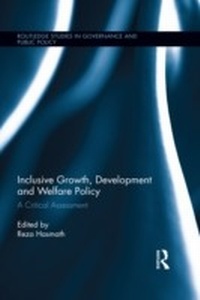
Inclusive Growth, Development and Welfare Policy
A Critical Assessment
1st Edition
Published on 20. February 2015
306 pages
978-1-317-55553-7 (ISBN)
Description

The recent global financial crisis has increased the scope of poverty and inequality. The gap between the richest and poorest nations has become wider. National income inequality has also been on the rise. The prospect of a shift in designing and implementing development and welfare policies is strong in this new environment. The neoliberal policies of the Washington Consensus are giving way to development models which look to a more active government role in both economic and social policies. Meanwhile, in the parallel universe of welfare policy a fundamental realignment is already taking place. Faced with the current economic and social challenges, policy communities have turned to a variety of instruments to ensure that growth and social inclusion go together.
This book offers a systematic analysis of the growing convergence on these matters in the development and welfare state literatures, utilizing the experiences of a myriad of jurisdictions around the world. Drawing upon the expertise of leading international policymakers, practitioners, and academics in the field, this book critiques the theoretical underpinning of growth and development, examine welfare state perspectives on inclusive growth and social/economic development, and presents lessons learned and best/worst practices from the experiences of developing and developed nations.
This book offers a systematic analysis of the growing convergence on these matters in the development and welfare state literatures, utilizing the experiences of a myriad of jurisdictions around the world. Drawing upon the expertise of leading international policymakers, practitioners, and academics in the field, this book critiques the theoretical underpinning of growth and development, examine welfare state perspectives on inclusive growth and social/economic development, and presents lessons learned and best/worst practices from the experiences of developing and developed nations.
Reviews / Votes
"This book is an invaluable resource. It provides a wide-ranging review of key themes and debates around social policy, inclusion, and the welfare impact of development policy. The book also examines inclusive policy alternatives which may help to improve outcomes for the poor. These achievements are supported by detailed case studies of experiences of inclusive (and not so inclusive) growth in different parts of the world. This is an essential reference for students, professionals, policy-makers and scholars working in the fields of development policy and social policy."-Alfredo Saad Filho, Professor of Development Studies, School of Oriental and African Studies, University of London:"This book makes a wide-ranging contribution in building the theoretical framework and policy instruments around the issues of growth and inequality, which is worthwhile for policy makers, economists and researchers. In exploring the interaction of 'social' elements and inclusive growth, the book offers to bridge the gap between economic growth and social inclusion. The key trends in the development and welfare policies are also reflected in detail with the move from rigid policy prescriptions to a more flexible and pragmatic approach, from classic neo-liberalism towards a restored emphasis on the active role of the state and, more generally, a shift from 'social spending to social investment.'" - Political Studies Review 15(1) 'This book is an invaluable resource. It provides a wide-ranging review of key themes and debates around social policy, inclusion, and the welfare impact of development policy. The book also examines inclusive policy alternatives which may help to improve outcomes for the poor. These achievements are supported by detailed case studies of experiences of inclusive (and not so inclusive) growth in different parts of the world. This is an essential reference for students, professionals, policy-makers and scholars working in the fields of development policy and social policy.'-Alfredo Saad Filho, Professor of Development Studies, School of Oriental and African Studies, University of London:
'This book directly faces one of the most pressing issues of developing and developed states in the twenty-first century: how to go beyond neoliberalism in fashioning a welfare system and economic structure that provides for all, not just the economic winners ... [It] provides a unifying argument that: (a) welfare regimes matter, (b) they should be based on local conditions, and (c) the shape of social assistance programmes should work with the market to assist the disadvantaged and excluded. This book should be seen as an attempt to rescue support for the market by advocating policies that share market-lead growth with all citizens of a nation ... The authors do a quite convincing job of outlining such a policy agenda and suggest a viable method to achieve policy results. Beyond the interesting content of the chapters, they directly spoke to each other, referencing arguments in previous or later chapters that help make the overall thematic concepts behind the book more cohesive. [The book] often felt as if the authors were in real dialog with each other, an uncommon but highly enjoyable and edifying experience.' - Andrew W. MacDonald, University of Louisville, Journal of Development Studies
'This book makes a wide-ranging contribution in building the theoretical framework and policy instruments around the issues of growth and inequality, which is worthwhile for policy makers, economists and researchers. In exploring the interaction of 'social' elements and inclusive growth, the book offers to bridge the gap between economic growth and social inclusion. The key trends in the development and welfare policies are also reflected in detail with the move from rigid policy prescriptions to a more flexible and pragmatic approach, from classic neo-liberalism towards a restored emphasis on the active role of the state and, more generally, a shift from 'social spending to social investment'.' - Political Studies Review 15(1): 126
More details
Series
Language
English
Place of publication
London
United Kingdom
Publishing group
Taylor & Francis Ltd
Target group
College/higher education
Product notice
Reflowable
Illustrations
9 s/w Tabellen, 20 s/w Zeichnungen
9 Tables, black and white; 20 Line drawings, black and white
ISBN-13
978-1-317-55553-7 (9781317555537)
Copyright in bibliographic data and cover images is held by Nielsen Book Services Limited or by the publishers or by their respective licensors: all rights reserved.
Schweitzer Classification
Other editions
Additional editions
Book
09/2018
1st Edition
Routledge
€71.80
Shipment within 10-20 days
Book
03/2015
1st Edition
Routledge
€232.10
Shipment within 10-20 days
Person
Reza Hasmath is a Lecturer in Chinese Politics at the University of Oxford, and an Associate Professor in Political Science at the University of Alberta. His research looks at state-society relationships, the labour market experiences of ethnic minorities, and development theories and practices.
Content
Selected Contents: 1. The Paradigms of Inclusive Growth, Development and Welfare Policy Reza Hasmath 2. Inequality and Growth - New Evidence and Policy Implications Pier Carlo Padoan 3. Does Domestic Welfare Reform Spill into Development Assistance Overseas? The South Korean Case Pil Ho Kim and Woojin Jung 4. Development in Transition: Lessons from Central and South Asia Shailaja Fennell 5. China's "Development Model" - A "Model" of Inclusion? Jennifer Y.J. Hsu 6. The Beijing Consensus as a Philosophical Policy Tool Reza Hasmath 7. Social Investment, Inclusive Growth and the State James Midgley 8. The 'Social' in Inclusive Growth. The Social Investment Perspective Jane Jenson 9. The Long Road Towards a Social Investment Welfare State Nathalie Morel, Bruno Palier, and Joakim Palme 10. The 'New' Social Investment Policies in Japan and South Korea Ito Peng 11. South Africa: A Different Welfare and Development Paradigm? Rebecca Surender 12. Social Investment for Inclusive Growth in Australia Paul Smyth 13. Inclusion, Citizenship, Poverty and Welfare Reform: The New Zealand Experience Mike O'Brien 14. Poverty, Invisibility and the Welfare State in the Developing World Joseph Wong 15. Basic Income in a Globalized Economy Philippe Van Parijs and Yannick Vanderborght
