

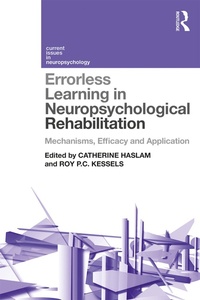
Errorless Learning in Neuropsychological Rehabilitation
Mechanisms, Efficacy and Application
1st Edition
Published on 2. January 2018
222 pages
978-1-317-33797-3 (ISBN)
Description

Errrorless learning is one of the most studied principles in neurorehabilitation. This is the first volume to capture all the key elements in the field in one invaluable resource, providing an up-to-date and broad analysis of the use of errorless learning principles in rehabilitation after brain injury.
With contributions from key researchers in the field, Errorless Learning in Neuropsychological Rehabilitation covers the historical foundations of errorless learning, current understanding of underlying mechanisms which support learning and its use in memory and language in rehabilitation as applied to particular populations across the age span. This volume also addresses questions of efficacy through analysis of research comparing errorless learning with other established learning methods and principles.
Errorless Learning in Neuropsychological Rehabilitation is an essential resource for practitioners, researchers and students of psychology, neuropsychology and rehabilitation.
With contributions from key researchers in the field, Errorless Learning in Neuropsychological Rehabilitation covers the historical foundations of errorless learning, current understanding of underlying mechanisms which support learning and its use in memory and language in rehabilitation as applied to particular populations across the age span. This volume also addresses questions of efficacy through analysis of research comparing errorless learning with other established learning methods and principles.
Errorless Learning in Neuropsychological Rehabilitation is an essential resource for practitioners, researchers and students of psychology, neuropsychology and rehabilitation.
Reviews / Votes
"As a child we often heard our parents and teachers say 'You need to learn from your mistakes', but for those who are unable to apply this saying, the development of errorless learning techniques has been crucial. This book presents the technique of errorless learning in a very comprehensive way, offering valuable theoretical as well as practical information for professionals and researchers in the field of neuro-rehabilitation. Experts discuss the application of errorless learning in many different patient groups, incorporating error-based approaches as well. With this scholarly and practical synthesis of information, the book offers 'all you need to know about errorless-learning' and more." Caroline M. van Heugten, Professor of Clinical Neuropsychology, Maastricht University, the Netherlands"For the neurologically compromised individual with cognitive impairment, traditional approaches to learning and training were mostly unsuccessful, while frustration often led professionals to avoid trying something new. Although animal research showed that errorless learning could be applied successfully to typically developed, healthy humans, the idea that errorless learning could be a beneficial rehabilitation strategy in the neurologically impaired patient, including those with neurodegenerative disease, was thought impossible. Catherine Haslam and Roy Kessels, who have lead the field over the past decade and a half, provide the most up-to-date information on the topic, from basic research to clinical application." Erin D. Bigler Ph.D., Professor of Psychology and Neuroscience, Founding Director, MRI Research Facility, Brigham Young University
More details
Series
Edition
1. Auflage
Language
English
Place of publication
London
United Kingdom
Publishing group
Taylor & Francis Ltd
Target group
College/higher education
Professional and scholarly
Illustrations
9 s/w Tabellen, 17 s/w Photographien bzw. Rasterbilder, 1 s/w Zeichnung
9 Tables, black and white; 1 Line drawings, black and white; 17 Halftones, black and white
File size
1,75 MB
ISBN-13
978-1-317-33797-3 (9781317337973)
Copyright in bibliographic data and cover images is held by Nielsen Book Services Limited or by the publishers or by their respective licensors: all rights reserved.
Schweitzer Classification
Other editions
Additional editions
Catherine Haslam | Roy Kessels
Errorless Learning in Neuropsychological Rehabilitation
Mechanisms, Efficacy and Application
Book
12/2017
1st Edition
Routledge
€206.30
Shipment within 10-20 days
Catherine Haslam | Roy Kessels
Errorless Learning in Neuropsychological Rehabilitation
Mechanisms, Efficacy and Application
Book
12/2017
1st Edition
Routledge
€72.30
Shipment within 10-20 days
Persons
Catherine Haslam is Professor of Clinical Psychology at the University of Queensland, Australia.
Roy P.C. Kessels is head of the Department of Neuropsychology and Rehabilitation Psychology and clinical neuropsychologist at the department of Medical Psychology, Radboud University, The Netherlands.
Roy P.C. Kessels is head of the Department of Neuropsychology and Rehabilitation Psychology and clinical neuropsychologist at the department of Medical Psychology, Radboud University, The Netherlands.
Content
PART 1 - Errorless learning: introductory, historical and theoretical overview, 1. "Make no mistake": errorless learning and its application in rehabilitation - Catherine Haslam and Roy Kessels, 2. The past, present and future of errorless learning in rehabilitation - Barbara A. Wilson and Jessica E. Fish, 3. Cognitive and neural correlates of errorless learning - Dirk Bertens and Inti A. Brazil, PART 2 - Applying errorless learning in neurorehabilitation, 4. Application of errorless learning in child rehabilitation - Catherine Haslam, 5. Application of errorless learning in adult acquired brain injury rehabilitation - Jonathan Evans, 6. Application of errorless learning in dementia - Roy Kessels, 7. Application of errorless learning in the treatment of acquired communication disorders - Paul Conroy, 8. Application of errorless learning in schizophrenia - Nicolas Cabe and Julien Cabe, 9. Application of errorless learning in alcohol-related cognitive disorders - Yvonne C.M. Rensen, Helene Beaunieux, Francis Eustache, and Anne-Lise Pitel, PART 3 - Error-based approaches and comparative techniques, 10. Learning from our mistakes: effects of learning errors on memory in healthy younger and older adults - Andree-Ann Cyr and Nicole D. Anderson, 11. Errors: friend or foe? The theory and evidence base for error-based learning - Tamara Ownsworth, 12. The tyranny of choice: can we choose between errorless learning, spaced retrieval and vanishing cues - Catherine Haslam, PART 4 - Conclusion, 13. Working with error in rehabilitation practice: making the most of errorless and error-based approaches - Catherine Haslam and Roy Kessels
