

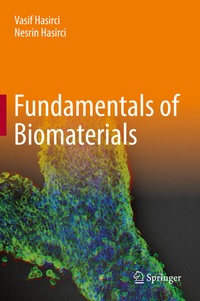
Fundamentals of Biomaterials
Description

This text for advanced undergraduate and graduate students covers the fundamental relationships between the structure and properties of materials and biological tissues. The successful integration of material and biological properties, shape, and architecture to engineer a wide range of optimized designs for specific functions is the ultimate aim of a biomaterials scientist. Relevant examples illustrate the intrinsic and tailored properties of metal, ceramic, polymeric, carbon-derived, composite, and naturally derived biomaterials.
Fundamentals of Biomaterials is written in a single voice, ensuring clarity and continuity of the text and content. As a result, the reader will be gradually familiarized with the field, starting with materials and their properties and eventually leading to critical interactions with the host environment. Classical and novel examples illuminate topics from basic material properties to tissue engineering, nanobiomaterials, and guided tissue regeneration.
This comprehensive and engaging text:
-
integrates materials and biological properties to understand biomaterials function and design
-
provides the basics of biological tissue components and hierarchy
-
includes recent topics from tissue engineering and guided tissue regeneration to nanoarchitecture of biomaterials and their surfaces
-
contains perspectives/case studies from widely-recognized experts in the field
-
features chapter-ending summaries to help readers to identify the key, take-home messages.
More details
Other editions
Additional editions
Persons
Dr. Nesrin Hasirci is a professor at the Department of Chemistry of the Middle East Technical University (METU), Ankara (Turkey). She is also a member and is among the founders of several interdisciplinary Graduate Departments such as Biomedical Engineering, Biotechnology, Micro and Nanotechnology, Polymer Science and Technology, as well as the Center of Excellence in Biomaterials and Tissue Engineering (BIOMATEN), all at METU. She is a Fellow of the Science Academy (Turkey). She is member of European Society for Biomaterials (ESB), Biomaterials and Tissue Engineering Society (Turkey), Turkish Society of Polymer Science and Technology, Turkish Chemistry Society, Fulbright AlumniAssociation of Turkey. She has 5 patents, 155 SCI journal papers, 16 chapters in scientific books, supervised 40 M.Sc. and 20 Ph.D. students, and has a H-index of 30 (Web of Science).
Content
Introduction.- Properties of Solids.- Metals.- Ceramics.- Polymers as Biomaterials.- Carbon Derived Materials.- Building Blocks of The Human Body.- Composites as Biomaterials.- Fundamentals of Human Biology and Anatomy.- Tissue-Biomaterial Interactions.- Biocompatibility.- Hemocompatibility.- Sterilization of Biomaterials.- Soft Tissue Applications.- Hard Tissue Implants.- Blood Interfacing Applications.- Controlled Release Systems.- Tissue Engineering and Regenerative Medicine.- Nano and Microarchitecture of Biomaterial Surfaces.
