

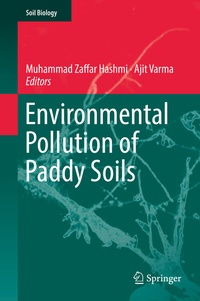
Environmental Pollution of Paddy Soils
Description

The paddy field is a unique agro-ecosystem and provides services such as food, nutrient recycling and diverse habitats. However, chemical contamination of paddy soils has degraded the quality of this important ecosystem.
This book provides an overview of our current understanding of paddy soil pollution, addressing topics such as the major types of pollutants in contaminated paddy soil ecosystems; factors affecting the fate of pollutants in paddy soil; biomonitoring approaches to assess the contaminated paddy soil; the impact of chemicals on soil microbial diversity; and climate change. It also covers arsenic and heavy metal pollution of paddy soils and their impact on rice quality. Further, new emerging contaminants such as antibiotics and antibiotics resistance genes (ARGs) in paddy soil and their impact on environmental health are also discussed. The last chapters focus on the bioremediation approaches for the management of paddy soils.
More details
Other editions
Additional editions
Persons
Dr. Muhammad Zaffar Hashmi is Assistant Professor at the Department of Meteorology, COMSATS Institute of Information Technology, Islamabad, Pakistan. He completed his PhD in Environmental Engineering at the Zhejiang University, China. Dr. Hashmi's research focuses on bioremediation of contaminated soil and cell toxicology. He has edited two books with Springer on hot issues (Antibiotics and Antibiotics Resistance Genes in Soils and Xenobiotics in the Soil Environment), which have been used at innumerable colleges, universities and research institutions around the globe.
Prof. Ajit Varma
(M.Sc., Ph.D.) was Professor of Microbial Technology at the School of Life Sciences, Jawaharlal Nehru University, New Delhi, before he became Director of the AMITY Institute of Herbal & Microbial Research in 2004. Professor Varma has won a large number of coveted national and international awards for his scientific contributions and was elected Fellow ofthe National Academy of Agricultural Sciences of India. He has lectured on various aspects of microbial sciences worldwide and has been honored for his excellence in teaching at esteemed universities. His first two books, dealing with mycorrhizal research, were published in 1991-1992 by Academic Press (UK) and have been used at innumerable colleges, universities and research institutions around the globe. Since then, he has compiled 18 books produced by leading scientific publishing houses.
Content
- Major Pollutants of Contaminated Paddy Soils. - Problems and Prospects of Cultivating Indigenous Flood and Brackish Water-Resistant Varieties of Paddy in the Context of Projected Sea Level Rise: A Case Study from Karnataka, India. - Environmental Pollution of Soil and Anthropogenic Impact of Polymetallic Hydrothermal Extractions: Case Study-Bregalnica River Basin, Republic of Macedonia. - Sources of Organochlorine Pesticidal Residues in the Paddy Fields Along the Ganga-Brahmaputra River Basin: Implications for Long-Range Atmospheric Transport. - Antibiotics Pollution in the Paddy Soil Environment. - Antibiotics and Resistant Genes in Paddy Soil. - Paddy Land Pollutants and Their Role in Climate Change. - Impact of Pollutants on Paddy Soil and Crop Quality. - Paddy Soil Microbial Diversity and Enzymatic Activity in Relation to Pollution. - Arsenic in Paddy Soils and Potential Health Risk. - Risk Assessment of Heavy Metal Contamination in Paddy Soil, Plants, and Grains ( Oryza sativa L.). - Arsenic in Untreated and Treated Manure: Sources, Biotransformation, and Environmental Risk in Application on Soils: A Review. - Fate of Organic and Inorganic Pollutants in Paddy Soils. - Tolerance Mechanisms of Rice to Arsenic Stress. - Enzymes' Role in Bioremediation of Contaminated Paddy Soil. - Bioremediation of Contaminated Paddy Soil.
