

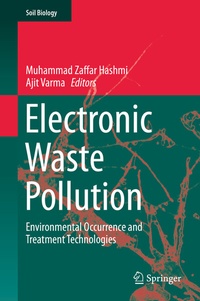
Electronic Waste Pollution
Description

Electronic and electric waste (e-waste), defined as end-of-life electronic products, including computers, television sets, mobile phones, transformers, capacitors, wires and cables, are a major global environmental concern. The crude recycling of e-waste releases persistent toxic substances, such as heavy metals, polybrominated diphenyl ethers (PBDEs), polychlorinated dibenzodioxins (PCDDs), polychlorinated dibenzofurans (PCDFs), polycyclic aromatic hydrocarbons (PAHs) and polychlorinated biphenyls (PCBs), and the environmental pollution and health risks caused by the improper disposal of e-waste has become an urgent issue.
This book offers an overview of e-waste history, sources, and entry routes in soil, air, water and sediment. It also addresses e-waste transport and fate, bioavailability and biomonitoring, e-waste risk assessment, impacts on the environment and public health. In addition, it discusses the impact of e-waste on soil microbial community diversity, structure and function and reviews the treatment and management strategies, such as bioremediation and phytoremediation, as well as policies and future challenges.
Given its scope, it is a valuable resource for students, researchers and scholars in the field of electronics manufacturing, environmental science and engineering, toxicology, environmental biotechnology, soil sciences and microbial ecology, as well as and plant biotechnology.
More details
Other editions
Additional editions
Persons
Muhammad Zaffar Hashmi
Dr. Hashmi is Assistant Professor at the Department of Meteorology, COMSATS Institute of Information Technology, Islamabad, Pakistan. He completed his PhD in Environmental Engineering at the Zhejiang University, China. Dr. Hashmi research focused on Bioremediation of contaminated soil and cell toxicology. His books: Xenobiotics in the Soil Environment and Antibiotics and Antibiotics Resistance Genes in soils published by Springer are used at icolleges, universities and research institutions all over the world.
Ajit Varma
Ajit Varma (M.Sc., Ph.D.) was professor of microbial technology at the School of Life Sciences, Jawaharlal Nehru University, New Delhi, before he became Director of the AMITY Institute of Herbal & Microbial Research in 2004. Professor Varma has won a large number of coveted national and international awards for his scientific contributions and was elected Fellow ofthe National Academy of Agricultural Sciences of India. He has lectured on various aspects of microbial sciences worldwide and has been honored for his excellence in teaching at esteemed universities. His first two books, dealing with mycorrhizal research, were published in 1991-1992 by Academic Press (UK) and have been used at innumerable colleges, universities and research institutions all over the world. Since then, he has compiled 18 books produced by leading and prestigious scientific publishing houses.
Prof. Varma is Chief Editor of the series "Soil Biology".
